
Best Opening Against the Caro-Kann for White
Learn the best opening against the Caro-Kann, why the Advance Variation works, when to choose the Panov, and the plans White must know.
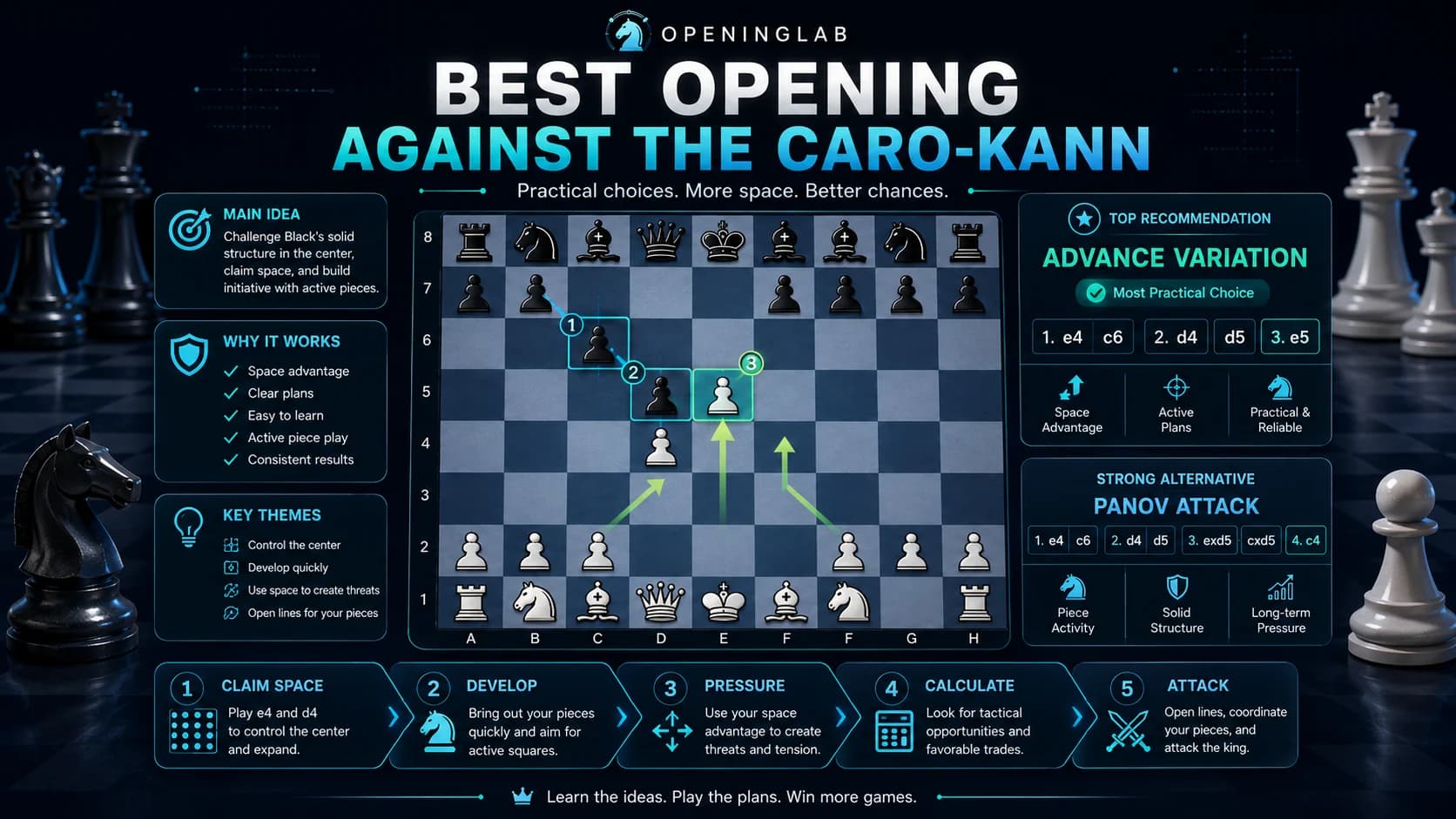
The best practical opening against the Caro-Kann is the Advance Variation. It gives White space, clear plans, and positions where understanding matters more than memorizing engine files.
- Memorize the first three moves: 1.e4 c6 2.d4 d5 3.e5.
- Understand the center: White's e5 and d4 pawns are assets only if they remain supported.
- Track Black's break: most Caro-Kann counterplay is built around c5 or pressure on d4.
- Keep one backup: use the Panov when you want a more open game or need variety.
- We recommend openings by practical value for real players, not only by engine equality at depth.
- We compare the Advance Variation, Panov-Botvinnik Attack, Fantasy Variation, Two Knights, Exchange, and Classical systems by plans, risk, and learning cost.
- We include FENs and move orders so readers can test the positions on the Chessonomy analysis board instead of memorizing claims.
The Caro-Kann has a reputation for being solid, and that reputation is deserved. Black is not trying to win the game in the first ten moves. Black wants a reliable structure, a sound pawn chain, and a healthy endgame if the opening becomes quiet. That is exactly why many White players choose the wrong approach. They try to punish the Caro-Kann as if it were a dubious opening, burn time chasing a quick attack, and then reach a position where Black has solved every problem.
A better way to choose an anti-Caro-Kann opening is to ask what kind of middlegame you can play well. The best opening against the Caro-Kann is not the line with the loudest name or the most traps. It is the line that gives White a practical claim and repeats useful patterns from game to game. You want positions where you understand which pawn breaks matter, which minor pieces should be traded, where the king belongs, and what Black is trying to achieve.
That is why this guide recommends the Advance Variation as the main answer for White. It is ambitious without being reckless. It is theoretical enough to be respected, but not so sharp that a club player needs twenty memorized engine files to survive. White grabs space with e5, makes Black prove how the light-squared bishop will develop, and gets clear attacking and central plans. If you want a second weapon, the Panov-Botvinnik Attack is the best backup because it leads to active piece play and isolated queen pawn structures that teach real chess.
Short Answer: Play the Advance Variation
The main recommendation is simple: after 1.e4 c6 2.d4 d5, play 3.e5. The starting position is rnbqkbnr/pp2pppp/2p5/3pP3/3P4/8/PPP2PPP/RNBQKBNR b KQkq - 0 3. You can paste that FEN into the analysis board and study the plans from both sides. White has more space, Black has a compact structure, and the game usually becomes a fight over whether Black can break the center with c5 or f6 before White builds useful pressure.
The Advance Variation is not a refutation of the Caro-Kann. No serious opening guide should promise that. Black is completely playable with accurate moves. The point is practical pressure. White asks Black to make several correct decisions: where to put the bishop, when to play c5, whether to trade on d4, how to handle h4 ideas, and how to avoid being squeezed. At beginner, intermediate, and club level, those decisions are often harder for Black than the first three moves are for White.
| White system | Move order | Best for | Main drawback |
|---|---|---|---|
| Advance Variation | 1.e4 c6 2.d4 d5 3.e5 | Players who want space, attacking chances, and repeatable plans. | Black can equalize if White ignores the c5 break. |
| Panov-Botvinnik Attack | 1.e4 c6 2.d4 d5 3.exd5 cxd5 4.c4 | Players who like open files, active pieces, and IQP positions. | White must understand isolated pawn endings and piece activity. |
| Two Knights | 1.e4 c6 2.Nf3 d5 3.Nc3 | Players who want simple development and fewer memorized branches. | Black can choose solid transpositions and reduce White's edge. |
| Fantasy Variation | 1.e4 c6 2.d4 d5 3.f3 | Tactical players who enjoy sharp pawn centers. | It is risky if White forgets development and king safety. |
| Exchange Variation | 1.e4 c6 2.d4 d5 3.exd5 cxd5 | Players who want a calm structure. | It can become too harmless without a clear plan. |
Why the Caro-Kann Is Hard to Beat
The Caro-Kann is hard to beat because Black solves one of the main problems of many 1.e4 defenses: the light-squared bishop. In the French Defense, Black often locks the bishop on c8 behind the e6 pawn. In the Caro-Kann, Black plays c6 and d5 first, then often develops the bishop to f5 or g4 before closing the structure with e6. That small difference changes the whole character of the opening. Black gets a solid pawn chain without accepting the same bad bishop problem.
Black also aims for reliable pawn breaks. In many Caro-Kann structures, the c6 pawn supports d5, and Black later challenges White's center with c5. If White overextends, Black trades in the center and reaches a comfortable game. If White plays too quietly, Black completes development and enjoys a position with no real weaknesses. This is why trap-based anti-Caro-Kann lines can feel good for a few games but fail against prepared opponents.
To beat the Caro-Kann consistently, White needs more than a trick. White needs a structure that creates questions. The Advance Variation asks whether Black can break down the e5 pawn chain without giving White kingside play. The Panov asks whether Black can neutralize active piece play before the isolated pawn becomes dangerous. The Fantasy asks whether Black can hit the center before White's space becomes an attack. These are real chess questions, not cheap opening traps.
The Main Line Setup for White
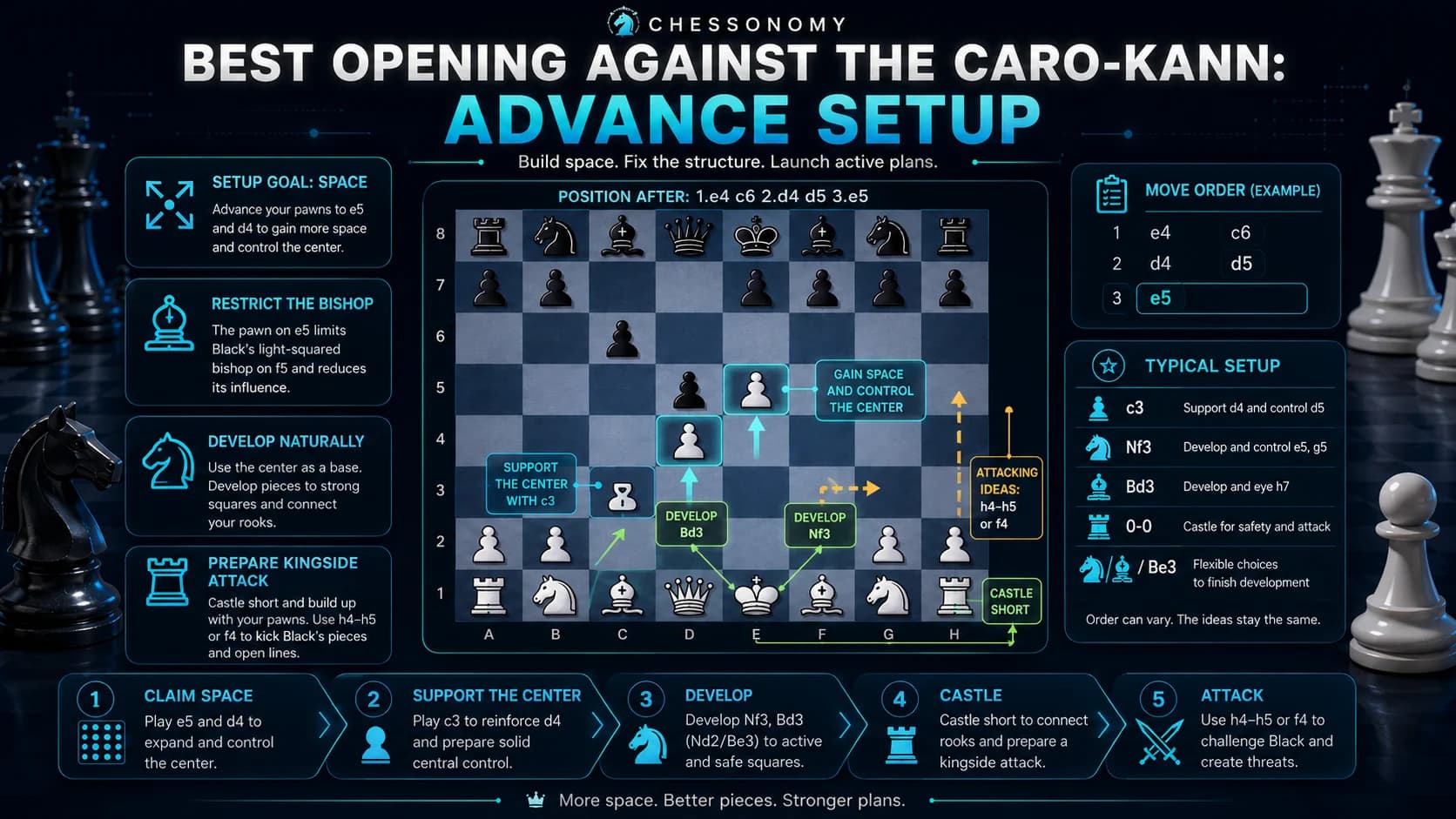
A dependable starting repertoire is 1.e4 c6 2.d4 d5 3.e5 Bf5 4.Nf3 e6 5.Be2 c5 6.Be3. This is not the only way to play the Advance, but it is a healthy practical setup. White develops naturally, keeps the center supported, prepares castling, and waits to see how Black handles the c5 break. The move Be3 also supports the d4 pawn and can prepare queenside development without committing to a premature pawn storm.
Many players want to attack immediately with h4 after Black plays Bf5. That move is playable and can be dangerous, but it should not be treated as an automatic button. The point of h4 is to ask the bishop where it is going and sometimes to gain kingside space with h5. The risk is that White spends tempi on rook-pawn moves while Black hits the center with c5. If your center is loose, the attack becomes cosmetic. If your center is stable, h4 can become a serious practical weapon.
For a first repertoire, I prefer teaching the calmer Nf3, Be2, Be3 setup before the sharper h4 lines. The reason is not that h4 is bad. The reason is that the quieter setup teaches the structure. You learn when dxc5 is useful, when c3 is needed, when Nc3 belongs in front of the c-pawn, and when Black's bishop on f5 is actually a target. Once those ideas are familiar, adding h4 becomes much easier.
What White Wants in the Advance Variation
White's first strategic goal is to keep the e5 pawn meaningful. That pawn gives White space and restricts Black's pieces, especially the knight on g8 and the bishop on f8. If the pawn becomes weak and falls without compensation, White has lost the point of the opening. If the pawn stays protected while White develops, Black has to spend effort proving that the space advantage is not permanent.
The second goal is to watch Black's c5 break. In many Advance Caro-Kann games, c5 is Black's main freeing move. White should not panic when it appears, but White must respect it. Sometimes dxc5 is correct because Black has to spend time recovering the pawn. Sometimes c3 is correct because White wants to keep the center closed. Sometimes Be3, Nc3, and Qd2 make the d4 pawn stable enough that Black's pressure does not bother White.
The third goal is to develop the kingside without turning the game into a pawn-only attack. Moves like Nf3, Be2, O-O, Re1, and sometimes h4 all make sense because they improve pieces while keeping pressure. White does not need to mate Black quickly. White needs to make Black work. If Black misplaces a piece or delays counterplay, the space advantage can become a kingside initiative or a better endgame.
A Practical Line Against 3...Bf5
The most common line begins 1.e4 c6 2.d4 d5 3.e5 Bf5. Black develops the bishop before playing e6. A practical White answer is 4.Nf3 e6 5.Be2 c5 6.Be3. From here, White can castle, support d4, and prepare c4 or dxc5 depending on Black's setup. If Black plays Nc6 and Qb6, White needs to be alert because d4 and b2 can both come under pressure. The best response is usually calm development, not panic.
One sample continuation is 1.e4 c6 2.d4 d5 3.e5 Bf5 4.Nf3 e6 5.Be2 c5 6.Be3 Nc6 7.O-O cxd4 8.Nxd4 Nge7. The position is playable for both sides, but White understands the tasks: finish development, watch c2 and d4, and use the space advantage to restrict Black's pieces. If Black trades too much without gaining activity, White can enjoy easier squares. If White forgets development and only attacks the bishop, Black can equalize quickly.
The best way to study this line is not to memorize ten moves and stop. Put the position on a board after move six and ask yourself what each side wants. White wants stable central control, safe king, and useful pressure. Black wants cxd4, Nc6, Qb6, and sometimes Bg4 or Nge7. Once you can name those plans, the moves become much easier to remember because they are attached to reasons.
When the h4 Idea Makes Sense
The line 1.e4 c6 2.d4 d5 3.e5 Bf5 4.h4 is one of the most direct ways to challenge Black's bishop. It can lead to sharp positions after h5, g4, and kingside expansion. This is attractive because Black's bishop is outside the pawn chain, and White wants to make that bishop uncomfortable before Black finishes development. At faster time controls, h4 can be especially unpleasant if Black is relying on familiar quiet positions.
Still, h4 is not a magic move. If Black replies h5, the kingside can become fixed. If Black plays e6 and c5 quickly, the center becomes more important than the bishop chase. If White delays Nf3, Be2, or c3 for too long, Black's counterplay arrives before White's attack is real. A good rule is simple: play h4 when you understand how you will answer c5. If you cannot answer that question, start with Nf3 and development.
For players under roughly 1800, I would learn h4 as an option, not as the whole repertoire. Use it against opponents who always put the bishop on f5 and play slowly. Use the quieter development setup against opponents who know how to strike the center. That flexibility is important because the best opening against the Caro-Kann is not a single move. It is a family of plans built around a structure you understand.
What to Do Against 3...c5
Some Caro-Kann players challenge the center immediately with 1.e4 c6 2.d4 d5 3.e5 c5. This move is principled. Black does not want White to build a comfortable space advantage for free. One practical answer is 4.dxc5 e6 5.Nf3 Bxc5 6.Bd3. White gives back the pawn or forces Black to spend time recovering it, then develops smoothly. The position is not a forced advantage, but White has avoided drifting into a passive setup.
Another approach is to keep more tension with c3 setups, but this requires care because Black may trade on d4 and attack the center. If you are building a first repertoire, you can keep the choice simple: against early c5, capture on c5 when it helps you gain time for development, then put pieces on natural squares. Against slower setups, maintain the pawn chain and make Black prove the break works.
The important point is psychological. Many White players think the Advance Variation means locking the center forever. It does not. Sometimes White should release the tension, exchange one pawn, and use development. The e5 pawn gives space, but the position still has to be played move by move. Strong opening preparation includes knowing when your original structure should change.
The Panov-Botvinnik Attack as a Backup Weapon
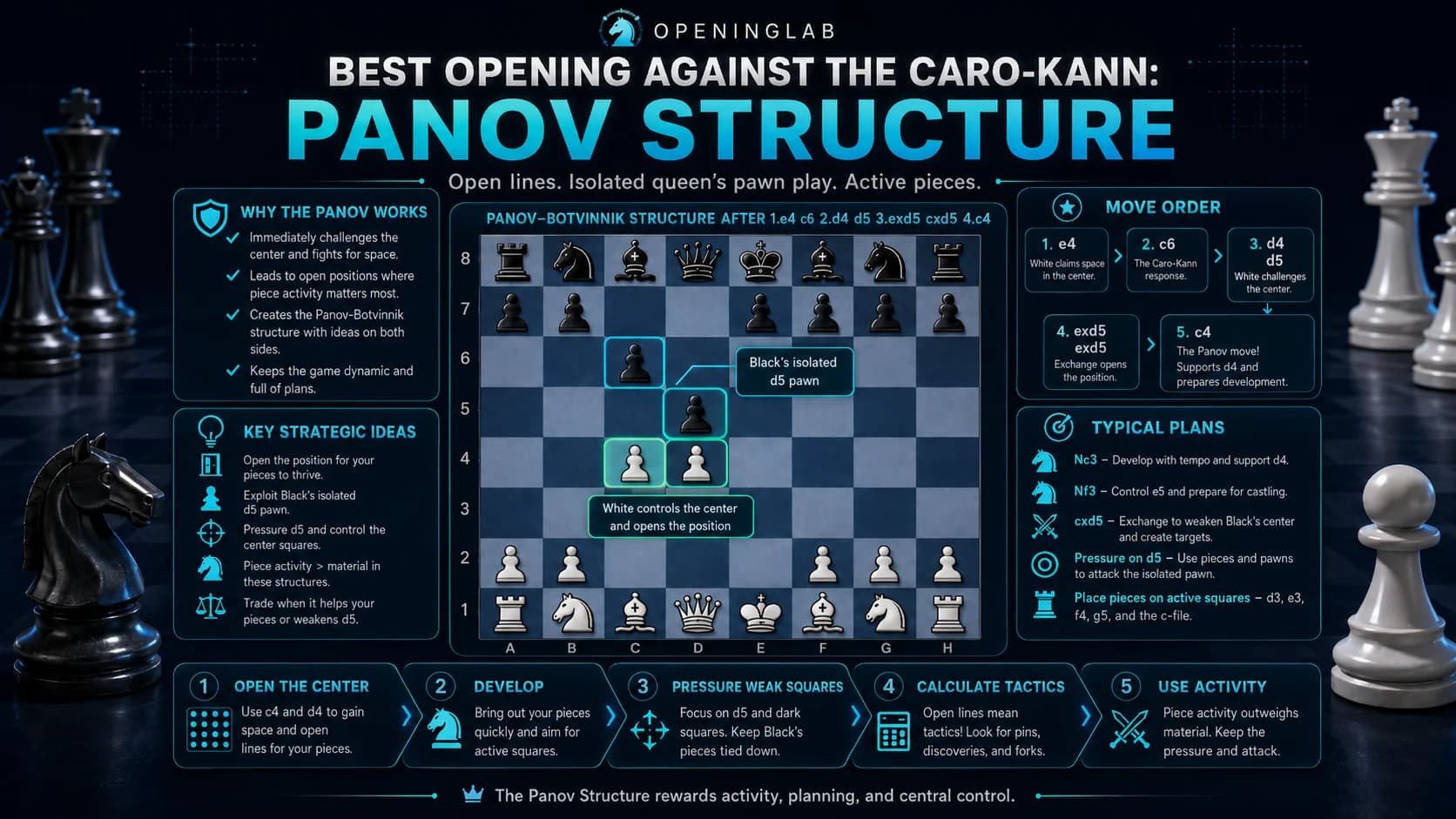
The Panov-Botvinnik Attack starts 1.e4 c6 2.d4 d5 3.exd5 cxd5 4.c4. The FEN after 4.c4 is rnbqkbnr/pp2pppp/8/3p4/2PP4/8/PP3PPP/RNBQKBNR b KQkq - 0 4. This is a very different anti-Caro-Kann choice from the Advance. Instead of gaining space with e5, White opens the position and accepts the possibility of an isolated queen pawn. White wants active pieces, open files, and pressure before Black can simplify comfortably.
The Panov is especially useful for players who already enjoy queen pawn structures with an isolated d-pawn. You often get active bishops, rooks on open files, and tactical chances around the center. The isolated pawn can become weak in an endgame, but in the middlegame it gives space and attacking chances. This makes the Panov a serious weapon, not just a sideline.
The reason I do not recommend the Panov as the single best choice for everyone is that it requires a different kind of understanding. If you trade too many pieces, the isolated pawn becomes a target. If you play too slowly, Black blockades the pawn and equalizes. The Advance Variation is easier to explain to a broad range of players because the plans are more visual: space, center, c5 break, bishop target, kingside initiative. The Panov is excellent, but it rewards players who like active structural play.
The Two Knights Variation for Simple Development
The Two Knights setup begins 1.e4 c6 2.Nf3 d5 3.Nc3. The position after 3.Nc3 is rnbqkbnr/pp2pppp/2p5/3p4/4P3/2N2N2/PPPP1PPP/R1BQKB1R b KQkq - 2 3. This is a useful option if you want to develop quickly and avoid some main-line theory. White is not making the same central claim as the Advance, but White gets natural piece play and can sometimes transpose into Classical or open positions.
The drawback is that Black has several comfortable responses. Black can exchange on e4, develop solidly, or steer the game into positions where White's setup is healthy but not especially challenging. That does not make the Two Knights bad. It makes it a practical low-maintenance choice. If you are building a serious repertoire, I would use it as a surprise weapon or a simple rapid-play option, not as the main answer forever.
Why the Fantasy Variation Is Not My Main Recommendation
The Fantasy Variation, 1.e4 c6 2.d4 d5 3.f3, is one of the most aggressive ways to meet the Caro-Kann. White supports e4, prepares a large pawn center, and invites sharp play. It is completely playable and can be dangerous against opponents who only know quiet Caro-Kann structures. For attacking players, it may feel like the most fun answer to the opening.
The problem is that f3 has a cost. It weakens the kingside, delays natural development, and gives Black immediate targets. If White knows the resulting structures, the move is dangerous. If White only wants an easy attacking system, the Fantasy can backfire. Black can hit the center, develop quickly, and make White regret the early pawn move. That is why I treat the Fantasy as a specialist weapon rather than the best universal opening against the Caro-Kann.
Common Mistakes White Makes Against the Caro-Kann
The first mistake is choosing a line because it contains a trap. Caro-Kann players are often solid, prepared, and happy to let White overreach. If your opening only works when Black misses a tactic on move six, it is not a repertoire. A good anti-Caro-Kann system should leave you with a playable position even when Black knows the main idea.
The second mistake is attacking the bishop while ignoring the center. In the Advance, White often wants to question the bishop on f5, but the d4 and e5 pawns are the heart of the position. If Black breaks the center successfully, the bishop chase becomes irrelevant. Before playing h4, g4, or Nh4, ask what happens after c5. That one question saves many bad games.
The third mistake is trading into a position with no plan. Some players exchange on d5 because they are afraid of theory, then realize they have given Black an easy game. The Exchange Variation can be played with ideas, especially with Bd3, c3, Bf4, and minority-attack structures, but it is not automatically challenging. If you choose it, choose it because you understand the plans, not because you want the opening to disappear.
Which Anti-Caro-Kann Line Should You Choose by Rating
For beginners and early club players, the Advance Variation with simple development is the best choice. The moves are logical, the pawn structure is easy to see, and the plans repeat. Play e5, develop your kingside, support the center, castle, and watch Black's c5 break. You do not need to memorize every sideline. You need to stop hanging the center and learn where the pieces belong.
For intermediate players, add the h4 option and one Panov backup line. This gives you variety without scattering your study. The Advance remains the main repertoire, but the Panov teaches a different structure and prevents you from becoming one-dimensional. If an opponent is very comfortable in Advance structures, switching to the Panov can create a completely different game.
For advanced club players, the best answer depends on your style and tournament needs. The Advance, Panov, Classical, and Fantasy can all be justified if you know the theory and resulting middlegames. At that level, preparation becomes opponent-specific. Still, the Advance remains a strong practical recommendation because it creates a full game and gives White room to outplay the opponent without needing an opening miracle.
How to Study This Repertoire Without Memorizing Everything
Start with model positions, not only model games. Put the Advance position after 3.e5 on the board. Then play through common Black setups: Bf5 with e6 and c5, early c5, e6 setups, and bishop moves to g4. For each setup, write down White's plan in one sentence. If you cannot explain the plan in one sentence, you do not understand the line yet. That is normal. It means the position needs more work.
Next, collect your own games. The best opening against the Caro-Kann for you is the one that survives your real mistakes. After each game, look at the first moment where you felt unsure. Was it Black's c5 break? A queen check on b6? A bishop on g4? A knight coming to f5? Save that position and analyze it. Opening improvement happens fastest when it starts from your own confusion, not from a random database line.
Finally, use engine analysis as a judge, not as a script. Stockfish may prefer a move because it holds a small edge with perfect play, but you still need a move you can understand. If two moves are close, choose the one that gives you clearer plans. If the engine hates your move, find out why. Did you lose the center? Did you miss a tactic? Did you allow an easy trade? The answer is more valuable than the numerical evaluation.
A Simple 30-Minute Training Plan
Use the first ten minutes to review the move order 1.e4 c6 2.d4 d5 3.e5 and the main Black replies. Do not try to memorize a whole book. Write down the three questions you expect Black to ask: where does the bishop go, when does c5 happen, and how does Black challenge the e5 pawn. If those questions are in your head, you will already play the opening with more purpose.
Use the next ten minutes to analyze one critical position. Paste the FEN after 3.e5 into the board, choose a Black reply, and find three candidate moves for White before checking the engine. This matters because opening study should train your decision-making. If you only click through lines, you may recognize the position but still fail to play it well.
Use the final ten minutes to solve tactics from similar structures. Advance Caro-Kann games often involve kingside space, overloaded defenders, sacrifices on e6 or h5, and tactics around the d4 pawn. The more you train those motifs, the more natural the opening feels. A repertoire is not just the first moves. It is the set of middlegame patterns you are ready to play.
Your Practical Anti-Caro-Kann Repertoire Card
A good opening repertoire should fit on one page before it grows into a file. If your anti-Caro-Kann notes are already too large to review before a game, they are not helping you yet. Start with a small card. Main weapon: Advance Variation with 1.e4 c6 2.d4 d5 3.e5. Default setup against Bf5: Nf3, Be2, Be3, O-O, and careful handling of c5. Sharp option: h4 only when you know how the center is protected. Backup weapon: Panov-Botvinnik with 3.exd5 cxd5 4.c4 when you want open play.
The card should also include Black's three most important plans. First, Black develops the bishop to f5 or g4 before playing e6. Second, Black challenges the center with c5. Third, Black attacks d4 with Nc6, Qb6, or cxd4. If you can recognize those plans during the game, you will not feel surprised by normal Caro-Kann moves. Most opening mistakes happen because a player memorized their own moves but never learned the opponent's purpose.
For the first ten moves, avoid trying to win the game immediately. Your target is a playable middlegame with your structure intact. If Black plays Bf5, develop and decide whether h4 is justified. If Black plays early c5, decide whether dxc5 gives you useful time or whether the pawn chain should stay closed. If Black delays counterplay, improve your pieces and keep the space. If Black offers a trade that removes your center without giving you activity, be suspicious.
This is also where human judgment matters more than an opening database. A database may show several moves with similar scores, but your game will be decided by the position you understand. A move that keeps a tiny theoretical edge but leaves you confused is not automatically your best practical choice. A move that is sound, repeatable, and connected to plans you can explain is often stronger for real games. That is why the Advance Variation works so well as a repertoire base.
- Memorize the first three moves: 1.e4 c6 2.d4 d5 3.e5.
- Understand the center: White's e5 and d4 pawns are assets only if they remain supported.
- Track Black's break: most Caro-Kann counterplay is built around c5 or pressure on d4.
- Keep one backup: use the Panov when you want a more open game or need variety.
- Review your losses: every painful Caro-Kann game should become one saved training position.
If you use this card for a month, your results will tell you what needs deeper work. Maybe you keep mishandling Qb6 pressure. Maybe you push h4 too early. Maybe you reach Panov positions and trade too many pieces. Those are fixable problems because they are specific. Strong opening study is not about adding more lines every week. It is about identifying the recurring position where your understanding breaks, then repairing that spot with analysis and practice.
Final Verdict
If you want one answer, play the Advance Variation. It is the best opening against the Caro-Kann for most practical players because it gives White a real space advantage, keeps the game rich, and teaches plans that repeat across many positions. Learn the solid setup with Nf3, Be2, and Be3 first. Add h4 when you understand the center. Keep the Panov-Botvinnik Attack as a second weapon if you enjoy open files and active pieces.
The Caro-Kann is too sound to be beaten by slogans. You beat it by choosing positions you understand better than your opponent. The Advance Variation gives you that chance without asking you to become a walking opening database. Study the pawn breaks, review your own games, test the FENs, and connect the opening to real middlegame training. That is how an opening choice becomes a weapon instead of a preference.
Choosing Between the Advance and Panov on Game Day
Choose the Advance Variation when you want a stable space advantage, a familiar pawn chain, and attacking plans you can recognize without recalling a long forcing line. Choose the Panov when you are comfortable with isolated-queen-pawn positions, active piece play, and earlier tactical calculation. Neither choice removes the need to understand Black's freeing breaks.
For most club players building one dependable answer, the Advance remains the cleaner starting point. Study the structure after 3.e5, learn when Black plays ...c5 and ...Bf5, and rehearse White's development before adding sidelines. A smaller repertoire with clear middlegame plans is usually more useful than switching systems every time an engine preference changes.
Chessonomy is an independent chess training workspace focused on practical game review, Stockfish analysis, puzzle training, and player-friendly explanations of engine feedback.
Questions Players Ask
What is the best opening against the Caro-Kann?
For most improving players, the best opening against the Caro-Kann is the Advance Variation: 1.e4 c6 2.d4 d5 3.e5. It gives White space, clear plans, and practical attacking chances without requiring the heaviest theoretical workload.
Is the Advance Variation good against the Caro-Kann?
Yes. The Advance Variation is one of White's most respected and practical choices. It is not a forced advantage, but it asks Black to handle the bishop development, the c5 break, and White's kingside space accurately.
Is the Panov-Botvinnik Attack better than the Advance Variation?
The Panov-Botvinnik Attack is better for players who like open files and isolated queen pawn positions. The Advance Variation is usually easier to recommend as a main weapon because the plans are more visual and repeatable for a wide rating range.
Should beginners play the Fantasy Variation against the Caro-Kann?
Beginners can try the Fantasy Variation, but it should not be the first recommendation. The move 3.f3 creates sharp play and weakens squares, so White needs good development habits and tactical awareness. The Advance Variation is usually safer to learn first.
What should White do after 1.e4 c6 2.d4 d5 3.e5 Bf5?
A practical setup is 4.Nf3 e6 5.Be2 c5 6.Be3, followed by castling and careful attention to Black's c5 break. Sharper h4 lines are playable, but White should understand the central structure before relying on them.