
brand logoChessonomy
Chessonomy
Study Lab
Puzzle training guide

Free chess puzzles and daily tactics training that transfers to real games

Free chess puzzles are most useful when they train calculation, pattern recognition, and review habits. Solve daily tactics, understand why the move works, and connect missed patterns back to your own games.

Reviewed June 14, 2026
Quick answer

Chessonomy's free chess puzzle page gives players a public puzzle interface, daily and classic puzzle modes, tactical training guidance, and a review-first approach to pattern recognition.

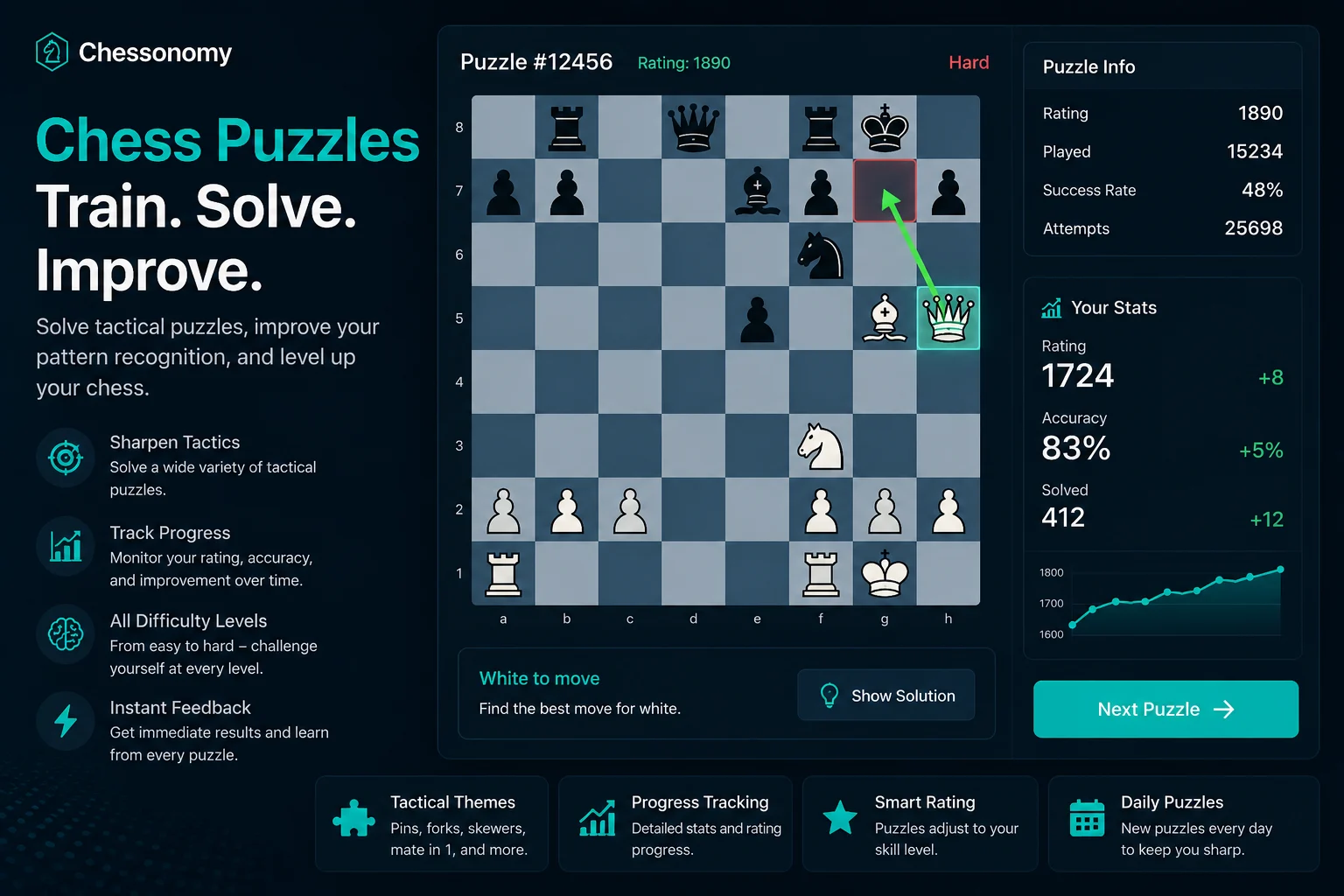
Free chess puzzles interface with a tactical position, daily puzzle mode, and puzzle progress controls

Why free chess puzzles work

Chess puzzles work because they compress important patterns into positions you can solve repeatedly. Forks, pins, skewers, discovered attacks, back-rank mates, trapped pieces, and overloaded defenders appear in real games, but they are easier to learn when the theme is isolated.

The point is not only to click the correct move. After solving, name why the tactic existed. Was the king exposed? Was a defender pinned? Was a piece loose? That sentence is what helps the pattern appear later in a real game.

  • Solve for the tactic, then name the reason it worked.
  • Review missed positions instead of rushing to the next puzzle.
  • Connect repeated mistakes back to your own game analysis.

Daily chess puzzle or classic puzzle mode

A daily chess puzzle is useful because it builds a repeatable habit. One careful puzzle every day is better than a random marathon once a week. The daily mode should be treated like brushing your tactical vision: short, focused, and consistent.

Classic puzzle mode is better when you want volume. Use it for 10 to 20 minutes, but keep the quality high. If you start guessing, stop. Guessing trains impatience, not calculation.

  • Use daily mode for consistency.
  • Use classic mode for longer tactical sessions.
  • Stop when calculation turns into guessing.

How many chess puzzles should you solve?

For most players, 5 to 15 focused puzzles per day is enough. Beginners should spend more time naming the pattern. Intermediate players should calculate the full line before moving. Stronger players should review alternative candidate moves and defensive resources.

The best number is the number you can solve with attention. Fifty rushed puzzles can be worse than ten serious ones because they reward clicking quickly instead of checking the opponent's reply.

Review missed puzzles instead of skipping them

A missed puzzle is valuable training material. Replay the solution, find the forcing move, and ask which candidate you rejected too early. If you missed a quiet move, look at what it threatened. If you missed a sacrifice, follow the forcing line until the compensation is obvious.

The fastest improvement loop is simple: solve puzzles, review misses, import your own games, and check whether the same tactical pattern appears there. That connects free chess puzzles to real game performance instead of keeping them as a separate mini-game.

Use a repeatable puzzle-solving checklist

Before moving, identify the side to move, material balance, king safety, loose pieces, and immediate threats. Calculate checks first, then captures, then forcing threats. For every candidate, ask for the defender's strongest reply and continue until the position becomes quiet.

After the solution, name the motif and the clue that revealed it. The clue might be an exposed king, overloaded defender, pinned piece, weak back rank, or alignment on a file or diagonal. Naming the clue helps the pattern transfer from puzzle mode to real games.

  • Scan the whole board before calculating.
  • Calculate the opponent's best defense.
  • Name the motif and the visual clue after solving.
Common questions

Are free chess puzzles enough to improve?

Yes, if you solve with attention and review missed positions. Puzzles improve real games when you understand why each tactic works.

How many chess puzzles should I do each day?

Most players should aim for 5 to 15 focused puzzles per day. Quality matters more than volume.

What is the difference between daily and classic chess puzzles?

Daily puzzles build consistency through one recurring challenge. Classic mode is better for longer tactical training sessions.

Why do I solve puzzles but still miss tactics in games?

In games, nobody tells you a tactic exists. Review why each puzzle works and connect the pattern to positions from your own games.