
Mate in 3 Puzzles: Solve a Position, Then Learn the Method
Try a mate in 3 puzzle on a clear chess diagram, reveal the full solution, and learn how to calculate checks, sacrifices, and the defender's replies.
White to move: mate in 3
Find a forcing first move, then look for a queen sacrifice. Calculate Black's replies before revealing the solution.
Reveal solution
1. Qc4+ forces 1...Kd2. Then 2. Qc1+ draws the king onto c1: 2...Kxc1 is the only legal reply. Finally 3. Nb3# uses the c5-knight to give check while the e3-knight covers d1 and c2. The queen sacrifice works because it changes where the king must stand. Both black replies are forced, and White has no forced mate in one or two moves from the starting position.
The analysis board opens with Stockfish enabled, so it will show the answer.
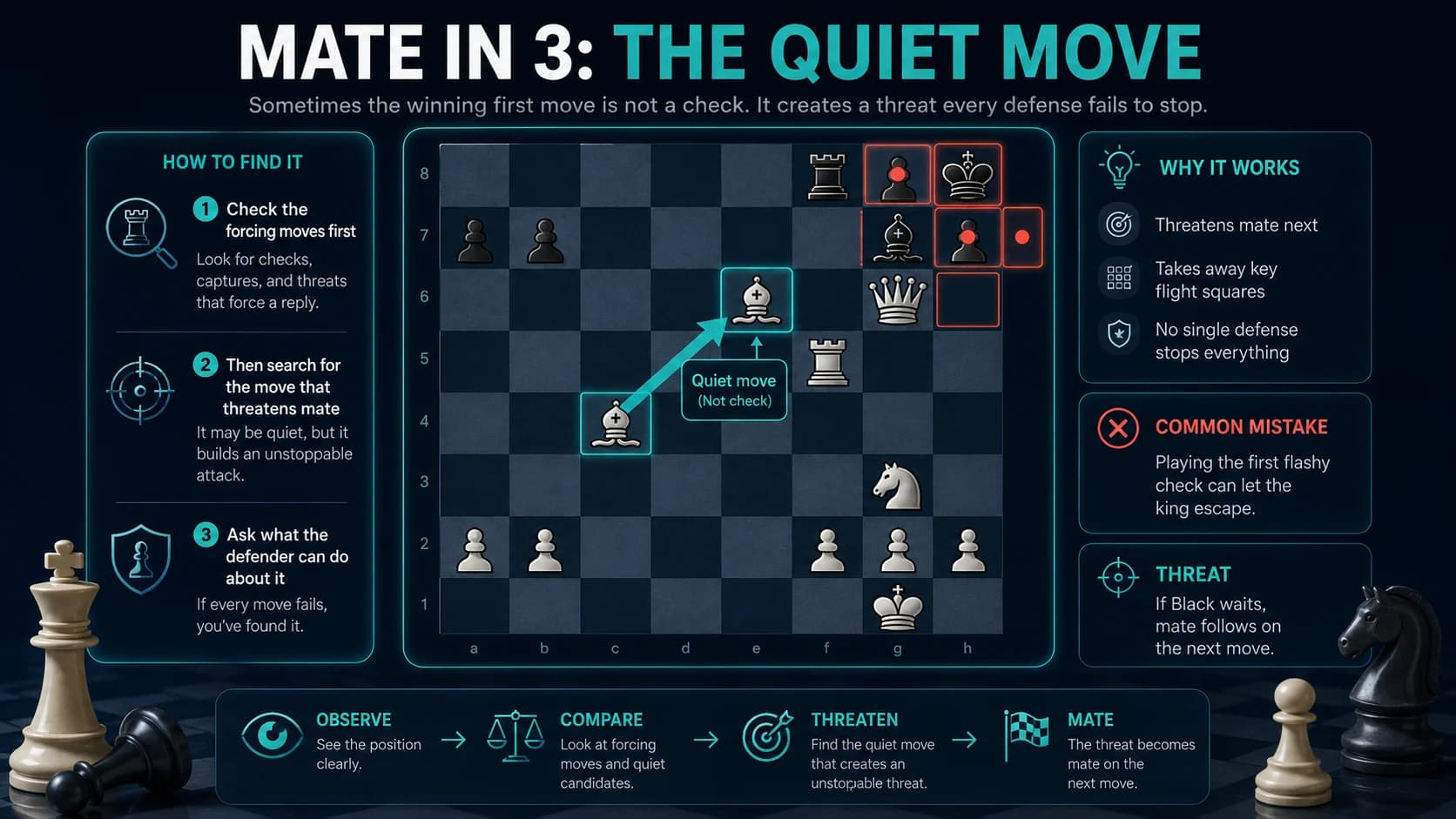
Mate in 3 puzzles teach forcing-line calculation. Use examples, escape-square maps, and defensive checks to find the first move that controls every reply.
- King map: mark every legal square the king might use now or after the first check.
- Defender map: identify pieces that can capture, block, or give a saving check.
- Forcing move list: collect checks, captures, threats, and quiet moves that create mate threats.
- Defense test: after each candidate, ask what happens if the defender chooses the most annoying legal reply.
- We explain mate in 3 as a forcing-line problem rather than a memorized trick.
- We separate checks, quiet moves, sacrifices, escape-square control, and defensive resources so the solving process is repeatable.
- We avoid fake puzzle positions and focus on the method players can apply to real games and training puzzles.
Mate in 3 moves is one of the best formats for chess training because it sits in the space between pattern recognition and real calculation. A mate in 1 is mostly a recognition test. A mate in 2 introduces defensive replies, but many positions still revolve around one forcing move. A mate in 3 demands more discipline. You have to see the first move, the defender's best resistance, the second forcing move, another defensive attempt, and the final checkmate. That is long enough to punish guessing, but short enough to solve with a clear method.
The phrase can confuse newer players because chess players use the word move in two ways. In a mate in 3 puzzle, the attacking side gets three moves. The defender may reply between them. So a full line can look like attacker move one, defender reply one, attacker move two, defender reply two, attacker move three mate. You are not trying to mate after only three half-moves on the board. You are trying to prove that your side has a forced mate by its third move.
Mate in 3 Example Position
Try the diagram above before reading its solution. White has a queen and two knights, but Black's rook and queen make casual moves dangerous. List White's checks and examine which squares the black king can reach after each one. The key is to force the king toward a square where a knight can deliver mate. The solution panel includes the complete line and explains why Black cannot choose a different defense.
When you study any mate in 3 example, do not stop after finding one line that mates. Try to break your own answer. What if the defender blocks? What if the defender captures the checking piece? What if the king runs to the only legal square? In this position, the key line demonstrates a queen decoy and a final knight mate. A correct mate in 3 solution survives every legal defense, which is why these puzzles train calculation better than simple mate-in-one recognition drills.
What Mate in 3 Really Means
A true mate in 3 is not simply a position where one line ends in checkmate after three moves. It is a position where the attacker can force checkmate against every legal defense. That difference matters. If you find a beautiful line but the opponent has one quiet escape move, the puzzle is not solved. In a real game, your opponent is allowed to resist. In a good puzzle, the defender is assumed to choose the most stubborn continuation.
This is why the first move is often the hardest part. The final mate may be familiar: a queen on h7, a rook on the back rank, a knight fork that covers escape squares, or a bishop guarding a diagonal. The first move has a different job. It has to create a threat while also controlling the opponent's attempts to run, capture, interpose, or give checking counterplay. The best first move is not always the loudest check. Often it is the move that makes every defense fail.
| Puzzle length | What it tests | Main risk |
|---|---|---|
| Mate in 1 | Immediate pattern recognition. | Missing a legal mate already on the board. |
| Mate in 2 | One forcing idea and one defensive reply. | Playing a check that allows an escape square. |
| Mate in 3 | Calculation tree, quiet moves, and defensive coverage. | Solving one line while ignoring another defense. |
| Longer mate | Deep forcing calculation and move-order precision. | Losing the thread or trusting a line without proof. |
Why Mate in 3 Puzzles Are Hard
Mate in 3 puzzles are hard because the board usually contains several moves that almost work. A direct check may drive the king toward a safe square. A queen sacrifice may look forcing but allow a defender to interpose. A quiet move may threaten mate, but the opponent might create a countercheck. The puzzle is designed to test whether you can reject tempting moves and find the one move that handles all of the defender's resources.
The most common mistake is solving the attacker's idea only from the attacker's point of view. You see a check, imagine the opponent making the reply you want, and finish the line. That is not calculation. That is storytelling. Calculation means giving the defender their best moves and still proving the mate. If the defender can run, capture the mating piece, block the line, give check, or make luft for the king, you need to see it before you play.
Another difficulty is that mate in 3 often begins with a non-checking move. Many players are trained to look for checks first, and that habit is good. But in composed puzzles and many real attacking positions, the key move can be a quiet move that threatens an unavoidable mate. Quiet moves are harder to find because they do not force the opponent immediately. You need to understand what they threaten and why every defense loses.
The Four Questions That Solve Most Mate in 3 Puzzles
A strong solving method starts with four questions. First, where can the king go? Second, which pieces defend those squares? Third, what are the forcing moves? Fourth, what is the opponent's best defense? These questions prevent random move hunting. They also make it easier to learn from a puzzle you miss, because you can identify exactly which part of the mating net you failed to see.
- King map: mark every legal square the king might use now or after the first check.
- Defender map: identify pieces that can capture, block, or give a saving check.
- Forcing move list: collect checks, captures, threats, and quiet moves that create mate threats.
- Defense test: after each candidate, ask what happens if the defender chooses the most annoying legal reply.
This method sounds slow, but it becomes fast with practice. At first, you might need to say the questions out loud or write candidate moves in a notebook. Later, your eyes will begin to move through the board in the same order automatically. That is the point of puzzle training. You are not trying to memorize a single mate in 3. You are building a search habit that helps in real games.
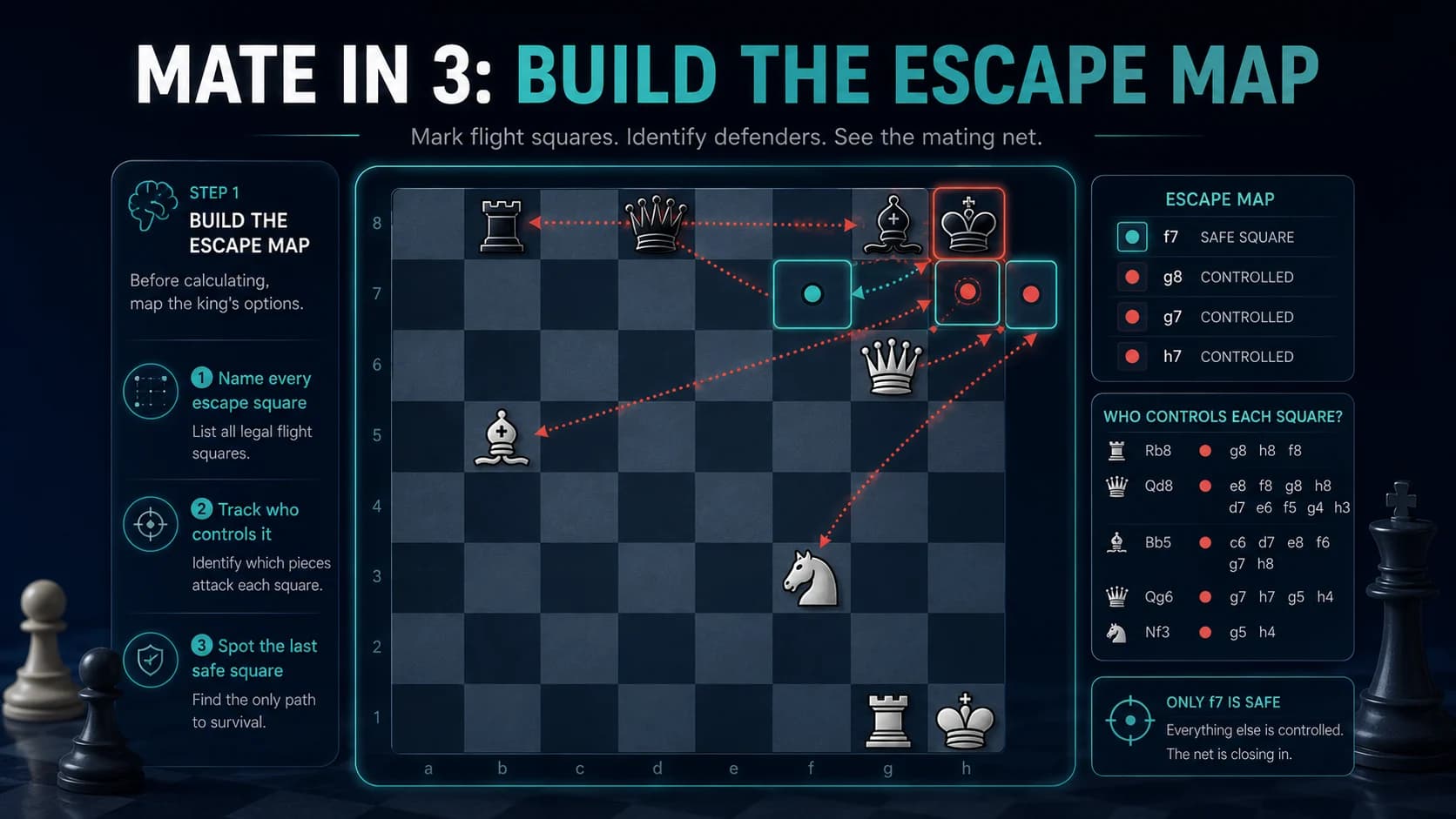
Step 1: Build the King's Escape Map
Before looking for a spectacular move, look at the enemy king. A checkmate is a position where the king is in check and has no legal escape. That means every mating idea depends on square control. If the king has one flight square, your move must cover it, force the king away from it, or make it illegal by pinning or occupying a defender. Many failed mating attacks fail because the attacker looks only at the checking line and forgets one quiet escape square.
In practical terms, you should name the squares. If the black king is on g8, ask whether it can move to h8, f8, h7, g7, or f7. Then ask which attacking pieces cover those squares. A bishop might cover h7, a rook might control the back rank, a knight might cover f7 and h7, and a queen might deliver the final check. Once you see the escape map, candidate moves become easier to judge.
Escape-square control also explains why quiet moves work. A quiet move can take away the last running square or prepare a mating pattern that could not happen immediately. For example, a move that places a rook on an open file might not check, but it may threaten a back-rank mate while the queen guards the only flight square. If the defender cannot create air, block, trade, or countercheck, the quiet move is decisive.
Step 2: List Forcing Moves Without Playing Them Yet
Checks are still the first candidates to inspect. In a mate puzzle, checks reduce the defender's options and often reveal the shape of the mating net. But the key word is inspect. Do not play the first check that looks strong. List the checks, then compare them. A checking move that pushes the king toward your pieces may be correct. A checking move that pushes the king away from the net may be a trap.
Captures are next. A capture can remove a defender, open a line, or sacrifice material to drag the king onto a mating square. Captures deserve attention when they are forcing or when they remove a piece that guards an important square. But not every capture is relevant. If the capture does not create check, threaten mate, or remove a key defender, it may just give the opponent time.
Threats and quiet moves come after checks and captures. This is where many mate in 3 puzzles are decided. A quiet move can threaten an immediate mate that cannot be stopped. It can also create zugzwang-like pressure, where every legal defense allows a different mate. The quiet move is not magic. It works because the defender has no resource that solves all threats at once.
Step 3: Test the Defender's Best Replies
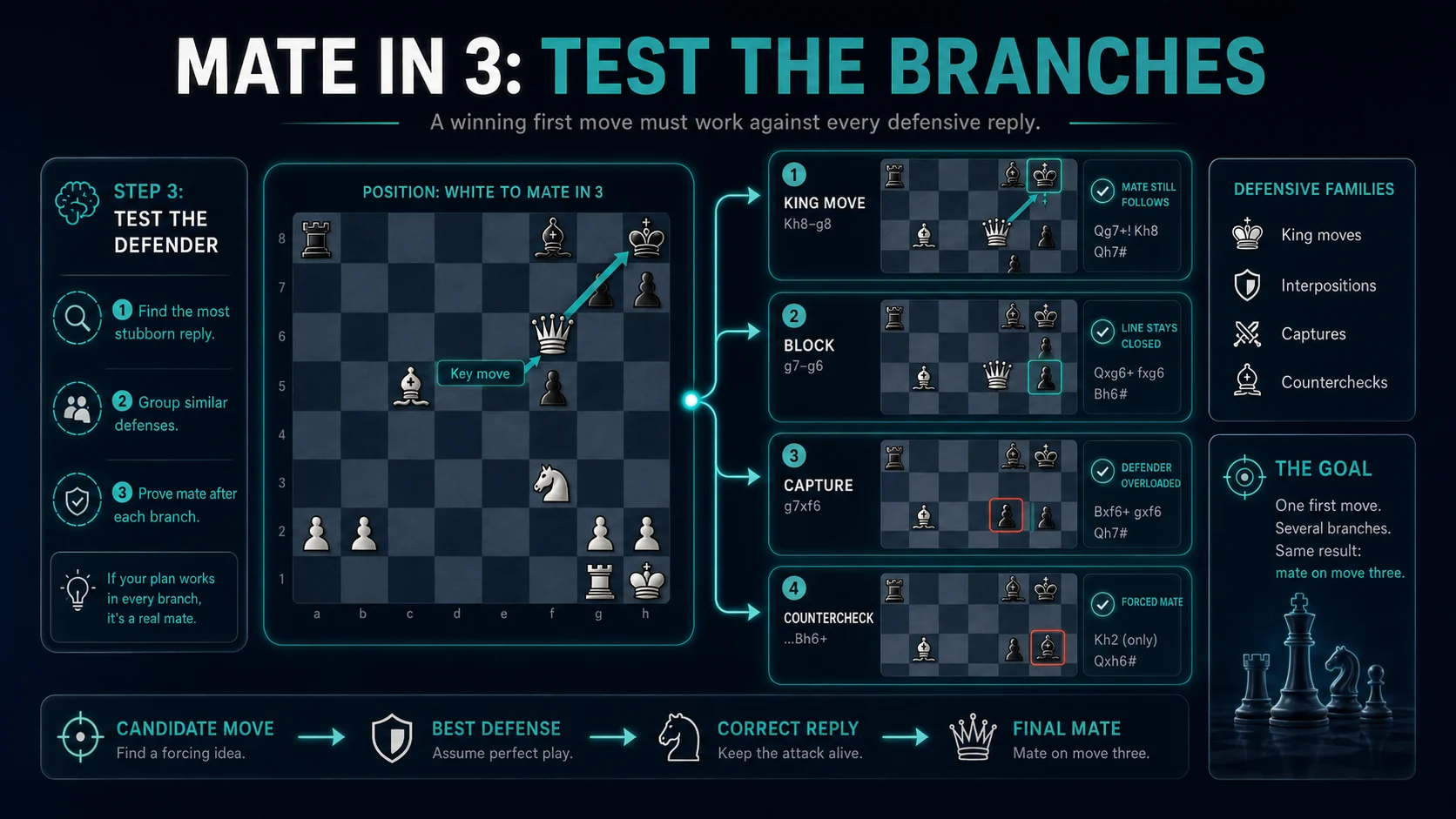
Once you have a candidate first move, do not jump to the final mate. Stop and become the defender. What would you play if your only goal were to survive? Could you capture the checking piece? Could you block the line? Could you move the king to a square the attacker forgot? Could you give check and force the attacker to respond? Could you trade queens or return material to break the net?
In mate in 3, the defender usually has several families of replies. There may be one king move, one capture, one blocking move, and one checking move. Your first move must have an answer to each family. This is why a solution often contains branches. The published answer might show one main line, but a correct solver understands why the side lines also fail.
A useful training habit is to search for the move that most annoys your intended solution. If your line depends on a queen delivering mate, ask whether the queen can be captured or blocked. If your line depends on a knight covering a square, ask whether the knight can be deflected. If your line depends on a back-rank mate, ask whether the defender can create luft. The most annoying reply is usually the reply that teaches you the most.
Step 4: Confirm the Final Mating Move
The final move in a mate in 3 should be a legal checkmate. That sounds obvious, but many wrong solutions end with a move that is check but not mate. Before accepting your answer, check three things. Is the king actually in check? Can the king move? Can the checking piece be captured or can the line be blocked? If any answer saves the defender, the line is not complete.
The final mating move often reveals the theme of the puzzle. A rook mate on the back rank tells you the first move was probably about controlling escape squares. A queen mate near the king tells you the first move may have removed a defender. A knight mate tells you the king's escape map was restricted by unusual squares. A bishop or discovered mate tells you the key was line opening.
| Final mate pattern | What the first move often does | What to verify |
|---|---|---|
| Back-rank mate | Controls luft or distracts the back-rank defender. | The king has no flight square and no blocking piece saves it. |
| Queen near-king mate | Removes a guard or forces the king onto a covered square. | The queen cannot be captured and all king moves are covered. |
| Knight mate | Uses the knight's unusual coverage while lines block the king. | The king cannot capture the knight and cannot run to a light or dark escape square. |
| Discovered mate | Opens a rook, bishop, or queen line with tempo. | The discovered line cannot be blocked or the moving piece gives a second threat. |
Quiet First Moves in Mate in 3
Quiet first moves are the reason many players love mate in 3 puzzles. A quiet move does not check and may not capture. It simply changes the geometry of the board so that all defenses fail. The move might place a piece on a square where it threatens mate, cut off a flight square, prepare a discovered attack, or create two threats at once. Because the defender cannot answer everything, mate follows.
To find quiet moves, look for candidate moves that change the king's escape map. A rook lift, queen retreat, bishop repositioning, or knight move can be stronger than a direct check if it controls a critical square. The quiet move often feels strange because it gives the opponent a turn. But if the move is correct, that turn is not useful. Every legal defense still allows mate by the third move.
A good way to train quiet moves is to ask what mate you would play if the opponent had to pass. If passing would allow Qh7 mate, then your candidate move must stop all defenses against Qh7. If passing would allow Rh8 mate, the candidate move must stop captures, blocks, and escape squares. This pass-move question is not legal chess, but it helps reveal the threat your quiet move should create.
Sacrifices in Mate in 3
Sacrifices in mate in 3 are not played because they look dramatic. They are played because they force the king or a defender onto a square where the mating pattern becomes unavoidable. A queen sacrifice may drag the king into a knight mate. A rook sacrifice may remove the last back-rank defender. A bishop sacrifice may open a file or diagonal. The material value does not matter if checkmate is forced.
The test for a sacrifice is simple: after the opponent accepts or declines it, can you still force mate within the required number of moves? If the sacrifice works only when accepted, but the defender can decline and survive, it is not a solution. If every response loses, the sacrifice is not just attractive. It is forcing.
- A decoy sacrifice pulls the king or defender onto a square where another piece mates.
- A deflection sacrifice removes a piece from guarding an escape square or mating square.
- A clearance sacrifice opens a line for a rook, bishop, or queen.
- A blocking sacrifice forces the defender's own piece to occupy the king's escape square.
- A countercheck sacrifice works only if the attacker has calculated the checking reply and final mate.
Common Mate in 3 Mistakes
The first common mistake is playing a forcing move without checking all king moves. Many mates fail because the king has one square that was invisible at first glance. The second mistake is forgetting interpositions. A rook or bishop line may look decisive, but the defender may block with a piece. The third mistake is missing countercheck. If the defender can check your king, your planned mate may no longer happen on time.
Another mistake is confusing winning material with checkmate. A candidate move may win the queen or force a huge material advantage, but if the puzzle says mate in 3, the answer must mate in 3. In puzzle solving, the instruction matters. A move that is objectively winning can still be wrong if it does not satisfy the exact task.
Players also fail by trusting the first line that works. Suppose your first move threatens mate and one defensive reply loses exactly as planned. That is encouraging, but not proof. You must check the other replies. Strong puzzle solvers are skeptical. They keep asking, what if the defender does not cooperate?
How to Train Mate in 3 Without Guessing
The best training method is slow at first. Set a timer for focus, not speed. Give yourself five to ten minutes for a serious mate in 3 puzzle. Do not move pieces immediately. Identify the king's escape map, list candidate checks, inspect captures, then search for quiet threats. Only submit a move when you can name the defender's main replies and your mating answer to each.
After solving, review the puzzle even if you were correct. Ask why the first move worked. Did it create a threat? Remove an escape square? Force a defender away? Set up a double threat? If you can name the idea, the puzzle becomes part of your pattern memory. If you only remember the move, the lesson fades quickly.
When you miss a mate in 3, do not simply look at the answer and move on. Find the exact failure. Did you ignore a quiet move because it was not check? Did you stop after one defender reply? Did you forget that a knight covers unusual squares? Did you miscount the number of moves? The error type tells you what to train next.
A Practical Mate in 3 Solving Routine
Use this routine whenever you face a mate in 3 puzzle. First, write down the side to move and the target king. Second, mark every escape square. Third, list candidate checks but do not choose yet. Fourth, list captures that remove defenders. Fifth, ask what quiet move would create the strongest mate threat. Sixth, test the defender's most stubborn replies. Seventh, confirm the final move is checkmate, not just check.
| Phase | Question | What you should know before moving |
|---|---|---|
| Map | Where can the king escape? | Every flight square and the piece that controls it. |
| Candidates | Which moves force or threaten mate? | Checks, captures, and quiet threats. |
| Defense | What is the best resistance? | Captures, blocks, king moves, counterchecks, and luft. |
| Proof | Is the final move checkmate? | No king move, capture, block, or countercheck saves the defender. |
This routine works because it forces you to solve the whole position. It also keeps your emotions out of the puzzle. Brilliant-looking checks become just one candidate among several. Quiet moves become easier to consider. Defensive resources become part of the work instead of an unpleasant surprise after you submit the wrong move.
Mate in 3 Patterns Worth Learning
Many mate in 3 puzzles are built from familiar mating patterns. Back-rank mate appears when a king is trapped by its own pawns and heavy pieces control the rank or file. Anastasia's mate uses a knight to cover escape squares while a rook or queen delivers mate on the rook file. Arabian mate uses rook and knight coordination. Smothered mate uses a knight when the king is boxed in by its own pieces.
Pattern knowledge does not replace calculation, but it gives you candidate ideas. If you recognize a smothered-mate shape, you know to look for knight checks, queen sacrifices, and forced king moves. If you recognize a back-rank shape, you know to inspect luft squares and defenders. A known pattern is a starting point, not an automatic answer.
- Back-rank mate: heavy piece checks while the king has no pawn escape.
- Smothered mate: a knight mates a king trapped by its own pieces.
- Anastasia's mate: a knight covers escape squares while a rook or queen attacks along the file.
- Arabian mate: rook and knight coordinate near the corner.
- Diagonal mate: bishop or queen controls a long diagonal while other pieces cover flight squares.
- Discovered mate: one piece moves and opens a mating line from another piece.
How Mate in 3 Helps Real Games
Some players think mate puzzles are artificial, especially composed mate in 3 positions. It is true that not every puzzle position looks like a normal game. But the calculation habits are very real. You learn to control escape squares, respect defensive replies, search for quiet moves, and calculate forcing sequences. Those habits transfer directly to attacking games, defensive saves, and endgame tactics.
In real games, you will not always announce mate in 3. You may simply sense that the opponent's king is short of squares. You may notice that a defender is overloaded or that a quiet move creates an unstoppable threat. That recognition comes from repeated exposure to mating nets. Mate in 3 puzzles train your eyes to see when the king is not just unsafe, but trapped.
The defensive value is just as important. When you solve mate in 3 puzzles, you learn how attackers coordinate pieces. That helps you defend your own king. You become more alert to luft, back-rank weakness, pinned defenders, overloaded pieces, and counterchecks. Good attacking training often produces better defense because you understand what the attacker needs.
Using an Analysis Board After You Solve
After solving a mate in 3, put the position on an analysis board and test the side lines. Do not use the engine only to confirm the main move. Use it to ask why alternatives fail. What happens if the defender captures instead of running? What happens if the defender blocks with a different piece? What if the attacker chooses the other check first? This turns a puzzle into a study session.
A good analysis board also helps you practice visualization. Set the position, hide the engine line, and replay the solution from memory. Then reset and try the main defensive branches. If you can reproduce the solution without looking, you have learned more than the answer. You have learned the shape of the mating net.
How Many Mate in 3 Puzzles Should You Solve?
Quality matters more than volume. Three carefully reviewed mate in 3 puzzles can be more valuable than thirty rushed attempts. If you are new to this format, solve slowly and keep a record of misses. After a few weeks, patterns will repeat. You may notice that you often miss quiet moves, knight coverage, or counterchecks. That pattern is useful because it tells you what to fix.
For a practical routine, use mate in 3 puzzles two or three times per week. Mix them with easier tactics so training does not become exhausting. On days when your calculation feels sharp, spend more time on long forcing lines. On tired days, solve fewer puzzles but review them properly. The goal is not to prove that you can suffer through hard positions. The goal is to build reliable calculation.
How to Count the Move Order Correctly
Move counting is a small detail that causes many wrong mate in 3 attempts. The attacking side's first move is move one. The defender replies. The attacking side's second move is move two. The defender replies again. The attacking side's third move must be checkmate. If your line needs one more attacking move after that, it is mate in 4, not mate in 3. If your line mates sooner, it may still be a valid forced mate in the position, but it does not explain the intended mate in 3 puzzle unless the puzzle allows shorter mates.
A clean way to avoid confusion is to write the line with move numbers for the attacker only. For example: first move creates the threat, second move handles the best defense, third move delivers mate. The defender's replies are part of the proof, but they do not add to the attacker's move count. This simple habit keeps you from accepting a line that feels forcing but arrives too late.
Counting also helps you judge candidate moves. A move that wins the queen on move three may be excellent in a real game, but it is not the answer to a mate in 3 puzzle. A move that gives perpetual checks may be safe, but it does not solve the task. The instruction is exact. Your solution must force checkmate within the announced number of attacking moves.
When There Are Several Defensive Branches
Many mate in 3 positions do not have one single straight line. The first move may create a threat, and the defender may have four or five legal attempts to stop it. One reply might allow a queen mate, another might allow a rook mate, and another might require a knight move. This is normal. The solution is not weaker because it has branches. In fact, the branches are the proof that the first move controls the whole position.
When studying a published solution, do not only memorize the main line. Ask why the other defenses fail. If the defender blocks with a bishop, what mate follows? If the defender captures a pawn to open a square, what changes? If the defender gives a check, how does the attacker respond while keeping the mate on schedule? The branches turn the puzzle from a trick into a lesson.
In your own analysis, group the branches by defensive idea. You do not need to list every legal move separately if several moves fail for the same reason. One group might be king moves, another group might be captures of the mating piece, another group might be interpositions, and another group might be counterchecks. This makes the tree easier to hold in your head.
How to Use Mate in 3 in a Weekly Training Plan
A good weekly plan should not be only mate in 3 puzzles. You need easier tactics to keep pattern recognition sharp, game review to connect puzzles to real mistakes, and occasional longer calculation work. Mate in 3 fits best as a focused calculation block. Use it when you have enough energy to think deeply and enough time to review the solution.
For example, train mate in 3 on two days per week. On the first day, solve three positions slowly and review every branch. On the second day, solve one position from memory after setting it up on an analysis board, then compare your line with the engine or puzzle answer. On the other days, use shorter tactics or game review. This keeps training balanced instead of turning every session into a struggle.
The most important part is keeping a small mistake log. Write down short labels such as missed quiet move, forgot escape square, ignored countercheck, moved too fast, or wrong move count. After ten or twenty puzzles, the pattern will be obvious. Your mistake log becomes a personal training map. That is far more useful than only tracking whether the puzzle was solved or failed.
Final Advice
Mate in 3 is not about finding a spectacular first move by instinct. It is about proving a forced result. The strongest solvers combine pattern recognition with disciplined doubt. They see the attacking idea, then ask how the defender can resist. They respect every legal move. They confirm the final mate. That mindset is exactly what makes the format so useful for chess improvement.
When you train this way, mate in 3 puzzles stop feeling like riddles and start feeling like calculation exercises. You learn to map the king, find forcing moves, value quiet threats, and handle defensive branches. Those skills matter far beyond puzzle pages. They help you attack more cleanly, defend more calmly, and recognize when a position has moved from advantage to forced mate.
Chessonomy is an independent chess training workspace focused on practical game review, Stockfish analysis, puzzle training, and player-friendly explanations of engine feedback.
Questions Players Ask
What does mate in 3 moves mean?
Mate in 3 means the side to move can force checkmate on its third move, no matter how the defender replies. The line usually includes two defender replies between the attacker's three moves.
How do you solve mate in 3 puzzles?
Start by mapping the king's escape squares, then list checks, captures, and quiet threats. Test the defender's best replies and confirm that the final move is checkmate against every branch.
Are mate in 3 puzzles good for chess improvement?
Yes. They train calculation, forcing moves, defensive awareness, and mating pattern recognition. They are especially useful when you review misses instead of only checking the answer.
Why is the first move in mate in 3 often quiet?
A quiet first move can create an unavoidable mate threat or control a key escape square. It works when every legal defense still allows mate by the third move.
Should beginners solve mate in 3 puzzles?
Beginners can solve some mate in 3 puzzles, but they should also practice mate in 1 and mate in 2. Longer puzzles are most useful once basic mating patterns are familiar.