
brand logoChessonomy
Chessonomy
Study Lab
Game review

Free chess game analysis and review

Import Chess.com or Lichess games, find critical moments, and continue the review with Stockfish-powered position analysis.

MA
Analyze magnuscarlsen's chess games
Chess.com0 games loaded
No games loaded
No games found
Try another username or platform.
Game analysis guide

Free chess game analysis for Chess.com and Lichess games

A good chess game review does more than label moves as mistakes or blunders. Import a Chess.com or Lichess game, find the position where the evaluation changed, then use analysis to understand the decision you should train next.

Reviewed June 14, 2026
Quick answer

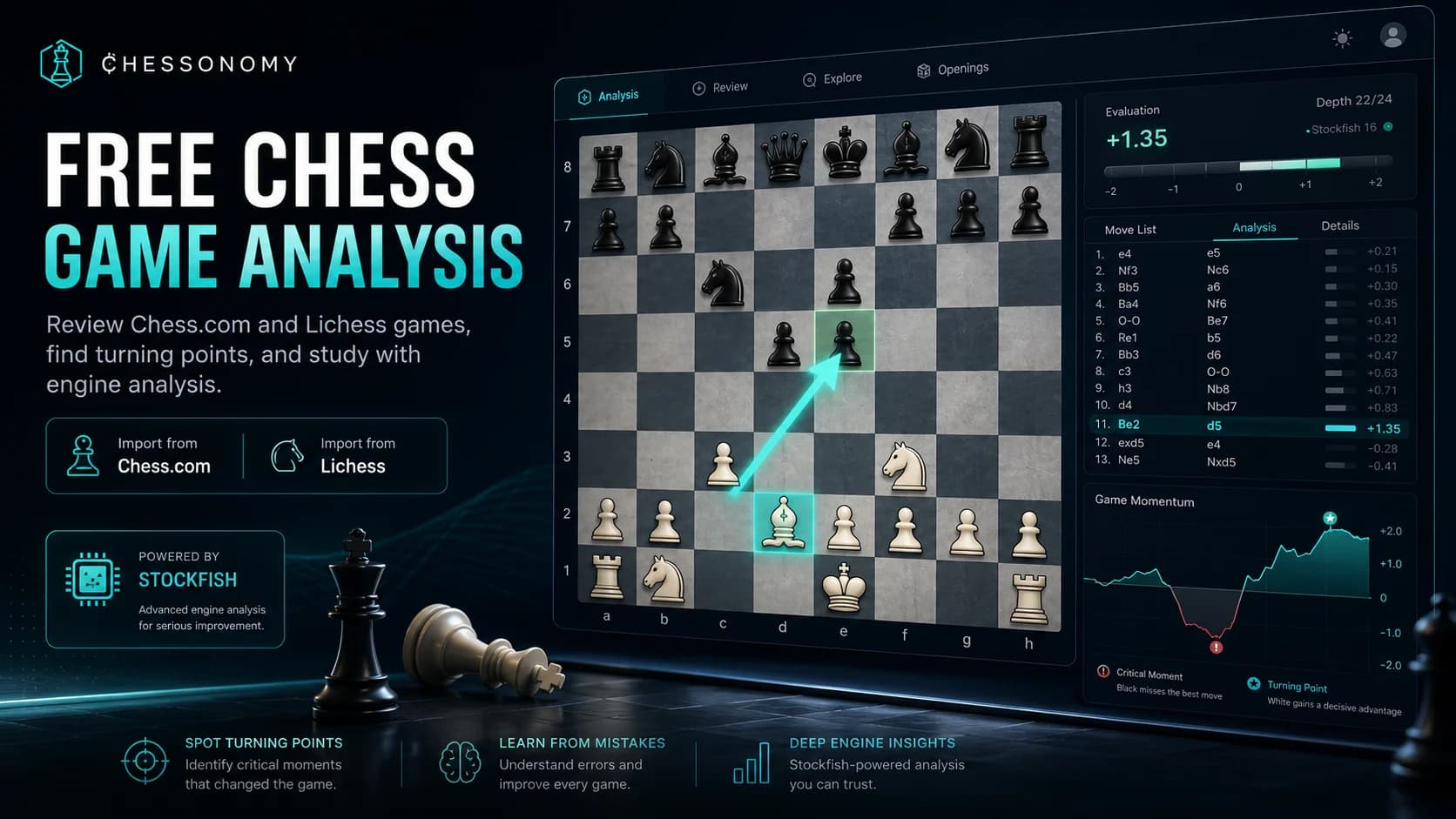
Chessonomy gives players a free chess game analysis workflow: import recent Chess.com or Lichess games, inspect the move list, open critical positions, and continue the review on a Stockfish-powered analysis board.

Chessonomy game review showing a move list, evaluation swings, and a Stockfish analysis board

Start with the game you actually played

Generic engine analysis is useful, but the fastest improvement usually comes from your own games. Search your Chess.com or Lichess username, load a recent game, and choose one result that still feels unclear. A loss is useful, but a messy win can be just as valuable because it often hides the same habits.

Before looking for the engine answer, write down what you thought was happening in the position. Were you attacking the king, defending a weak pawn, trying to trade pieces, or playing quickly because of the clock? That human context is what turns free chess game analysis into training instead of passive scrolling.

  • Import a game from Chess.com or Lichess before opening the engine line.
  • Choose one unclear game instead of trying to review an entire archive.
  • Write the human reason for your move before checking Stockfish.

Find the turning point before judging every move

Most players try to analyze every move with equal attention. That is rarely necessary. Start with the largest swing in the game: the move where a good position became equal, an equal position became worse, or a worse position became lost. That one moment usually explains more than ten small inaccuracies.

When you find the turning point, step back one move and ask for candidate moves. Checks, captures, threats, pawn breaks, and trades should all be considered before the engine line becomes the final answer. If Stockfish prefers a move you never considered, the lesson is not just the move. The lesson is the type of move missing from your calculation.

  • Prioritize the biggest evaluation swing first.
  • Review the position before the mistake, not only the move after it.
  • Turn the missed candidate move into a training theme.

Use Stockfish as a second opinion, not a shortcut

Stockfish can show the best continuation, but it cannot automatically teach the habit that failed during the game. If the engine line starts with a quiet move, ask what it prevents. If it starts with a sacrifice, calculate the forcing line until the material or mate becomes clear. If two moves are close in evaluation, choose the one you can explain and repeat in a real game.

A practical review ends with one sentence: 'I missed this because...' Maybe you ignored a pinned defender, rushed a recapture, traded into a bad endgame, or played a plan without checking the opponent's forcing reply. That sentence becomes your next puzzle or analysis theme.

Turn one review into the next training task

Do not leave the game review with only a score or an accuracy number. Save one position as a FEN, replay the critical line, and connect it to a concrete training task: back-rank tactics, overloaded pieces, rook endings, pawn breaks, or king safety. One clear task is easier to improve than a vague instruction to calculate better.

This is where Chessonomy connects the workflow. Import the game, open the key position on the analysis board, test the next move, and then train similar patterns with puzzles. The goal is simple: help the player keep the lesson after the game is over.

Understand move labels without chasing perfect scores

Move labels such as Best, Excellent, Inaccuracy, Mistake, Blunder, or Brilliant summarize an evaluation method; they are not universal chess laws. A label can change with engine depth, evaluation thresholds, the number of acceptable alternatives, and the review product's own rules.

Use labels to locate positions worth reviewing, then inspect the actual consequence. A move called Okay may still be the engine's top move when several options are close. A sacrifice called Brilliant should still be tested against the strongest defense. The position and the continuation matter more than the badge.

  • Treat labels as navigation aids, not final explanations.
  • Compare the played move with the best defensive reply.
  • Record the chess reason for the evaluation change.
Common questions

Can I analyze Chess.com and Lichess games for free?

Yes. Chessonomy lets you import recent games from Chess.com or Lichess and open them for review without starting from a blank board.

What is the best way to review a chess game?

Start with the biggest evaluation swing, inspect the position before the mistake, compare your candidate moves with the engine line, and write down the pattern you need to train.

Is game analysis only useful after losses?

No. Wins often contain missed tactics, weak plans, and lucky escapes. Reviewing wins helps you fix mistakes before they become losses against stronger players.

Should I trust the engine move every time?

Use the engine as a second opinion. If you cannot explain why the engine move works, play through the line and identify the tactical or positional idea before moving on.