
How to Analyze a Chess Position with Stockfish
Learn how to analyze a chess position: assess threats, compare candidate moves, calculate defenses, and test an example FEN with Stockfish.
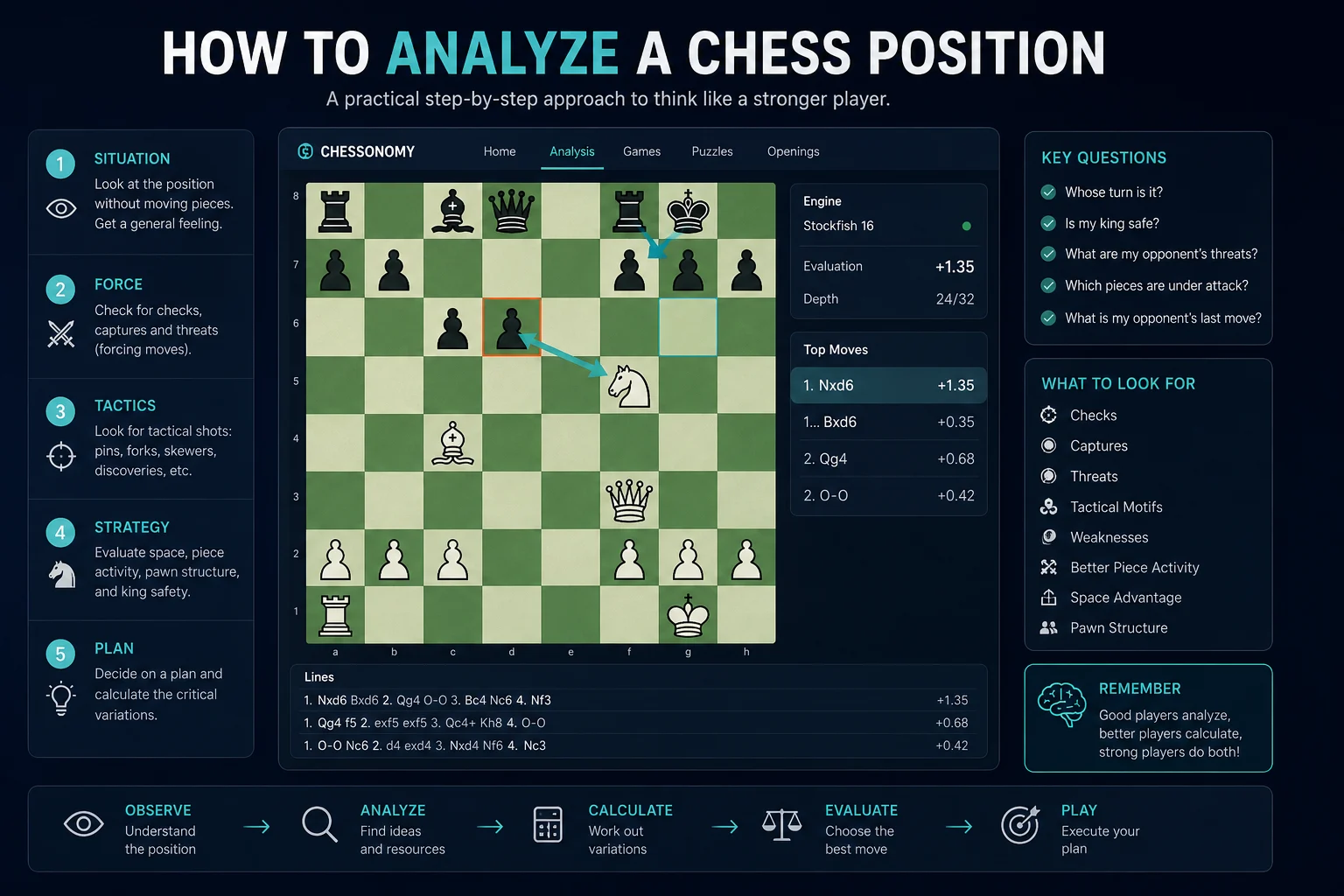
Strong analysis is not just reading the engine's top move. Use Stockfish as a second opinion after you understand threats, candidates, and plans.
- Side to move: confirm whose turn it is before judging any tactic.
- Immediate threats: name what each side wants on the next move.
- King safety: check open files, weak diagonals, and missing defenders.
- Loose pieces: mark undefended pieces and overloaded defenders.
- We separate human candidate-move work from engine verification so players do not skip the learning step.
- We use FEN and PGN workflows because they are the most reliable way to reproduce a position exactly.
- We recommend comparing multiple candidate moves instead of treating the first engine line as a complete explanation.
The fastest way to waste a chess engine is to ask for the best move before you have asked your own questions. Stockfish can tell you that one move is better than another. It cannot tell you what you were thinking during the game, why one candidate attracted you, or which weakness in your process caused the mistake. That is the part a player has to recover through analysis.
A good analysis session feels less like asking an oracle and more like replaying the decision with better lighting. You put the position on the board, describe what is happening, choose candidate moves, calculate a little, and only then compare your work with the engine. That order matters because it turns the engine from a shortcut into feedback.
This guide is written for practical players. It is not about producing grandmaster annotations or memorizing twenty-ply computer lines. It is about taking one position from your game, a puzzle, or a study book and leaving with a clear answer: what did the position demand, what did I miss, and what should I train next?
Start With a One-Minute Diagnosis
Before you move any pieces, describe the position in plain language. Do not try to sound clever. A useful note can be simple: Black's king is still in the center, my knight on f3 attacks e5, the d-file may open, and my queen is not yet active. That sentence already gives the engine line a place to land later.
- Side to move: confirm whose turn it is before judging any tactic.
- Immediate threats: name what each side wants on the next move.
- King safety: check open files, weak diagonals, and missing defenders.
- Loose pieces: mark undefended pieces and overloaded defenders.
- Pawn structure: look for breaks, passed pawns, holes, and fixed targets.
- Candidate moves: write two or three moves before starting engine analysis.
This first minute is where many improving players make the biggest gain. The goal is not to be perfect. The goal is to force your brain to see the board before the engine interrupts. If your first diagnosis is wrong, that is useful too. The correction tells you what type of position you misread.
Use This Example Position Before Turning On Stockfish
Take this common opening position after 1.e4 e5 2.Nf3 Nc6 3.Bc4 Nf6. FEN: r1bqkb1r/pppp1ppp/2n2n2/4p3/2B1P3/5N2/PPPP1PPP/RNBQK2R w KQkq - 4 4. White to move. If you ask Stockfish immediately, you will get a move. If you analyze first, you learn how the position works.
A human diagnosis might say: Black attacks e4, both kings are still uncastled, White's bishop eyes f7, and the position can become tactical quickly. Candidate moves include 4.Ng5, 4.d3, and 4.O-O. Each move answers a different question. Ng5 attacks f7 at once. d3 protects e4 and keeps the center stable. Castling improves king safety and prepares Re1. That comparison is already real chess analysis.
Only after that comparison should the engine enter the room. If Stockfish prefers one line, ask why. Does it punish Black's king? Does it defend e4 with tempo? Does it avoid a tactical resource? The answer matters more than the move label. You are not trying to memorize this one opening position. You are training the habit of comparing candidate moves by purpose.
Use FEN When the Position Must Be Exact
FEN is the safest format when you want to analyze one exact chess position. It stores piece placement, side to move, castling rights, en passant availability, and move counters. If any of those details are wrong, the engine may analyze a different position from the one you played.
| Input | Best use | Common mistake |
|---|---|---|
| FEN | One critical position from a game, book, or puzzle. | Forgetting castling rights or side to move. |
| PGN | A complete game where move order and context matter. | Jumping to one move without reviewing the build-up. |
| Manual board | Training a pattern or recreating a simple position. | Misplacing one piece and trusting the result. |
This is not a technical detail for programmers only. Castling rights can change the best move. The side to move can turn a winning tactic into a losing blunder. En passant can affect pawn endings. If you are studying a serious game, copy the FEN from the exact move before the decision and paste it into the analysis board. Guessing the position by hand is fine for simple training, but exact review deserves exact input.
Separate Candidate Moves From Engine Moves
A candidate move is not a guess. It is a move with a reason. You might choose a check because checks restrict the king. You might choose a capture because it removes a defender. You might choose a quiet move because it improves your worst piece or stops counterplay. Write the reason next to the move, even if the reason is short.
For example, in a middlegame attack you might compare Bxh6, Re1, and Qg4. Bxh6 tries to remove a king defender. Re1 brings a rook to the open file. Qg4 creates direct pressure. The engine may later say one move is clearly best, but your comparison tells you what you were trying to do. Without that comparison, the engine answer is just a command.
| Candidate type | What it asks | When to trust it |
|---|---|---|
| Check | Can I force the king or win time? | When every legal reply has been checked. |
| Capture | Does removing this piece change the position? | When the recapture and in-between moves are safe. |
| Threat | Can I create a problem the opponent cannot ignore? | When the opponent has no stronger counter-threat. |
| Improving move | Can I make my worst piece useful? | When tactics do not demand immediate action. |
| Defensive move | What must I stop first? | When the opponent's threat is stronger than your plan. |
Calculate the Defender's Best Reply
Most bad analysis is too cooperative. A player looks at their move, imagines the opponent making a natural reply, and concludes the idea works. Stronger analysis asks a harsher question: what would I hate to face after my move? If the move still works against that reply, it becomes a serious candidate.
Use the simple line format: my move, their best reply, my answer. You do not need to calculate forever. In many positions, two moves for each side is enough to expose the problem. If you cannot find a good answer to the defender's reply, mark the move as suspicious and compare it with another candidate. This is how you avoid building analysis around hope.
Read Stockfish Lines Like a Player
Stockfish gives a principal variation, but a principal variation is not a lesson by itself. Translate the line into ideas. Does the move win a tempo? Remove a defender? Force a favorable endgame? Stop counterplay? If the answer is not clear, compare it with your own candidate move and find the exact move where the engine's line improves.
A useful translation might look like this: Stockfish wants Re1 because the e-file matters more than the immediate bishop check. Or: the engine rejects my pawn grab because Black gets counterplay against my king. Or: the quiet king move works because the pawn ending is winning only after opposition is secured. These are human lessons. The engine line is only evidence.
Do Not Chase Tiny Evaluation Changes
A move changing the evaluation from +0.34 to +0.48 is rarely the main lesson for a club player. A move changing a winning attack into equality is a lesson. A move allowing mate is a lesson. A move turning a drawn rook ending into a lost pawn ending is a lesson. Use the engine to find meaningful turning points, not to shame every normal human move.
This is one reason full-game review and single-position analysis should work together. The full game shows where the evaluation changed. The position board lets you slow down at that exact moment. If you analyze every move with the same intensity, you will burn time and remember little. If you analyze the critical positions deeply, the lesson is more likely to survive.
Analyze Tactical Positions Differently From Strategic Positions
A tactical position asks for calculation first. Checks, captures, threats, overloaded pieces, pins, exposed kings, and forcing moves deserve priority. If a tactic exists, a slow improving move may be too late. Your candidate list should be concrete, and the engine should be used to verify whether the tactic survives best defense.
A strategic position asks for a plan first. You may need to improve a knight, contest an open file, prepare a pawn break, exchange the opponent's good bishop, or create a better endgame. In these positions, Stockfish can be confusing because its move may look quiet. Translate the move into a plan before judging it. Ask what square, file, pawn break, or endgame the move is improving.
A Practical Endgame Example
Use this training position: 8/8/8/3k4/3P4/3K4/8/8 w - - 0 1. White to move. This is not a flashy tactic, but it teaches analysis discipline. The first question is not which move looks active. The first question is whether the kings and pawn create opposition, whether White can make progress, and whether moving the king or pawn changes the result.
Endgame analysis is where many players overtrust material. Being up a pawn does not automatically mean winning. The position may be drawn if the king cannot improve. When Stockfish gives an endgame move, do not only copy it. Test the losing-looking alternatives. Ask which move gives opposition, which move wastes a tempo, and which move changes the pawn race. Endgame lessons are often hidden in one square.
A Simple Analysis Routine You Can Repeat
For most players, a repeatable routine beats a deeper engine search. Spend one minute diagnosing the position, two or three minutes calculating candidate moves, then use the engine to test your work. If your move was wrong, write down the reason in one sentence. That sentence is the training value.
| Step | Question | Output |
|---|---|---|
| Diagnose | What is the position asking for? | A short description of threats and plans. |
| Calculate | Which forcing moves deserve attention? | Two or three candidate moves. |
| Verify | What does Stockfish prefer and why? | A corrected line with the key idea. |
| Train | What pattern should I remember? | A tactic, endgame theme, or positional rule. |
How to Write Notes That Actually Help
A good analysis note is short, specific, and reusable. Do not write I blundered. Write I missed that the knight on c6 defended e5 twice. Do not write Stockfish says Re1. Write Re1 works because the e-file opens and Black cannot castle comfortably. Specific notes help you recognize the same pattern in a future game.
- Position source: game, puzzle, book, or training board.
- Side to move and FEN if the exact position matters.
- Your candidate moves before engine help.
- Engine move and the idea behind it.
- The mistake category: tactic, plan, endgame, opening memory, or time pressure.
- One training action: solve similar puzzles, review an opening structure, or practice the endgame.
When to Use Chessonomy's Analysis Board
Use the analysis board when the position deserves more than a one-move answer. Paste a FEN for a critical position, or reach it by playing legal moves. If you have a PGN and the move order explains the mistake, import it through Game review first. Once you have the right position, compare your candidate moves with Stockfish and write the practical lesson.
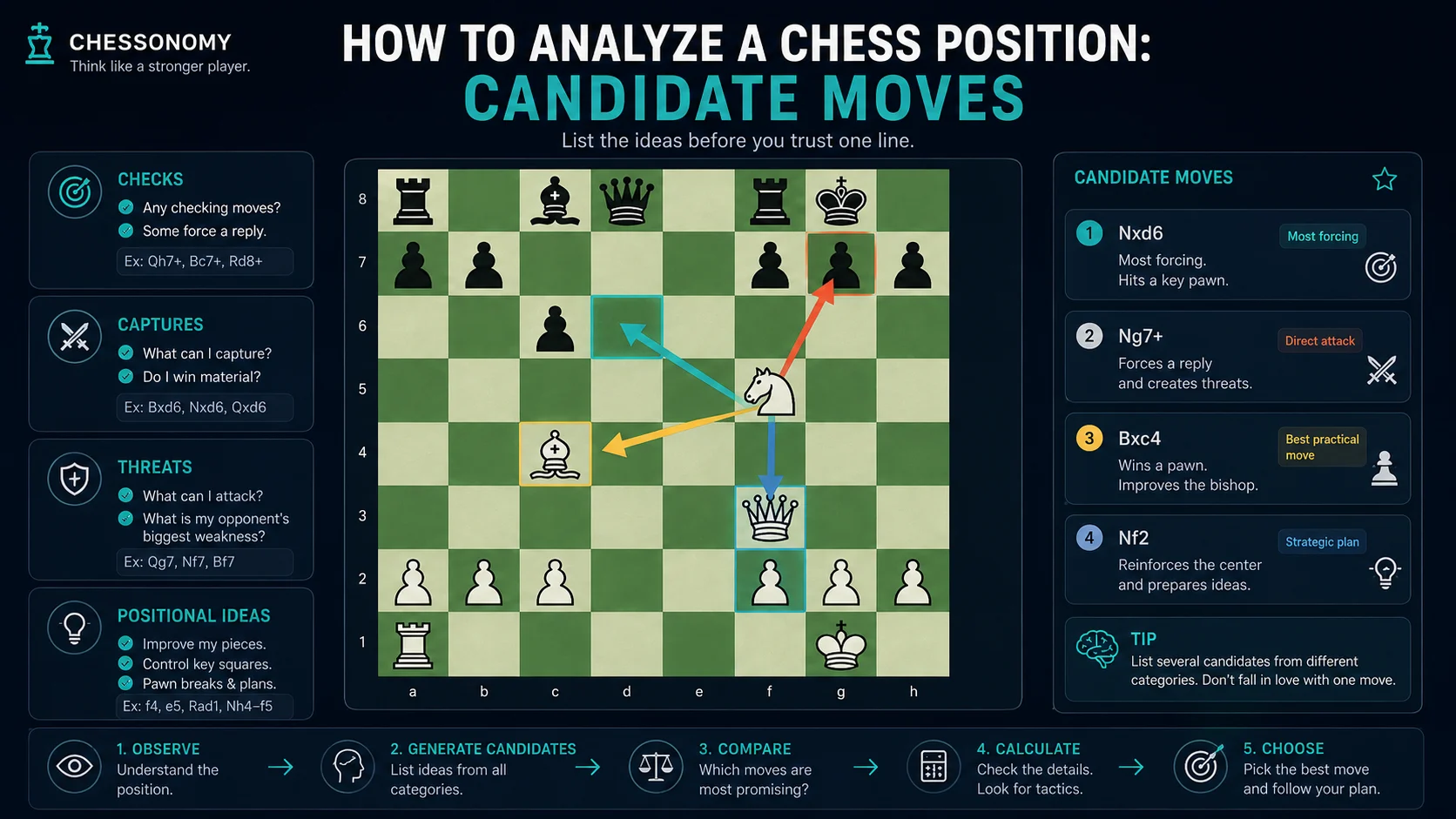
Use the next-move tool when your question is narrower: what is the strongest move in this exact position? Use Game review when you need to find the critical moments first. If the engine's answer surprises you, return to the position and calculate the opponent's reply. Finish only when you can explain what your original move overlooked.
Final Takeaway
The best chess analysis is not engine worship and it is not engine rejection. It is a conversation. You make a human diagnosis, choose candidate moves, calculate the defender's best replies, and then let Stockfish challenge your work. When the engine disagrees, the disagreement is the lesson.
If you keep the routine simple, one position can teach more than an entire game skimmed too quickly. Save the FEN, name the theme, compare your candidates, and write one sentence you can remember. That is how a single chess position becomes training rather than a forgotten engine line.
Why Human Analysis Must Come Before Engine Analysis
The biggest mistake players make with a chess analysis board is turning on the engine too early. The engine is extremely strong, but it answers a different question from the one a player needs to ask. Stockfish can tell you which move it prefers. It does not automatically tell you how a human should find that move, what feature of the position matters most, or which weakness in your thinking caused you to miss it.
Human analysis should begin with a diagnosis. You need to describe the position before receiving the answer. Is the position tactical or strategic? Is the king unsafe? Is one side ahead in development? Are there open files, weak diagonals, pinned pieces, or pawn breaks? When you write this down first, the engine result has context. If you skip it, the engine line becomes a sequence of moves without meaning.
This is especially important for club players. Most rating improvement does not come from memorizing engine moves. It comes from fixing repeated decision errors. Maybe you miss loose pieces. Maybe you trade when you should attack. Maybe you push pawns around your king. Maybe you stop calculating after the first capture. A good analysis routine helps you find those patterns.
A Complete Position Analysis Framework
Use a repeatable framework every time you analyze a position. First, identify the side to move and the immediate threats. Second, evaluate king safety. Third, compare piece activity. Fourth, examine pawn structure. Fifth, list forcing moves. Sixth, choose candidate moves. Seventh, calculate the opponent's best replies. Eighth, use the engine to verify or correct your work.
| Stage | Question | Common discovery |
|---|---|---|
| Threats | What is each side threatening right now? | A hidden tactic or urgent defensive need. |
| King safety | Which king is easier to attack? | Open files, weak diagonals, or missing defenders. |
| Pieces | Which pieces are active or misplaced? | A worst piece that needs improvement. |
| Pawns | Which pawn breaks or weaknesses matter? | A target, passed pawn, or square weakness. |
| Candidates | Which moves deserve calculation? | Checks, captures, threats, and improving moves. |
The framework is not meant to slow you down forever. It is training. After enough repetitions, you will see these categories more naturally during games. The point is to create a stable thinking process when the position is complicated and emotions are high.
How to Choose Candidate Moves
Candidate moves are the bridge between evaluation and calculation. Without candidates, analysis becomes passive. You stare at the board and wait for an idea. With candidates, you compare real choices. A good candidate list usually includes forcing moves, defensive necessities, and at least one quiet improving move. If you only consider checks, you may miss a strong positional move. If you only consider plans, you may miss tactics.
Start with forcing moves because they limit the opponent's options. Checks are first, then captures, then threats. But do not stop there. Ask which piece is worst placed. Ask whether a pawn break changes the structure. Ask whether trading helps or hurts. Ask whether the opponent has one threat that must be prevented. Strong analysis includes both tactics and strategy.
- Include every legal check that is not immediately absurd.
- Include captures that remove defenders, win material, or open lines.
- Include threats that force the opponent to respond.
- Include defensive moves if your king or queen is vulnerable.
- Include one quiet move that improves the worst piece or prepares a pawn break.
How to Use Stockfish Without Becoming Dependent
Stockfish is most useful after you have done your own work. Compare your candidate list with the engine's top lines. If the engine likes your move, do not stop. Ask why. If the engine rejects your move, find the exact reply that refutes it. The refutation is the lesson. Maybe you missed a tactic, maybe you evaluated an endgame incorrectly, or maybe you underestimated a quiet defensive move.
Do not chase tiny evaluation changes as if they are moral judgments. A difference between plus 0.30 and plus 0.45 is not always meaningful for human play. A swing from plus 2 to equal is meaningful. A forced mate is meaningful. A move that changes a winning position into a difficult endgame is meaningful. Use the engine to understand decisions, not to obsess over decimal points.
Engine depth also matters. A shallow engine line can miss long tactics, fortress ideas, or deep defensive resources. If the position is tactical, let the engine search longer and compare lines. If the best move changes several times, treat the position carefully. That instability often means the position contains tactics or long-term compensation that deserve deeper study.
Analyzing Tactical Positions
A tactical position has forcing moves. The most important features are king safety, loose pieces, pins, overloaded defenders, and forcing checks. When analyzing tactics, calculate concrete lines before making general comments. A beautiful plan does not matter if your queen is hanging. A positional weakness does not matter if there is mate in two.
In tactical analysis, move order is critical. The same idea can work or fail depending on whether you start with a check, capture, or quiet threat. Use the board to test move orders. If one line fails, do not discard the whole idea immediately. Ask whether the sequence should be reversed. Many combinations are discovered by changing the move order.
Analyzing Strategic Positions
A strategic position may not have immediate tactics. The analysis focuses on plans, piece placement, pawn breaks, and long-term weaknesses. Here, Stockfish can be confusing because it may recommend a quiet move without obvious explanation. Your job is to translate the move into human terms. Does it improve the worst piece? Stop a pawn break? Prepare pressure on a file? Create a better endgame?
Strategic analysis is also where comparison helps most. Play your natural move on the board, then inspect the engine's reply. Then play the engine move and inspect the difference. Often the engine move prevents counterplay you did not notice. Sometimes it prepares a pawn break one move earlier. Sometimes it improves a piece before starting the attack. The contrast teaches the plan.
Analyzing Endgames
Endgame analysis requires precision. Small details such as opposition, passed-pawn races, active kings, rook activity, and tempo can decide the result. Do not rely only on a general material count. A pawn-up endgame can be drawn. An exchange-down position can be winning if a passed pawn is unstoppable. Use the engine, but also learn the principle behind the line.
When possible, reduce the endgame to a question. Can the king catch the pawn? Can the defender build a fortress? Can the rook get behind the passed pawn? Can the stronger side trade into a winning pawn ending? Questions keep endgame analysis practical. They also help you remember the lesson next time.
From One Position to a Full Game Review
A single position rarely exists in isolation. In a full game, the critical position usually has a history. Maybe you weakened a square ten moves earlier. Maybe you traded the wrong defender. Maybe you entered an opening structure without understanding the pawn break. When you analyze one position, scroll backward and ask how it appeared. That backward review often reveals the real training point.
Then scroll forward and ask what happened after the critical moment. Did the mistake decide the game immediately, or did you still have defensive chances? Did the winning move require conversion technique? Did the opponent miss a stronger continuation? Full game review helps you avoid exaggerating one move and missing the larger pattern.
A Practical Review Template
Use a simple template after every serious analysis session. Write the position source, the side to move, the candidate moves you considered, the move the engine preferred, the reason your move was wrong or right, and the training theme. Keep the note short. A useful note is one you will actually read again.
| Field | Example | Purpose |
|---|---|---|
| Position | Move 18, White to move. | Makes the lesson easy to find. |
| Candidates | Bxh6, Qg3, Rad1. | Shows your thinking process. |
| Engine point | Best defense after sacrifice was missed. | Identifies the correction. |
| Theme | Deflection and king safety. | Turns one game into a pattern. |
| Next training | Solve five deflection puzzles. | Creates an action step. |
Final Takeaway
A chess analysis board is powerful only when it supports a disciplined thinking process. Start with your own diagnosis, choose candidate moves, calculate the defender's best replies, and then use Stockfish to verify. The goal is not to agree with the engine instantly. The goal is to understand why the best move works and why your alternatives succeed or fail.
When you analyze this way, every position becomes training material. Tactical positions teach calculation. Strategic positions teach plans. Endgames teach precision. Full games teach patterns in your decision-making. That is how analysis turns from a report into improvement.
Opening Positions: Analyze Plans, Not Only Moves
Opening analysis is easy to misuse. Players often ask whether one move was book or not, then stop. A better question is what the opening position is asking for. Does the pawn structure point toward a kingside attack, queenside expansion, central break, minority attack, isolated-pawn position, or piece-pressure game? The engine can tell you the best move, but the plan explains how to play the next ten moves.
When analyzing an opening position, compare development, king safety, central control, and pawn breaks. If one side is behind in development, tactics may appear quickly. If the center is locked, flank plans become more important. If a pawn break is available, ask whether it should be played now or prepared. Strong opening analysis connects the current move to the structure.
Do not memorize engine lines without understanding the purpose. If Stockfish recommends a developing move, ask what square the piece improves from and what it supports. If it recommends a pawn break, ask what opens and who benefits. If it recommends castling, ask whether the king needs safety before the center opens. This turns opening analysis into practical knowledge.
Middlegame Positions: Find the Imbalance
Most middlegame positions are built around imbalances. One side may have the bishop pair, better pawn structure, safer king, more space, an open file, a strong outpost, or better development. The first step is identifying which imbalance matters most. If you choose the wrong imbalance, your candidate moves will point in the wrong direction.
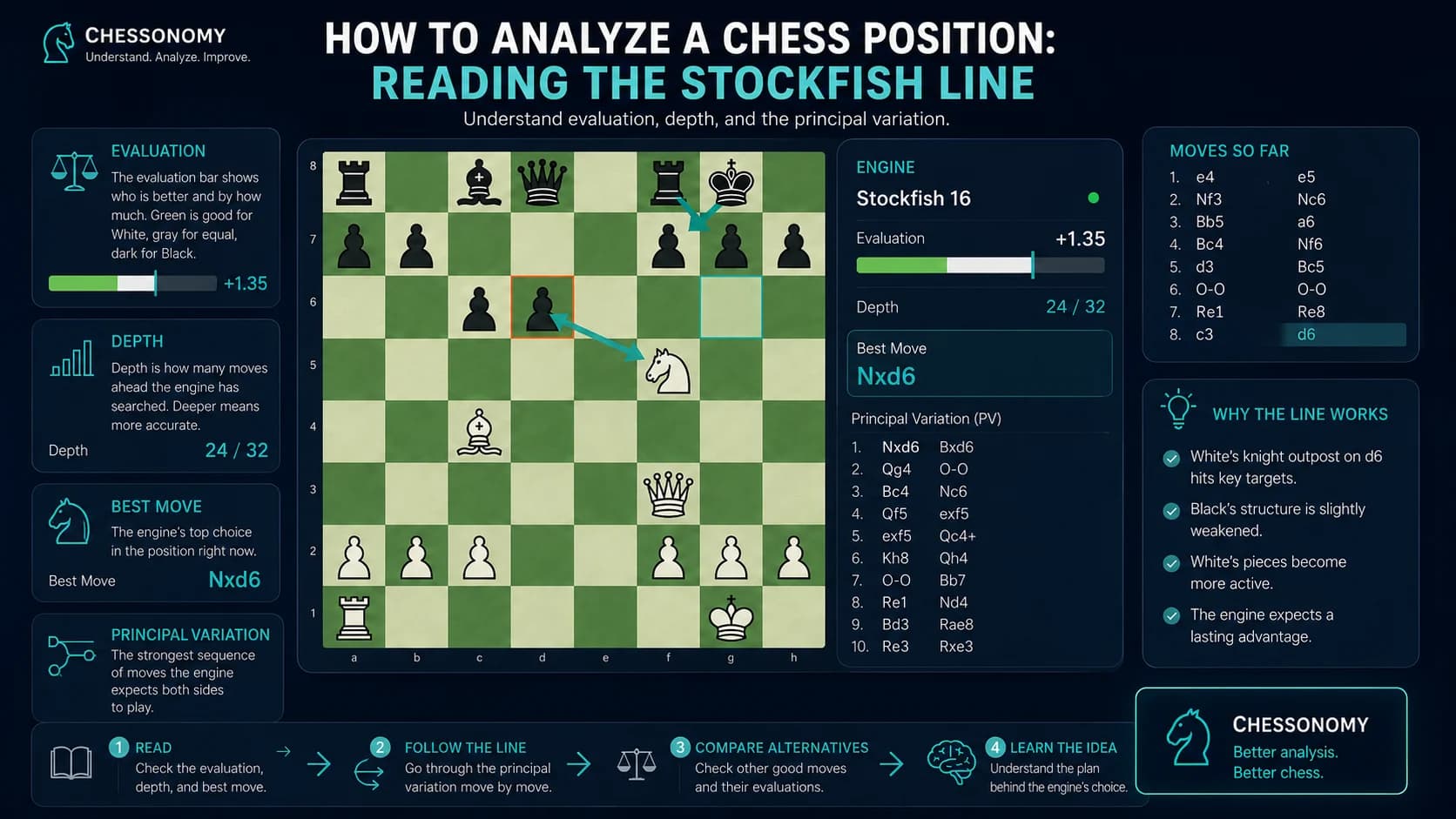
For example, if you have more space but a weak king, an attacking move may be less important than consolidation. If you have an open file but no entry square, doubling rooks may look logical but achieve little. If you have a strong knight outpost, trading that knight may give away the main advantage. Middlegame analysis is the art of matching moves to the real imbalance.
Use the engine to test your strategic conclusion. If you think your advantage is on the queenside but the engine keeps choosing kingside moves, find out why. Maybe there is a tactical reason. Maybe your king needs a luft square. Maybe the central break is urgent. The disagreement is useful because it exposes a hidden feature of the position.
Defensive Analysis: Find the Resource
Players often analyze only when they are attacking. Defensive analysis is just as important. If your position is worse, the task changes. You are looking for resources: trades, counterplay, perpetual check, fortress ideas, active defense, and simplification. A worse position is not always lost. Many games turn because the defender finds the one move that asks the attacker to prove the win.
When defending, do not only ask what move looks natural. Ask what the opponent wants. If they want to attack your king, trade attackers or create counterplay. If they want to win a weak pawn, activate your pieces. If they want to queen a passed pawn, calculate the race. Defensive analysis starts with the opponent's plan and searches for friction.
Engine analysis can be very helpful here because defensive resources are easy to miss. A quiet king move, temporary sacrifice, or countercheck may hold the position. Study those resources carefully. They often become reusable defensive patterns in future games.
How to Annotate a Position
Annotation forces clarity. A good annotation does not need to be long. It should state the evaluation, the plan, the candidate moves, and the key tactical point. For example: White is better because Black's king is weak and the e-file is open. Candidate moves are Re1, Bxh6, and Qg4. The critical line is Bxh6 because the g-pawn is pinned. This kind of note teaches more than a raw engine line.
Avoid annotations that only repeat the move. Saying White plays Re1 is not analysis. Saying Re1 brings the rook to the open file and threatens Rxe6 because the f7 pawn is pinned explains the move. Good annotation connects move to reason. That is what helps you remember the idea later.
How to Analyze Without Moving the Pieces Too Early
Moving pieces on the board is useful, but doing it too early can weaken visualization. Before you drag a candidate move, try to calculate one line in your head. Then move the pieces to verify. This trains the same skill you need during a real game, where you cannot move pieces freely. Analysis should support visualization, not replace it completely.
A practical method is to calculate the first two moves mentally, then use the board for branch checking. If the line is tactical, you may need to move pieces more often. If the line is strategic, try to visualize the resulting structure before confirming. Over time, your internal board becomes more reliable.
Common Analysis Traps
One trap is result bias. If you won the game, you may assume your decisions were good. If you lost, you may assume everything was bad. The board does not care about the result. Analyze the position objectively. You can win a game after a poor move because the opponent blundered later. You can lose a game after a good move because the position was already difficult.
Another trap is engine worship. If the engine says a move is best, players sometimes stop asking why. But why is the whole point. If you cannot explain the move, you may not be able to find it next time. Use engine lines as evidence, then translate them into human concepts.
A third trap is over-analysis. Not every move deserves twenty minutes. Focus on critical positions: evaluation swings, tactical moments, plan changes, time-pressure decisions, and endgame turning points. Deep analysis is valuable when the position teaches something. Random deep dives waste energy.
Final Checklist Before You Leave the Position
Before closing an analysis board, make sure you can answer five questions. What was the best move? Why did it work? What did my move miss? What defensive resource mattered? What pattern should I train next? If you cannot answer those questions, you have seen the engine output but not finished the analysis.
This final checklist is what turns analysis into improvement. It creates a bridge from information to action. The next action may be a puzzle theme, an endgame study, an opening note, or a reminder to calculate forcing moves. Without that action, analysis remains passive.
How to Analyze Candidate Moves Side by Side
One of the strongest analysis habits is comparing candidate moves side by side. Do not analyze one move, see that it is playable, and stop. Put two or three serious candidates on the board and ask what each one gives up. One move may attack faster but weaken your king. Another may defend accurately but allow the opponent to improve. A third may look quiet but remove all counterplay. Comparison reveals tradeoffs that a single-line review hides.
A good comparison uses the same depth of attention for each move. If you calculate your favorite move deeply but reject the others after one glance, the comparison is biased. Give each candidate the opponent's best reply. Then evaluate the resulting positions. Which position would you prefer to play over the board? Which plan is easiest to understand? Which move keeps the most control? These practical questions matter alongside engine evaluation.
How to Review Engine Disagreements
Sometimes the engine's move will feel wrong. This is a valuable moment. Do not assume the engine is irrational, and do not assume your human plan is worthless. Instead, investigate the disagreement. Play your move and look at the engine's best response. Then play the engine move and look at the plan it prevents or creates. The difference usually reveals the hidden tactic, tempo, or defensive resource.
Engine disagreements often come from time. Humans think in plans, while engines calculate concrete replies. You may want to attack, but the engine sees that one defensive move stops everything. You may want to win a pawn, but the engine sees that activity matters more. You may want to trade, but the engine sees that the endgame is worse. Each disagreement teaches you how to evaluate more concretely.
How to Analyze a Position From Both Sides
After choosing your candidate move, flip the board mentally. What does the opponent want? What would be annoying for you to face? Which move would you hope they miss? This defensive perspective is essential. Many bad moves are bad because they ignore the opponent's strongest idea. Good analysis respects both plans at once.
Analyzing from both sides also improves practical play. You become better at prophylaxis, which means preventing the opponent's idea before it becomes dangerous. A quiet move that stops counterplay may look less exciting than an attack, but it can be the strongest move in the position. Engines often value these moves highly because they preserve control.
Turning Analysis Into a Training Plan
Every serious analysis session should end with a training plan. If the position was lost because of a tactic, train that motif. If the problem was a bad minor-piece trade, study similar structures. If the issue was an endgame tempo, review that endgame type. If the mistake came from opening unfamiliarity, add one clear note to your repertoire. The next action is what makes analysis valuable.
Without a next action, analysis becomes content consumption. You saw the best move, nodded, and moved on. With a next action, the lesson enters your training. Chess improvement is built from these small loops: mistake, explanation, practice, repeat. A good analysis board helps you see the mistake. A good routine makes sure you do something with it.
How to Use Analysis Before a Tournament
Before a tournament, analysis should become practical and selective. Do not spend hours chasing engine perfection in random positions. Review recent games and identify the positions that are most likely to repeat: opening structures you play often, endgames you mishandled, tactical motifs you missed, and defensive positions where you felt uncomfortable. These are the positions that deserve focused board work.
For each position, create one takeaway you can remember during a game. For example: in this isolated-pawn structure, activity matters more than pawn defense; in this rook endgame, get behind the passed pawn; in this opening line, develop before grabbing the b-pawn. Tournament preparation should turn analysis into simple decision rules under pressure.
This is also where a free analysis board becomes more than a tool. It becomes a preparation notebook. You can revisit the exact positions that matter, test the candidate moves that confused you, and keep the lesson close to the board. Strong preparation is not memorizing dozens of computer lines. It is understanding the recurring positions you are most likely to play.
That clarity is what makes analysis practical, repeatable, and useful.
How to Analyze Positions With Limited Time
Not every analysis session can be deep. Sometimes you have only five minutes after a game. In that case, do not try to analyze every move. Find the biggest evaluation swing, the most confusing decision, or the moment where your plan changed. Put that one position on the board and answer three questions: what did I think, what did I miss, and what should I train? A short focused review is better than a rushed review of the whole game.
When time is limited, avoid opening too many engine branches. Choose the main position, compare your move with the engine's first choice, and identify the reason for the difference. If the reason is tactical, save the position for puzzle-style review later. If the reason is strategic, write a short note about the plan. This keeps the session useful without becoming overwhelming.
How to Analyze Positions After a Loss
Losses are emotionally noisy. Many players either avoid them or overanalyze them harshly. A better approach is to separate result from decision quality. Find the first moment where the game became uncomfortable, not only the final blunder. Often the final blunder is caused by an earlier strategic mistake, poor king safety, or a missed simplifying chance. The earlier moment is usually the better training target.
After a loss, write one practical lesson. Not ten. One. For example: I must check opponent counterplay before grabbing pawns. Or: in this structure, my dark-square bishop is important and should not be traded casually. A single clear lesson is more likely to affect your next game than a long list of vague regrets.
How to Analyze Positions After a Win
Wins deserve analysis too. A win can hide poor decisions because the final result feels good. Look for moments where the opponent missed a chance, where you allowed counterplay, or where conversion became harder than necessary. If you only review losses, you may miss repeated weaknesses that opponents failed to punish.
The best question after a win is how could I have made this easier? Maybe you had a cleaner tactic. Maybe you could have traded into a winning endgame. Maybe you attacked before finishing development. Winning analysis helps you become more efficient, not only less error-prone.
Chessonomy is an independent chess training workspace focused on practical game review, Stockfish analysis, puzzle training, and player-friendly explanations of engine feedback.
Questions Players Ask
What is the best free way to analyze a chess position?
Paste a FEN into the analysis board, write down candidate moves, then compare your ideas with Stockfish. For a PGN, start with Game review. The learning comes from comparing lines, not from copying the top move.
Should I use FEN or PGN for chess analysis?
Use FEN for one exact position. Use PGN when the full game matters, especially when opening choices, repeated mistakes, or earlier tactical themes explain the critical position.
Why does Stockfish change its best move at deeper depth?
The engine sees farther as depth increases. In tactical positions, a shallow search can miss defensive resources or long forcing lines, so the preferred move may change.