How to Find the Best Move in Chess: A Practical Method
Learn how to find the next chess move by checking threats, forcing moves, candidate moves, and then verifying the position with Stockfish.
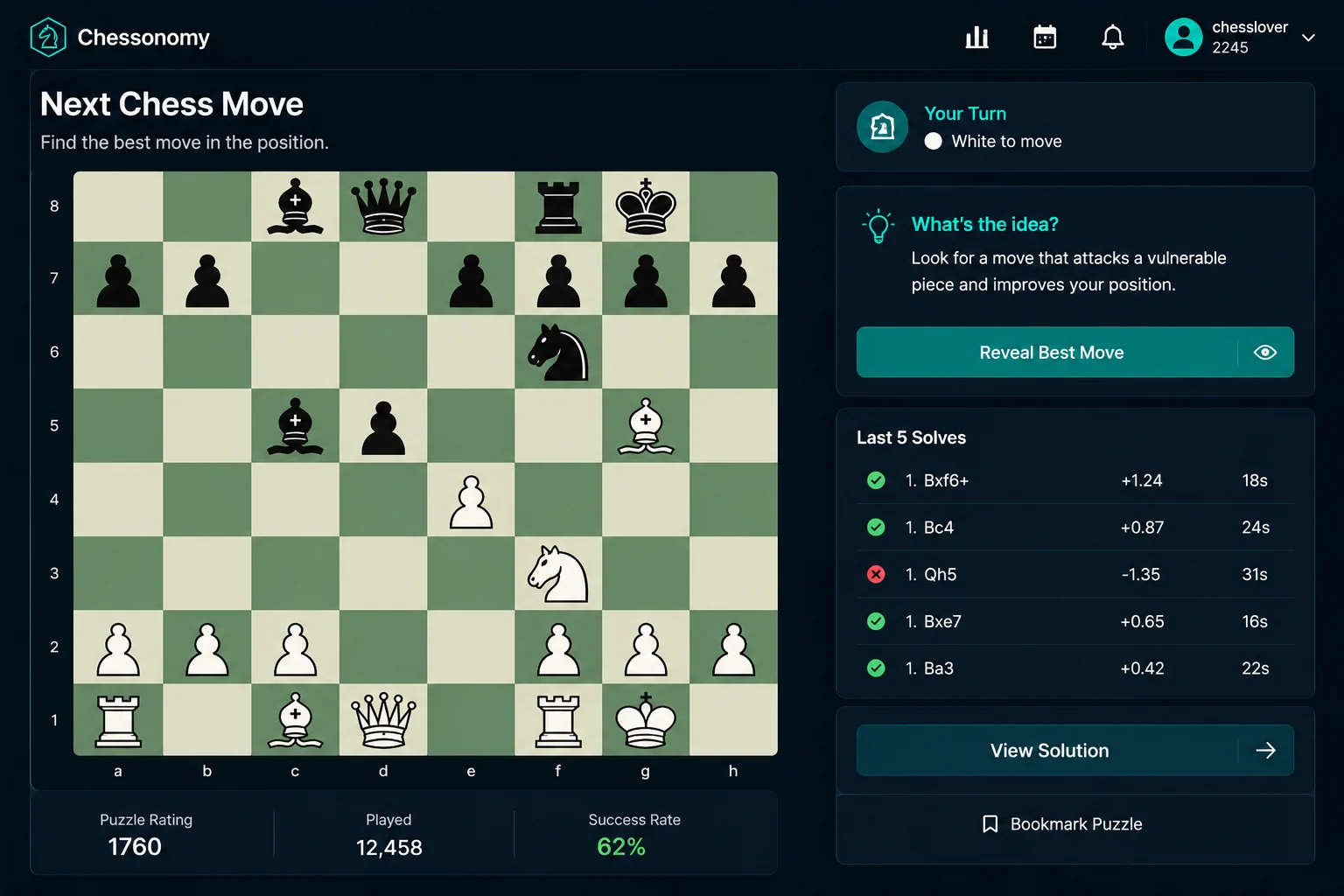
Finding the best move is not guessing. Use forcing moves, opponent threats, candidate moves, and engine verification to choose a move you understand.
- Look for legal checks and ask whether any check wins by force.
- Look for captures and ask whether the captured piece is really safe to take.
- Look for threats that improve your position or create immediate problems.
- Ask what your opponent wants to do next.
- We treat next-move selection as a human decision process first and an engine verification process second.
- We separate forcing moves, opponent threats, candidate move comparison, positional plans, and Stockfish confirmation.
- We include FEN examples and internal tool links so readers can test the method instead of only reading advice.
Every chess position asks a question. Sometimes the question is tactical: can you win material, force mate, or avoid a threat? Sometimes it is strategic: which piece should improve, which pawn break matters, or which trade changes the structure? The phrase next chess move sounds simple, but the real task is choosing the move that answers the position better than every alternative.
Many players look for the next move by feeling. They choose the move that looks natural, the move they played in a similar opening, or the move that seems active. That can work in quiet positions, but it fails when the board contains tactics, hidden threats, or a change in pawn structure. A good move-finding process protects you from playing on autopilot. It makes you inspect the position before you commit.
A next chess move tool can help because it gives fast engine feedback. But the tool should not replace thinking. If you paste a FEN, copy the top Stockfish move, and never ask why it works, you have found a move but not learned a skill. The stronger workflow is to choose candidate moves first, check them with the engine second, and write down the human reason afterward. That is how a best-move check becomes training.
Short Answer: How to Find the Next Chess Move
Use this order: checks, captures, threats, opponent threats, candidate moves, calculation, final safety check. Checks come first because they force the opponent to respond. Captures come next because they change material and open lines. Threats matter because a quiet move can be strongest if it creates a problem the opponent cannot meet. Opponent threats matter because your beautiful idea may fail if you ignore mate, a hanging queen, or a pawn break.
- Look for legal checks and ask whether any check wins by force.
- Look for captures and ask whether the captured piece is really safe to take.
- Look for threats that improve your position or create immediate problems.
- Ask what your opponent wants to do next.
- List two or three serious candidate moves before calculating.
- Calculate the most forcing reply for each candidate.
- Before moving, check whether your move leaves anything undefended.
This process may sound slow, but it becomes fast with practice. In blitz, you may only have time for a shortened version: checks, captures, threats, opponent threat, move. In rapid or classical chess, you can use the full version. The point is not to make every move complicated. The point is to avoid missing simple forcing ideas because you moved by habit.
Why the Next Move Is Often Not the Most Natural Move
The natural move is often the first move your brain recognizes. It develops a piece, castles, attacks something, or follows a familiar opening pattern. Natural moves are important because chess would be impossible if every turn started from zero. The problem is that positions change. A move that was natural one turn ago may be wrong after your opponent creates a threat, opens a file, or leaves a tactical resource.
This is why strong players pause when the position becomes concrete. If a king is exposed, a piece is loose, a pawn break is available, or a queen and rook sit on the same file, the next move may be tactical rather than natural. You cannot solve those positions with general principles alone. You need calculation. The move that looks quiet may be the only move that prevents a tactic. The move that looks greedy may be the correct capture because it comes with check.
A good move-finding habit asks one question before every natural move: what changed? If your opponent's last move attacked a piece, opened a diagonal, weakened a square, or removed a defender, your next move must respond to that change. Many mistakes happen because players play the move they already planned instead of the move the new position requires.
The Candidate Move Method
Candidate moves are the serious moves you are willing to calculate. You do not need ten candidates. Most positions only need two or three. One candidate may be forcing, one may be positional, and one may be defensive. Writing them down mentally keeps you from falling in love with the first move you see. It also gives the engine something to test later, because you can compare your human shortlist with the objective best move.
A practical candidate list might look like this: Qh5 because it attacks the king, Bxh7+ because it is a forcing sacrifice, and Re1 because it improves the rook and supports the center. Those moves are different in character. The next step is not to pick the prettiest one. The next step is to calculate the opponent's best reply to each. A move is only good if it survives resistance.
When your candidate list is weak, your move is usually weak too. If all candidates are based on your own plan and none consider the opponent's threat, you are not analyzing the whole position. If all candidates are quiet while the board contains forcing tactics, you may miss a win. If all candidates are sacrifices, you may be forcing an attack that is not actually there. Balance matters.
| Position type | First candidates to inspect | Main risk |
|---|---|---|
| King attack | Checks, sacrifices, forcing threats. | Missing the defender's only escape or countercheck. |
| Loose pieces | Captures, pins, discovered attacks. | Assuming a capture is safe without checking tactics. |
| Quiet middlegame | Worst-piece improvement, pawn breaks, useful trades. | Playing a routine move with no purpose. |
| Endgame | King activity, passed pawns, rook activity, pawn breaks. | Trading into a losing pawn ending by habit. |
| Opening | Development, center control, opponent's main break. | Memorizing moves without understanding the plan. |
Always Ask What the Opponent Wants
The fastest way to improve your next-move decisions is to ask what your opponent wants. This sounds basic, but many players skip it. They look only at their own attacking idea, their own development, or their own material gain. Chess is a two-player game. If your move does not account for the opponent's threat, it may fail immediately.
Opponent threats come in different forms. There are direct threats, such as mate, winning a queen, or attacking a pinned piece. There are positional threats, such as playing a freeing pawn break, trading your active bishop, or occupying an outpost. There are endgame threats, such as creating an outside passed pawn or activating the king. Good move selection starts by naming the threat type.
Once you name the threat, you have three choices. You can stop it, ignore it because your own threat is stronger, or meet it indirectly with a move that creates a bigger problem. Beginners often stop every threat mechanically. Stronger players learn when a counter-threat works. The key is calculation. You are allowed to ignore a threat only if you can prove your next move is more forcing.
A Simple Example Position
Use this FEN as a training example: r1bq1rk1/ppp2ppp/2n2n2/3pp3/2B1P3/2NP1N2/PPP2PPP/R1BQ1RK1 w - - 0 8. White to move. A natural move might be Re1, because it supports the e-pawn. Another natural move might be Bg5, pinning the knight. But before choosing, White should inspect forcing moves and Black's central plan. Black has developed normally, the center is tense, and both sides may soon face a decision around d5 and e4.
Start with the immediate problem: Black's pawn on d5 attacks the bishop on c4. Candidate moves must address that threat or create something more forcing. Compare exd5, which removes the attacking pawn, with Bb3, which moves the bishop away. Then examine Black's strongest reply to each. Re1 and h3 may look useful in a similar structure, but they leave the bishop under attack here. General plans do not replace checking which pieces can be captured.
For a concrete test, play 1. h3 dxc4 2. dxc4. Every move is legal, but White has exchanged a bishop for a pawn. Recapturing on c4 does not restore the lost piece. Undo the line and compare 1. exd5 instead: Black no longer has a pawn on d5 to capture the bishop. You still need to calculate the recapture, but your candidate now addresses the actual threat. Write that distinction in your notes before looking at the engine score.
When you paste the position into a next-move tool, do not only record the best move. Compare the engine's best move with your shortlist. If the engine chooses a move you considered, study the line until the reason is clear. If it chooses a move you did not consider, ask what category you missed. Was it a check, capture, threat, pawn break, or defensive move? That category becomes your training note.
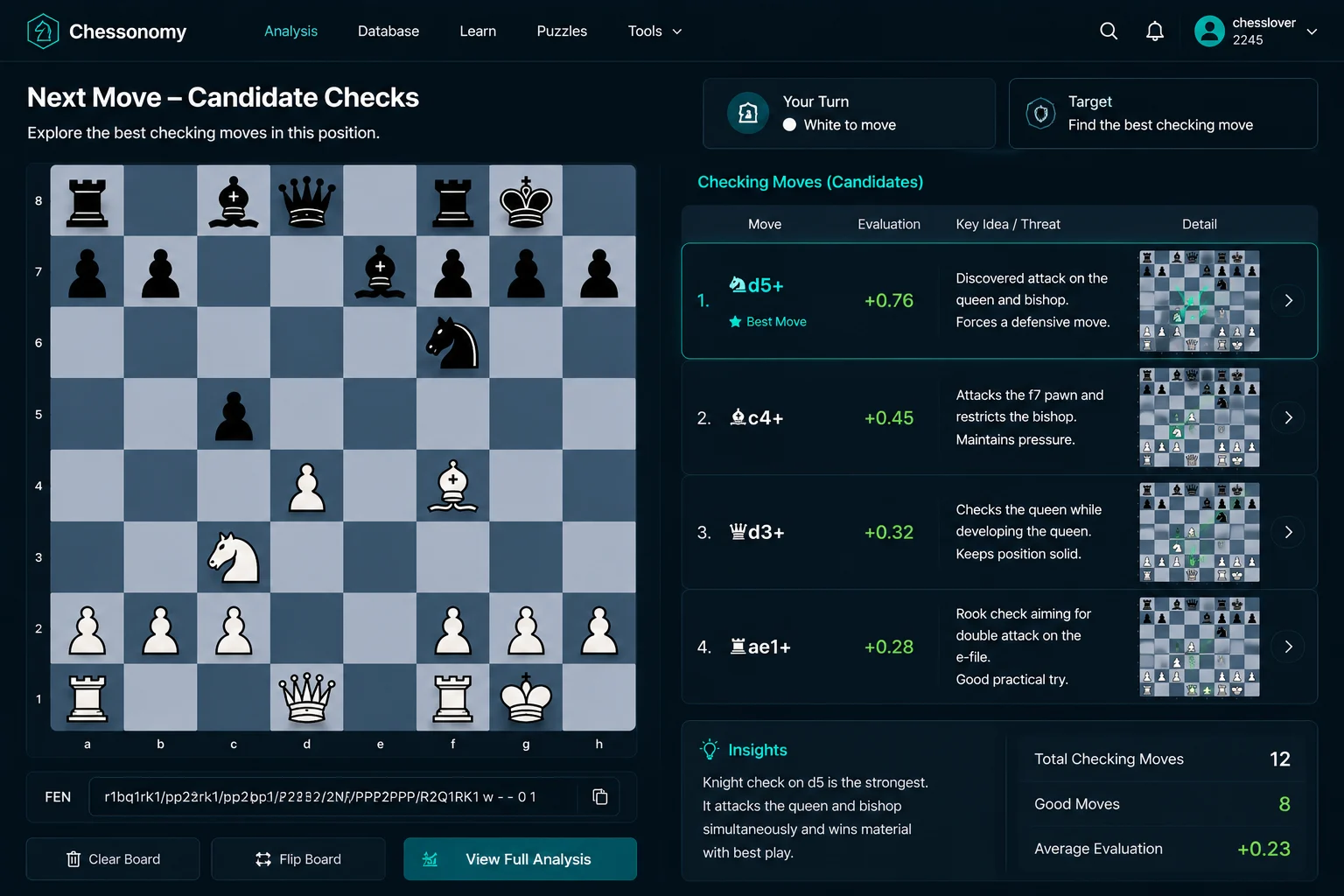
How to Use a Chess Move Calculator Without Becoming Dependent
A chess move calculator is useful when it helps you verify a decision. It becomes harmful when it replaces the decision. If you always ask the engine before forming an opinion, your calculation skill does not develop. The engine gives an answer, but your brain never practices the search. This is why the order matters: human shortlist first, engine check second.
Choose your candidate moves before opening the next-move tool, because its Stockfish suggestions appear automatically. Write down your first choice, second choice, and the reply you expect. Then load the FEN and compare. For an engine-free first pass on screen, use the analysis board and pause Stockfish. Agreement is useful when you understand the line; disagreement is useful when you can identify the defense you missed.
The wrong way is to treat the engine like a vending machine for moves. You paste the position, take the answer, and move on. That may help in one puzzle, but it does not build judgment. A better session ends with a sentence: the best move worked because it removed the defender, forced a queen trade, created an outside passer, stopped the c-file counterplay, or improved the worst piece. The sentence is the part you remember.
Reading the Engine Line Correctly
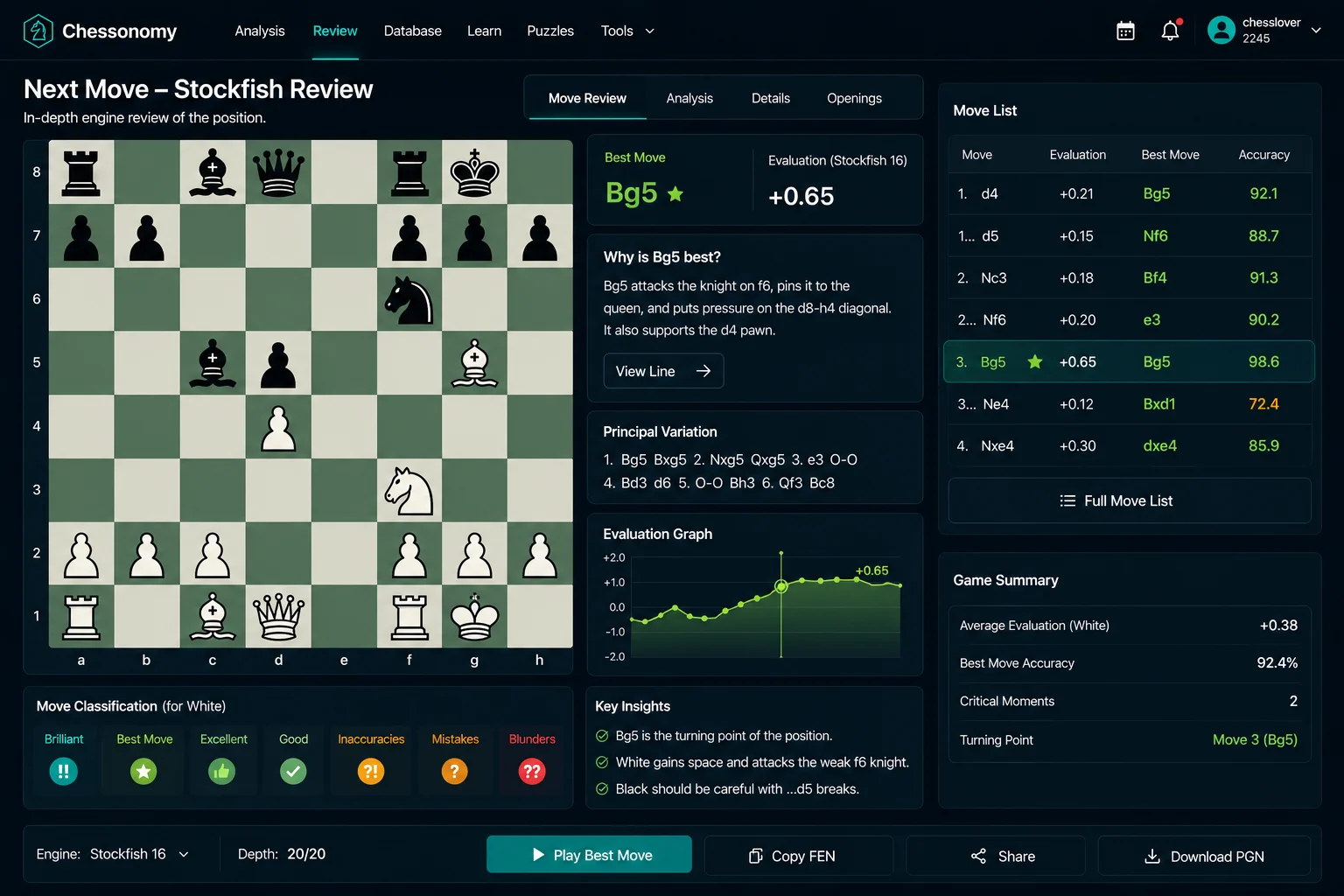
A next-move engine usually gives a best move, evaluation, depth, and principal variation. The best move is the engine's preferred first move. The evaluation estimates which side is better. Depth shows how far the engine searched. The principal variation is the engine's expected continuation. All four pieces matter. A move at shallow depth may change. A line with a big evaluation swing deserves more attention than a line where several moves are nearly equal.
Do not overreact to tiny evaluation differences. If three moves are all around +0.20, the practical best move may be the one you understand and can follow up. If one move is +2.50 and your move is equal, that is a real miss. If your move goes from equal to losing, stop and find the tactic. Engine analysis is most valuable when it identifies a real decision, not when it makes you anxious about small numerical changes.
The principal variation should be translated into human language. If the line is 1.Nxd5 Nxd5 2.Bxd5 Qxd5 3.Re1, the human explanation might be: trades remove Black's defender and leave White with pressure on the e-file. If the line is 1.h3 Be6 2.Bxe6 fxe6, the explanation might be: White trades a bishop to damage structure, but gives Black central control. The notation is not enough. The reason matters.
Next Move in Tactical Positions
In tactical positions, forcing moves dominate. Checks are especially important because they limit the opponent's choices. But not every check is good. A check that drives the king to safety may be worse than a quiet move that traps it. A sacrifice that looks dramatic may fail if the defender has one calm reply. Tactical move selection requires both imagination and skepticism.
Use a forcing tree. Start with the most forcing candidate. Ask what the opponent's legal replies are. Remove the replies that are illegal, losing immediately, or clearly worse. Focus on the strongest defense. If your tactic works against the strongest defense, it works. If it only works against the move you hope your opponent plays, it is not a tactic. It is a wish.
Tactical training makes next-move decisions faster because patterns become familiar. Forks, pins, skewers, back-rank mates, overloads, deflections, discovered attacks, and trapped pieces all show up in real games. When you miss a tactical next move, save the position and tag the motif. If the same motif repeats, train that motif directly.
Next Move in Quiet Positions
Quiet positions are harder for many players because there is no obvious forcing move. The next move may be a small improvement: centralizing a rook, improving a knight, preparing a pawn break, stepping out of a pin, or preventing the opponent's plan. These moves do not always feel urgent, but they decide many games. A quiet position rewards patience and clarity.
A useful quiet-position checklist is simple. Which piece is worst? Which pawn break do I want? Which pawn break does my opponent want? Which trade helps me? Which square can become an outpost? Is my king safe enough for active play? These questions produce candidate moves. The best next move in a quiet position is often the move that improves your worst problem while limiting your opponent's best plan.
Do not confuse quiet with passive. A move like Re1, h3, Kh1, or Nb1 can be excellent if it solves a concrete problem. It can also be useless if it only passes the turn. The difference is purpose. During analysis, force yourself to write the purpose of the quiet move in one sentence. If you cannot, keep looking.
Next Move in the Opening
Opening next-move decisions are often distorted by memory. You may know the first six moves of a line and still have no idea what to do when your opponent deviates. The correct response is not to panic. Ask opening questions: does the move affect the center, development, king safety, or a known pawn break? If the opponent plays something unusual but harmless, normal development may be the best answer.
If the position is sharp, use the same forcing-move process as any other phase. Opening traps work because one side ignores a threat while playing automatic moves. Before castling, check whether the center can open. Before grabbing a pawn, check development and king safety. Before copying a known setup, ask whether the opponent's move changed the structure. Good opening play is not only memory. It is memory plus position awareness.
When using a next-move tool for opening study, do not save every engine preference. Save ideas. For example: in this structure, Black's main break is c5. Or: White should not trade the active bishop before forcing a weakness. These notes are more useful than a long list of move numbers because they help when the opponent changes the move order.
Next Move in the Endgame
Endgame next moves are concrete in a different way. The king becomes a fighting piece, pawn races matter, and one tempo can decide the result. Before moving in an endgame, ask whether the position is about king activity, passed pawns, opposition, rook activity, or simplification. A move that looks natural in the middlegame may be too slow in the endgame.
The biggest endgame mistake is trading by habit. Players often exchange pieces because they are ahead material or because trades feel safe. But the resulting pawn ending may be drawn or lost. Before any major trade, visualize the position after the trade. Can your king enter? Are your pawns faster? Does the opponent have an outside passer? If you cannot answer, the next move should not be automatic.
Engines and tablebases are especially helpful in endgames, but they still need translation. If the best move is a waiting move, ask what opposition or zugzwang it creates. If the best move is a rook check from behind, ask how it improves activity. If the best move pushes a pawn, ask whether it creates a passer or fixes a weakness. Endgame understanding grows from these explanations.
Common Mistakes When Choosing the Next Chess Move
- Playing the first natural move without checking forcing moves.
- Ignoring the opponent's threat because your own plan looks attractive.
- Calculating only the reply you want the opponent to play.
- Using a chess move calculator before making your own candidate list.
- Overreacting to tiny engine evaluation differences.
- Choosing a quiet move without being able to explain its purpose.
- Trading into an endgame without evaluating the resulting pawn structure.
The fix is not to think forever. The fix is to think in the right order. Forcing moves first. Opponent threats second. Candidate moves third. Calculation fourth. Safety check last. This order catches most avoidable mistakes. It also creates a consistent mental routine, which matters when the clock is running and the position feels unclear.
A Practical 10-Minute Next-Move Training Routine
Use one position per session. Set the board, hide the engine, and spend two minutes listing candidate moves. Spend three minutes calculating the most forcing candidate. Spend two minutes calculating the best quiet candidate. Then turn on the engine and compare. Use the final three minutes to write the lesson. This routine is short enough to repeat and serious enough to build skill.
The written lesson should be specific. Not: I missed the best move. Better: I missed the best move because I did not check captures on a pinned defender. Not: engine liked a weird move. Better: the quiet king move worked because it stepped out of a future fork and kept the pawn ending winning. The specificity is what makes the training useful later.
If you do this with twenty positions, patterns will appear. You may always miss backward knight moves. You may ignore opponent pawn breaks. You may calculate attacks well but mishandle endgames. These patterns are more valuable than a single best move. They show what kind of next-move decisions cost you points.
How Time Control Changes the Next Move
The right move-finding process changes with the clock. In classical chess, you can build a full candidate list and calculate the critical branches. In rapid chess, you still need candidates, but you must be more selective. In blitz, the routine has to be compressed: check forcing moves, check the opponent's threat, and choose the move that solves the biggest problem. The goal is not to think the same way in every format. The goal is to preserve the most important questions when time is short.
In long games, spend time when the position changes character. A pawn break, sacrifice, queen trade, king exposure, or endgame transition deserves attention. Do not spend ten minutes on a routine recapture and then blitz through the critical move. In faster games, use principles to narrow the search. Improve the worst piece, keep the king safe, stop the opponent's forcing threat, and avoid unnecessary pawn weaknesses. Principles do not replace calculation, but they help when full calculation is impossible.
This matters when reviewing with a next-move tool. If you missed a move in blitz because it required a five-move forcing line, that is different from missing a one-move tactic. The first may be a time-control limitation. The second is a pattern problem. Good analysis separates these cases. You should train missed patterns aggressively, but you should also build practical rules for positions where time pressure makes perfect calculation unrealistic.
A useful rule is to trust calculation when the position is forcing and trust principles when the position is quiet, then verify both afterward. If checks, captures, and threats dominate the board, calculate. If no forcing move exists, improve your position with a clear purpose. After the game, use Stockfish to see whether your practical choice held up. Over time, you will learn which positions require deep calculation and which positions reward calm improvement.
How Chessonomy Helps You Find the Next Move
Chessonomy's next-move workflow is designed for focused decisions. You can paste a FEN, play with the board, and ask for engine guidance on the position in front of you. That is useful when a full game review is too broad and one position deserves attention. It is also useful for opening preparation, puzzle review, and checking critical moments from your own games.
For deeper review, the analysis board gives you more room to explore lines. For a full game, game review is the better entry point because it finds mistakes and critical positions across the whole PGN. For tactical reinforcement, puzzles turn repeated themes into practice. The best study loop connects all of these: find the critical position, choose candidate moves, check the next move, understand the reason, then train the pattern.
This is also the difference between a one-off answer and improvement. A next-move tool can tell you what to play now. A good workflow teaches you why you did not find it yourself. That second part is where progress happens. The goal is not to become dependent on the engine. The goal is to use the engine as a mirror for your decision process.
Final Takeaway
The best next chess move is not found by guessing, and it is not learned by blindly copying an engine. It is found through a repeatable process: inspect forcing moves, respect the opponent's threat, compare candidate moves, calculate the strongest replies, and verify with Stockfish. When the engine gives the answer, translate it into a reason. That reason is what improves your next game.
Start with one position today. Before using the tool, write down your top two candidate moves and the opponent's strongest reply. Then check the engine. If you were right, confirm the reason. If you were wrong, identify the category you missed. That simple routine turns a next-move search into real chess training.
A Ten-Minute Next-Move Training Drill
A short drill can make the candidate-move method usable under real time pressure. Choose a position from one of your recent games and set a ten-minute timer. Spend the first minute checking the opponent's threat and the position's tactical features. Do not calculate yet. Your only job is to understand what demands attention.
Use the next three minutes to write three candidates. Include every serious check and capture, then add the move that best improves your worst piece or stops the opponent's plan. Writing the candidates matters because it exposes whether your search is broad enough. If all three moves serve the same idea, you may be overlooking a tactical or defensive option.
Spend four minutes calculating the opponent's strongest reply to each candidate. Begin with the move that looks most forcing, but do not assume it is best. Follow each line until the position becomes quiet enough to compare. At that point, judge material, king safety, piece activity, pawn structure, and practical difficulty. A move is not useful merely because the first move looks attractive.
Use the final two minutes to choose a move and write one sentence explaining it. Then open the next-move calculator and compare your decision with Stockfish. If the engine agrees, verify that your explanation matches the engine line. If it disagrees, identify the first move or reply that your calculation missed. This keeps the feedback attached to a specific thinking error.
- Minute 1: identify threats, loose pieces, and tactical features.
- Minutes 2-4: write three genuinely different candidate moves.
- Minutes 5-8: calculate the opponent's best reply to each candidate.
- Minutes 9-10: choose, explain, and verify with the engine.
What to Record After the Engine Check
Keep the note short enough to use again. Record the FEN, your chosen move, the engine move, the critical reply, and one reason for the difference. Good reasons sound like chess: I ignored a forcing check, I undervalued a pawn break, I missed that my defender was overloaded, or I traded the piece that controlled the key square. Avoid notes such as calculate better because they do not tell you what to change.
Review the note a few days later without the engine. If you can reconstruct the idea and find the move again, the position has become training. If you cannot, replay the line and simplify the lesson. The practical conclusion is not that Stockfish sees more. It is that your next search should include the category of move you missed.
Chessonomy is an independent chess training workspace focused on practical game review, Stockfish analysis, puzzle training, and player-friendly explanations of engine feedback.
Questions Players Ask
How do I find the next chess move?
Start with checks, captures, and threats. Then identify your opponent's threat, list two or three candidate moves, calculate the strongest replies, and use an engine such as Stockfish to verify the final choice.
What is a next chess move calculator?
A next chess move calculator is a tool that analyzes a position, usually from a FEN, and suggests the strongest move with engine evaluation and a principal variation.
Should I always play the engine's best move?
In analysis, the engine's best move is the objective reference. In your own improvement work, you should also understand why it works. If several moves are close, the practical move you understand may be more useful than a tiny engine preference.
Why did Stockfish choose a move I never considered?
Usually because you missed a category: a forcing move, hidden tactic, defensive resource, pawn break, or quiet improvement. Compare the engine move with your candidate list to identify the blind spot.
Can beginners use a next-move tool?
Yes. Beginners should use it after making their own guess. The goal is to compare human thinking with engine feedback, then learn one clear reason behind the best move.