
brand logoChessonomy
Chessonomy
Study Lab
Tools

Chess Elo calculator

Estimate rating changes for wins, draws, and losses with expected score and K-factor.

If you WIN

New rating: 1510

+10

If you DRAW

New rating: 1500

0

If you LOSE

New rating: 1490

-10
Rating guide

Chess Elo calculator for rating changes, expected score, and K-factor

Use a chess Elo calculator to estimate how many rating points you gain or lose after a win, draw, or loss based on rating difference and K-factor.

Reviewed May 19, 2026
Quick answer

Chessonomy's chess Elo calculator estimates rating change by comparing your expected score against the actual result, then applying the selected K-factor.

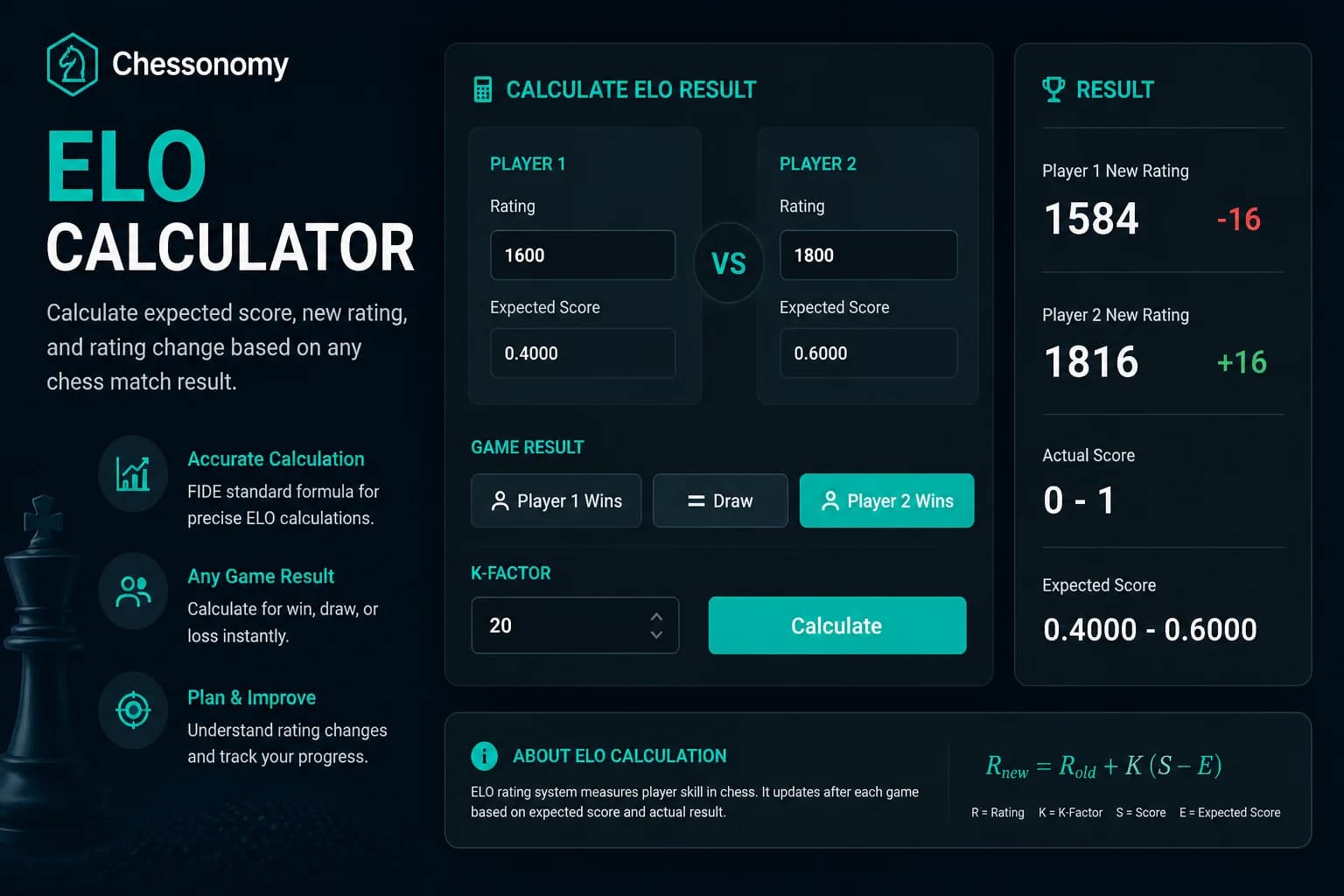
Chess Elo calculator showing player rating, opponent rating, result, K-factor, and estimated rating change

How a chess Elo calculator works

The Elo system is based on expectation. If two players have the same rating, each is expected to score about 0.5. If one player is much higher rated, that player is expected to score more. Your rating change depends on whether your result beats or falls short of that expectation.

The common formula is: new rating equals old rating plus K multiplied by actual score minus expected score. A win counts as 1, a draw counts as 0.5, and a loss counts as 0.

  • Actual score is 1 for a win, 0.5 for a draw, and 0 for a loss.
  • Expected score comes from the rating difference.
  • K-factor controls how quickly the rating changes.

Why beating a stronger player gives more points

If you beat a stronger opponent, your actual score is much higher than your expected score. The rating system rewards that difference. If you beat someone rated far below you, the system expected you to win, so the gain is smaller.

The same logic explains painful rating losses. Losing to a lower-rated player costs more because the expected score was high. Drawing a much lower-rated opponent can also lose points because the draw underperforms expectation.

What K-factor means

The K-factor controls volatility. A higher K-factor means the rating moves faster after each game. Newer players often use a higher K because the system is still learning their strength. Established players usually use a lower K so one result does not swing the rating too far.

Different platforms use different rating systems and adjustments. Chess.com and Lichess ratings are not pure FIDE Elo, so this calculator should be treated as a clear estimate of Elo logic rather than a guarantee of the exact platform change.

  • Use a higher K-factor for faster-moving provisional ratings.
  • Use a lower K-factor for more stable established ratings.
  • Treat online platform ratings as separate pools, not interchangeable numbers.

Use rating change as feedback, not identity

A rating number is useful because it gives feedback over time. It is not a complete description of your chess. One result can be noisy; a pattern across many games is meaningful. If your rating drops after the same type of loss, the training target is probably visible.

Use the Elo calculator to understand the math, then connect it back to study: review the game, find the turning point, and train the pattern that cost the points.

Common questions

How is Elo rating change calculated?

Elo rating change is K multiplied by actual score minus expected score. Expected score is based on the rating difference between the two players.

What K-factor should I use?

Use a higher K-factor for new or volatile ratings and a lower K-factor for established ratings. Many examples use 40, 20, or 10 depending on rating rules.

Can I lose Elo from a draw?

Yes. If you draw against a much lower-rated opponent, your actual score can be below your expected score, so the rating change can be negative.

Are Chess.com and Lichess ratings the same as Elo?

No. They use related rating systems with their own pools and adjustments, so numbers are not directly interchangeable with FIDE Elo.