
How to Get Better at Chess Puzzles
Build a chess puzzle routine that improves calculation, pattern recognition, accuracy, and review habits without rushing through tactics.
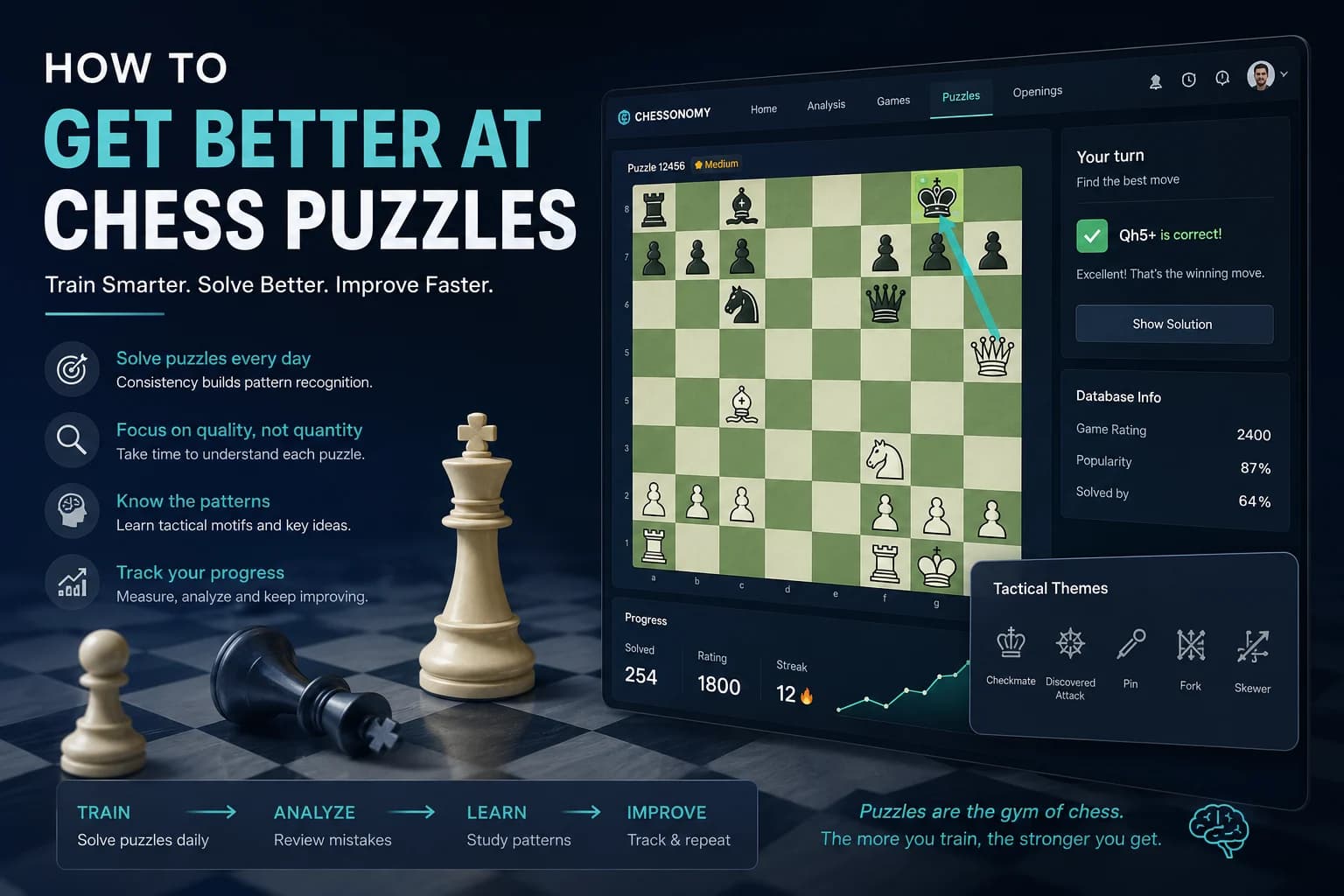
Puzzle improvement comes from accuracy, review, and pattern memory. A smaller set of well-reviewed puzzles beats hundreds of rushed guesses.
- Find all checks, captures, and threats.
- Choose the opponent's strongest reply, not the reply you want.
- Calculate until the position is clearly winning, drawn, or simplified.
- Name the tactic before you submit the move.
- We prioritize accuracy and review quality over puzzle volume because rushed solving creates weak pattern memory.
- We separate daily training from longer classic sessions so players can build consistency without fatigue.
- We recommend linking missed puzzles back to game review so tactics training stays connected to real mistakes.
Many players do chess puzzles every day and still feel stuck. The problem is usually not talent. It is the training method. If you guess the first forcing move, celebrate when it works, and skip review when it fails, your puzzle rating can move without your calculation improving much.
A better routine treats each puzzle as a calculation exercise. You are not trying to move quickly. You are trying to see the opponent's best defense, finish the tactic, and remember the pattern when a similar position appears in your own game.
Solve the Whole Line Before Moving
The most useful puzzle habit is also the simplest: do not move until you can explain the full sequence. In many tactics, the first move is obvious but the second or third move is the real test. If you only find the first move, you are training hope more than calculation.
- Find all checks, captures, and threats.
- Choose the opponent's strongest reply, not the reply you want.
- Calculate until the position is clearly winning, drawn, or simplified.
- Name the tactic before you submit the move.
- After the puzzle, replay the line once without arrows or hints.
Daily Mode vs Classic Mode
Daily puzzles are best for consistency. They keep tactics in your routine even on busy days. Classic puzzle sessions are better when you have more time and want to build endurance. The key is not choosing one forever. Use both for different jobs.
| Mode | Best for | How to use it |
|---|---|---|
| Daily | Habit building and steady contact with tactics. | Solve carefully, review the motif, then stop if time is short. |
| Classic | Longer calculation sessions and rating improvement. | Work in sets of 5 to 10 puzzles with review after each miss. |
| Game review | Connecting puzzles to your real mistakes. | Save missed tactical positions from your own games. |
Review Misses More Than Wins
A missed puzzle is useful only if you identify why you missed it. Did you stop calculating too early? Ignore a quiet move? Miss a defensive resource? Forget about back-rank weakness? The answer tells you what to train next.
- If you missed a forcing move, practice checks and captures first.
- If you missed the opponent's defense, slow down before submitting.
- If you chose the right idea but wrong order, replay the move sequence.
- If you failed an endgame tactic, review the pawn race or king activity.
- If the motif repeats often, write it down as a personal weakness.
A Practical 20-Minute Puzzle Routine
You do not need a complicated plan. A focused 20-minute routine can be enough if you protect the quality of the work. Spend two minutes warming up with one easy puzzle, ten minutes solving carefully, five minutes reviewing misses, and three minutes replaying the hardest line from memory.
| Time | Task | Goal |
|---|---|---|
| 2 minutes | Warm up with one simple tactic. | Activate pattern recognition. |
| 10 minutes | Solve 3 to 6 puzzles slowly. | Calculate instead of guessing. |
| 5 minutes | Review every miss and hesitation. | Find the repeated weakness. |
| 3 minutes | Replay one line from memory. | Make the pattern stick. |
How Puzzle Training Transfers to Real Games
Puzzles help most when you connect them to your own games. After each game review, look for tactical moments: missed forks, pins, overloaded defenders, back-rank ideas, mating nets, and promotion races. Those are the motifs that deserve extra puzzle work because they already appear in your play.
Why More Puzzles Do Not Always Mean More Improvement
It is easy to measure puzzle work by volume. Ten puzzles feels productive. Fifty puzzles feels even better. But puzzle volume can hide weak training. If you guess quickly, skip defensive replies, and move on after every miss, you are not building reliable calculation. You are building a habit of hoping the first attractive move works.
The best puzzle training is slower and more deliberate. You solve fewer positions, but you extract more from each one. You identify the motif, calculate the full line, review the miss, and connect the pattern to your own games. This is why a small number of deeply reviewed puzzles can help more than a large number of rushed attempts.
Puzzle rating can be useful, but it should not be the only goal. A rating number can rise because you are faster at familiar patterns. It can also fall because you are finally working on harder positions. The better question is whether you are recognizing tactics in real games. If puzzle work does not transfer to your games, the routine needs adjustment.
Build Pattern Recognition First
Pattern recognition is the foundation of tactics. Forks, pins, skewers, discovered attacks, overloaded pieces, back-rank mates, deflections, decoys, and clearance sacrifices appear again and again. When you recognize a pattern quickly, calculation becomes easier because you know what kind of move to search for. Without pattern recognition, every puzzle feels like a completely new mystery.
Beginners and improving club players should not be ashamed of solving easier puzzles. Easy puzzles build speed of recognition. The problem is not easy puzzles. The problem is solving them mindlessly. Even in an easy tactic, name the motif. Say pin, fork, back rank, deflection, or trapped piece. Naming the motif strengthens memory.
Then Build Calculation Depth
Once you recognize basic patterns, calculation depth becomes the next target. This means seeing not only your first move, but the opponent's best reply and your continuation. Many players fail puzzles after finding the correct first idea because they stop too early. The first move opens the door. The rest of the line wins the game.
A simple rule helps: do not move until you know what you will do after the most forcing reply. If your move is a sacrifice, ask what happens if the opponent accepts. If your move is a check, ask where the king can go. If your move attacks the queen, ask whether the opponent has a stronger counterattack. Calculation means giving the defender agency.
Choose the Right Puzzle Difficulty
The best difficulty is challenging but not random. If you solve almost every puzzle instantly, the set may be too easy for calculation training. If you fail almost every puzzle without understanding the answer, the set may be too hard. A productive range creates effort, mistakes, and reviewable lessons. You should feel stretched, not lost.
| Success rate | What it means | How to adjust |
|---|---|---|
| 90% or higher | Likely too easy for deep calculation. | Use as warm-up or increase difficulty. |
| 65% to 85% | Good training range for most sessions. | Keep solving and review misses carefully. |
| 40% to 60% | Hard but useful if review is strong. | Reduce volume and spend more time per puzzle. |
| Below 40% | Probably too difficult right now. | Return to simpler motifs and rebuild confidence. |
Reviewing a Miss the Right Way
A missed puzzle is not a failure if you review it correctly. First, identify whether the first move, the move order, or the final conversion was wrong. Second, find the opponent resource you missed. Third, name the motif. Fourth, replay the solution without looking. Fifth, solve one similar puzzle later. This process turns a miss into memory.
Do not write vague notes such as I blundered or I did not see it. Write specific notes. Missed knight fork. Ignored back-rank weakness. Forgot defender could interpose. Played capture before check. Stopped calculating after move one. Specific notes reveal patterns across sessions.
Use Themes Without Becoming Dependent on Them
Themed puzzle sets are useful when learning a motif. If you are studying pins, solving many pin puzzles helps your eyes notice pinned pieces. But themed sets can also become too easy because you already know what to look for. Mixed puzzles are closer to real games, where nobody tells you the theme. Use both.
A strong weekly routine might include one themed session and two mixed sessions. The themed session builds pattern recognition. The mixed sessions test whether the pattern appears naturally among other possibilities. If you can solve a motif only when the category name is shown, it is not yet fully learned.
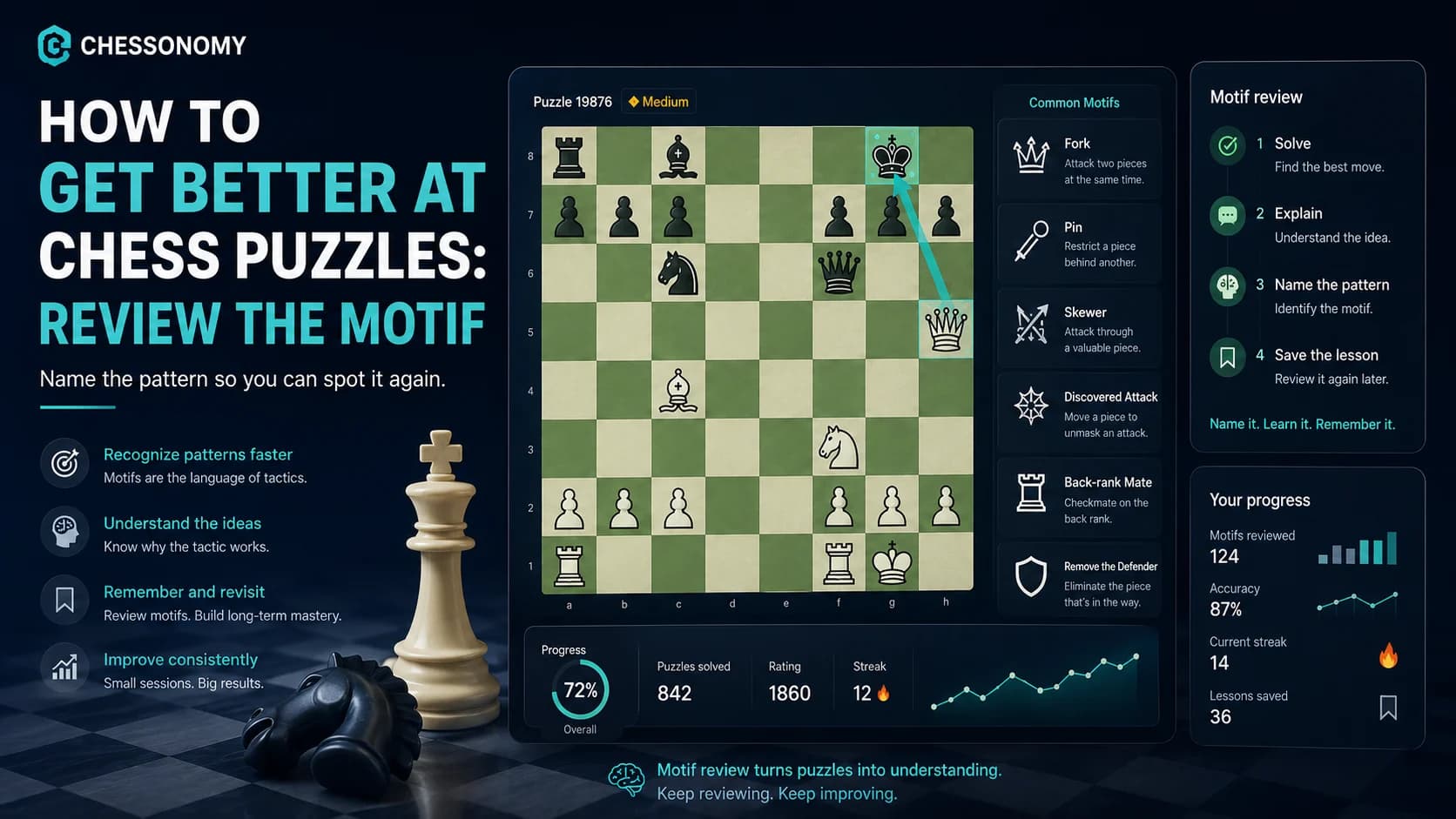
Connect Puzzle Training to Your Own Games
The fastest way to make puzzle training practical is to connect it to your own mistakes. After each game review, identify the tactics you missed or allowed. If you missed a back-rank tactic, train back-rank puzzles. If you allowed a knight fork, train fork patterns. If you missed a defensive resource, train calculation puzzles where the opponent has counterplay.
This creates a feedback loop. Games reveal your weaknesses. Puzzles train those weaknesses. Future games show whether the training worked. Without this loop, puzzle training can become separate from your actual chess. You may get better at puzzle websites while repeating the same mistakes in games.
Timed vs Untimed Puzzle Training
Timed puzzles are useful for pattern speed, but untimed puzzles are better for building calculation discipline. If you are working on accuracy, remove the clock. If you are preparing for fast time controls, add timed sets after the motifs are familiar. Speed should be built on top of accuracy, not used as a replacement for it.
A good compromise is to solve untimed first, then replay the same puzzle quickly after review. The first pass builds understanding. The replay builds recognition. Over time, the pattern becomes faster without sacrificing accuracy.
A Four-Week Puzzle Improvement Plan
A four-week plan should be simple enough to follow. In week one, focus on accuracy and motif naming. In week two, add deeper calculation and force yourself to see the full line before moving. In week three, connect missed motifs to your game review. In week four, mix difficulty levels and measure which mistakes still repeat.
| Week | Focus | Main habit |
|---|---|---|
| 1 | Pattern recognition. | Name every tactic after solving. |
| 2 | Calculation depth. | See the opponent's best reply before moving. |
| 3 | Game connection. | Train motifs from your own missed tactics. |
| 4 | Mixed review. | Track repeated mistake types and adjust difficulty. |
How to Know Your Puzzle Training Is Working
Puzzle training is working when you notice tactical warnings earlier in real games. You may see a fork threat before it happens. You may create luft before a back-rank tactic. You may calculate one move deeper before sacrificing. You may stop hanging pieces to simple tactics. These are more important signs than a temporary puzzle rating jump.
You should also feel that your review language is becoming more precise. Instead of saying I missed it, you can say I missed the defender was overloaded or I forgot the zwischenzug. Clear language reflects clearer thinking. Clear thinking transfers better to games.
Final Takeaway
Getting better at chess puzzles is not about rushing through endless tactics. It is about training recognition, calculation, and review. Solve carefully. Give the defender their best reply. Name the motif. Review mistakes. Connect the work to your own games. That is how puzzle training becomes chess improvement instead of a separate mini-game.
If you keep the routine focused, puzzle work becomes one of the most efficient forms of chess training. Every position asks you to make a decision, calculate consequences, and learn from feedback. That is exactly what real games demand.
The Difference Between Solving and Training
Solving a puzzle means finding the answer. Training means changing how you think. These are related, but they are not the same. A player can solve many puzzles by intuition and still fail to improve if they never review the process. Another player can solve fewer puzzles but improve faster because every miss becomes a specific lesson.
Training asks process questions. Did you look for checks first? Did you consider the opponent's best reply? Did you calculate until the position was clearly resolved? Did you understand why the tempting move failed? Did you name the theme afterward? These questions create habits that transfer to games.
How Beginners Should Use Chess Puzzles
Beginners should start with simple tactics and common mates. The goal is not to solve the hardest positions possible. The goal is to build a library of patterns. Forks, pins, skewers, back-rank mates, discovered attacks, and hanging pieces decide many beginner games. If those patterns become automatic, the player will stop missing free chances and stop allowing simple tactics.
A beginner session should be short and consistent. Ten minutes of careful puzzle work is better than one long session that ends in frustration. After each puzzle, the beginner should name the tactic. If the tactic has no clear name, they should at least say what changed: won queen, checkmated king, trapped rook, promoted pawn, or removed defender.
How Intermediate Players Should Use Chess Puzzles
Intermediate players usually know the basic motifs but fail in calculation, move order, and defensive awareness. Their puzzle training should focus on seeing the whole line. The first move is not enough. They need to ask what happens if the defender chooses the most stubborn reply. This is where many rating gains are available.
Intermediate players should also track mistake types. If most misses come from quiet moves, they should train positions where the first move is not check. If most misses come from move order, they should replay lines and compare similar candidate sequences. If most misses come from defensive resources, they should spend more time calculating the opponent's replies before moving.
How Advanced Players Should Use Chess Puzzles
Advanced players need puzzle work that resembles real decision-making. Mixed themes, defensive resources, calculation under uncertainty, and conversion tactics are more useful than obvious one-move shots. They should also analyze why a tactic arose. Was it caused by a weak square, a bad trade, a misplaced piece, or a time-pressure decision? The deeper lesson may come before the tactic.
For advanced players, puzzle training can also include defensive puzzles. Finding the only move to survive is just as valuable as finding a winning tactic. Real games often require saving worse positions, escaping mating nets, and choosing the most resilient defense. Defensive puzzle work builds practical toughness.
How to Handle Puzzle Plateaus
A puzzle plateau is normal. It usually means your current habits are no longer enough for the next difficulty level. Do not respond by only solving more. Change the training variable. Slow down. Review misses more deeply. Lower the difficulty for pattern refresh. Train one motif for a week. Add calculation notes. Plateaus require better feedback, not only more effort.
Another useful plateau strategy is delayed review. When you miss a puzzle, review it immediately, then solve it again the next day without looking at the answer. If you miss it again, the pattern is not learned. If you solve it quickly, the review worked. This method builds memory better than one-time exposure.
The Role of Visualization
Visualization is the ability to see the board after moves are played in your head. Puzzle training is one of the best ways to build it. Before moving, imagine the position after your candidate move and the opponent's reply. Where are the pieces? Which lines opened? Which square became weak? This skill matters because real games do not allow you to move pieces experimentally.
If visualization is hard, start with short lines. Calculate one move for each side, then check. Gradually extend to two moves, then three. Do not force blindfold-level calculation immediately. Accurate short visualization is better than blurry long calculation.
How to Make Puzzles Feel Less Random
Puzzles feel random when you do not know what features trigger tactics. Start looking for signals: exposed king, loose piece, lined-up queen and king, pinned defender, overloaded piece, back-rank weakness, advanced passed pawn, or trapped piece. These signals tell you when tactics may exist. In real games, the signal often appears before the tactic.
After every puzzle, identify the signal. For example, the tactic worked because the defender was pinned, because the back rank had no escape square, or because the queen and king were on the same diagonal. Over time, you will notice these signals before calculating. That is when puzzle training begins to influence your games.
A Sustainable Long-Term Routine
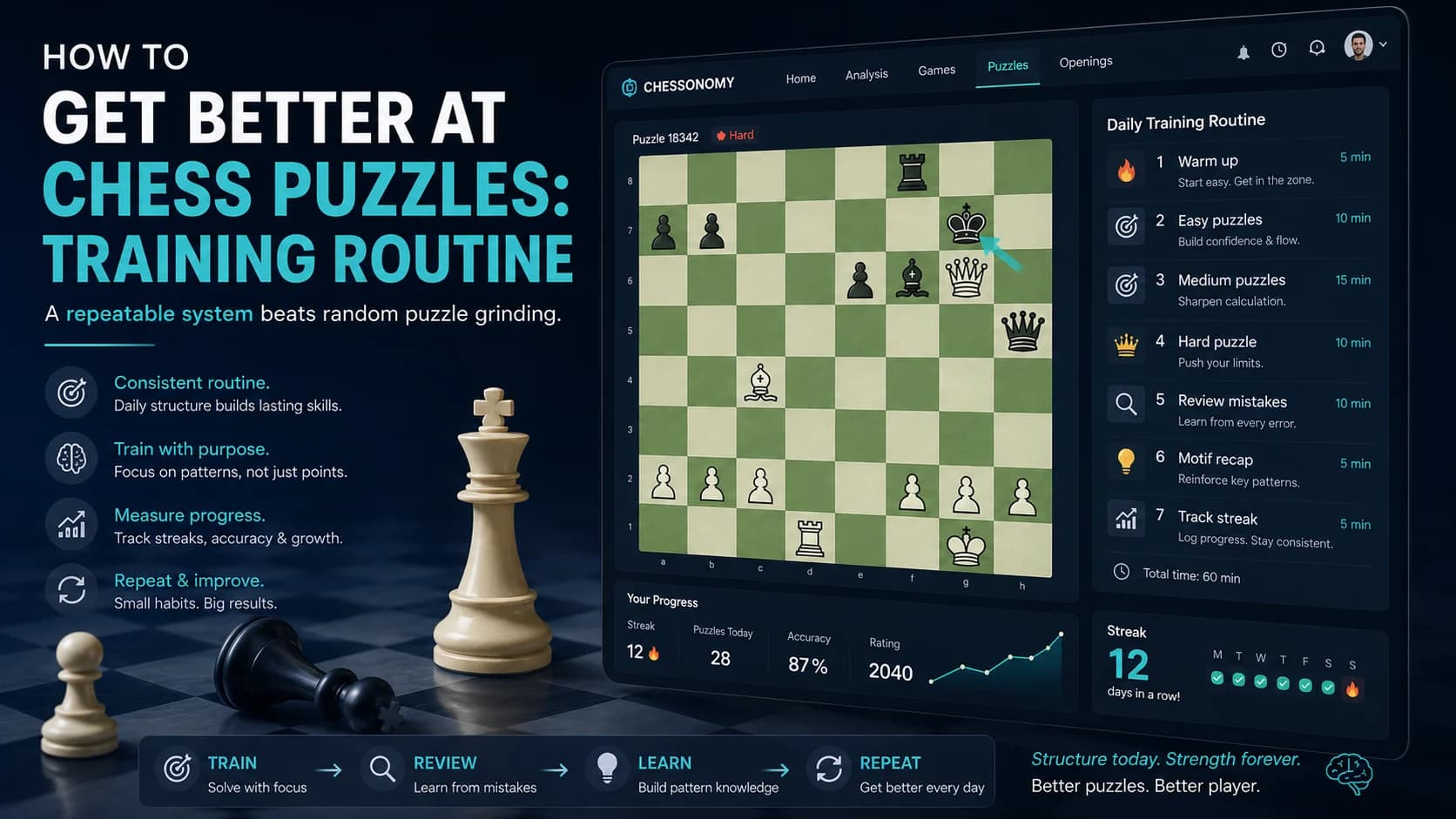
The best routine is one you can keep. Daily training does not need to be dramatic. Five careful puzzles, one reviewed miss, and one note about a repeated theme can be enough. On days with more time, add a longer calculation set. On days with less energy, solve easier puzzles for pattern maintenance. Consistency beats intensity that disappears after a week.
Every month, review your notes. Which motifs appear most often? Which errors repeat? Which puzzle types improved? This monthly review helps you choose the next training focus. Without it, puzzle work becomes a stream of disconnected positions. With it, the work becomes a plan.
How to Review a Puzzle You Solved Correctly
Correct puzzles deserve review too. If you solved by calculation, confirm the line and name the motif. If you solved by intuition, ask whether you actually saw the defender's best reply. Many players get correct answers for incomplete reasons. That is fine during a game, but training should expose the gap. A correct guess is not as valuable as a correct calculation.
After a correct puzzle, ask why the other candidate moves failed. This deepens the lesson. If a different check almost worked, what defensive move saved the opponent? If a capture was tempting, why was the move order wrong? These comparisons make future calculation sharper because you learn not only what works, but why nearby ideas fail.
How to Build a Personal Tactics Library
A personal tactics library is a small collection of positions that represent your repeated mistakes. It does not need to be large. Twenty well-chosen positions can be more useful than thousands of anonymous puzzles. Save positions where you missed a tactic in your own game, failed a puzzle twice, or misunderstood the defensive resource. Revisit them weekly until the pattern feels obvious.
Organize the library by theme. Back rank, knight fork, deflection, discovered attack, mating net, trapped piece, promotion tactic, defensive resource. When a theme appears often, train it deliberately. This turns puzzle work from random practice into personalized improvement.
How to Stay Honest During Puzzle Training
Puzzle training is easy to game. You can move quickly, use hints too soon, or make a move because it feels puzzle-like. Honest training means holding yourself to the standard you want in real games. Do not submit until you would play the move over the board. Do not use a hint until you have named the candidate moves. Do not count a solved puzzle as fully learned if you cannot explain the line.
This honesty is what makes puzzle training powerful. The board gives immediate feedback, but you decide whether the feedback becomes learning. If you treat every puzzle as a chance to improve your thinking process, even short sessions become valuable.
What to Do When You Are Tired
Tired puzzle training can create bad habits. If you are exhausted, lower the difficulty or shorten the session. Use easy puzzles for pattern maintenance, or review previous misses instead of forcing new hard positions. There is no benefit in teaching yourself to guess because your concentration is gone.
A sustainable routine respects energy. Hard calculation belongs on days when you can focus. Light pattern review belongs on busy days. This balance keeps training consistent without turning puzzles into frustration.
How to Track Puzzle Improvement Over Time
Tracking improvement should include more than rating. Keep an eye on accuracy, average time, repeated motifs missed, and whether mistakes from your own games are decreasing. A player can have a higher puzzle rating but still miss the same defensive resource in real games. The best tracking connects puzzle performance to actual chess decisions.
A simple monthly review is enough. Look at the motifs you missed most often, the difficulty range where accuracy dropped, and the puzzle types that felt uncomfortable. Then choose one theme for the next month. This turns training into a cycle: measure, focus, practice, review. That is more productive than solving whatever appears and hoping the rating rises.
You should also track transfer to real games. If your puzzle notes say you trained back-rank mates for a month, check whether you still allow back-rank tactics in your games. If your puzzle work focused on knight forks, check whether you now notice loose king-and-queen alignments earlier. Real-game transfer is the reason tactics training matters. Puzzle statistics are useful, but better decisions over the board are the actual goal.
When the transfer is weak, change the routine. Add game review before puzzle training. Save positions from your own games. Solve slower. Explain the motif in words. Replay failed puzzles from memory. The answer is rarely to abandon puzzles. The answer is to make the puzzle work more connected to the mistakes you actually make.
How to Review Puzzle Sessions Like a Coach
At the end of a puzzle session, review the session instead of only reviewing individual positions. Ask what kind of mistakes appeared across the set. Did you miss first moves, follow-up moves, defensive resources, or final conversions? Did you fail because the motif was unfamiliar, or because you moved before calculating? A session-level review shows patterns that one puzzle cannot reveal.
This coach-like review is where long-term improvement becomes visible. If three misses came from the same motif, the next training block is obvious. If all misses happened after five or six minutes of work, fatigue may be the issue. If you solved easy puzzles quickly but missed every quiet move, the routine needs more non-checking tactics. The goal is to use the session as feedback, not just a score.
How to Choose the Next Puzzle After a Miss
The next puzzle after a miss should not always be harder. Often it should be similar. If you missed a deflection, solve another deflection. If you missed a back-rank idea, solve a back-rank puzzle with a slightly different move order. Similar repetition helps the brain separate the core pattern from the exact position.
After two or three similar puzzles, return to mixed training. This prevents dependency on theme labels while still reinforcing the weakness. The balance between focused repetition and mixed testing is what makes puzzle improvement durable.
How to Use Puzzle Streaks Without Letting Them Control You
Puzzle streaks can motivate consistency, but they can also distort training. If you care only about keeping the streak alive, you may choose puzzles that are too easy or avoid reviewing mistakes honestly. Use streaks as a reminder to show up, not as the main measure of improvement. The real measure is whether your calculation becomes clearer in games.
When a streak breaks, do not treat it as failure. Treat it as data. Why did the puzzle fail? Was it a new motif, a familiar motif missed under pressure, or a calculation mistake? A broken streak with a clear lesson is more valuable than a long streak of easy puzzles that never challenge your thinking.
How to Mix Puzzles With Game Review
The strongest routine combines puzzle training with game review. After reviewing a game, choose one missed theme and train it for the next few sessions. If you missed a deflection, solve deflection puzzles. If you allowed a back-rank mate, solve back-rank patterns. If you failed to see a defensive resource, solve harder mixed puzzles where the opponent has active replies.
This makes puzzle training personal. Instead of solving random positions forever, you are answering questions raised by your own games. The connection is important because improvement happens when training changes future decisions. A puzzle theme that never appears in your games is less urgent than one you keep missing.
How to Avoid Burnout
Tactics burnout happens when every session feels like a test. To avoid it, vary the intensity. Use easy pattern puzzles for warm-up, serious mixed puzzles for calculation, and review sessions for learning. Do not make every day a maximum-difficulty day. Chess improvement needs recovery and repetition, not constant pressure.
A healthy puzzle habit should feel sustainable. You should be able to keep it during busy weeks. If your routine requires an hour of hard calculation every day, it may collapse quickly. A smaller routine that survives real life is stronger than an ambitious plan that lasts only a few days.
What a Good Puzzle Interface Should Support
A good puzzle interface should help the player think. The board should be readable, move feedback should be clear, and review should be easy after a miss. The interface should not rush the player into the next puzzle before the lesson is understood. Strong puzzle UX supports solving, reviewing, and remembering.
This matters for SEO content too. An article about puzzles should not only say solve more tactics. It should explain how to train, how to review, how to choose difficulty, and how to connect puzzles to real games. That is what makes the page useful to a searcher who wants genuine improvement.
Chessonomy is an independent chess training workspace focused on practical game review, Stockfish analysis, puzzle training, and player-friendly explanations of engine feedback.
Questions Players Ask
How many chess puzzles should I do per day?
For most players, 5 to 10 carefully reviewed puzzles are more useful than 50 rushed puzzles. Accuracy and review quality matter more than volume.
Why am I not improving at chess puzzles?
Common reasons include guessing too quickly, failing to calculate the opponent's best reply, skipping review, and doing puzzles that are too easy or too hard for your current level.
Are daily chess puzzles enough to improve?
Daily puzzles help build consistency, but deeper improvement usually needs review, pattern tracking, and occasional longer sessions where you calculate full lines.