
Free Chess Training Tools on Chessonomy
See how Chessonomy connects free game review, analysis, puzzles, next-move calculation, and Elo tools into one chess study workflow.
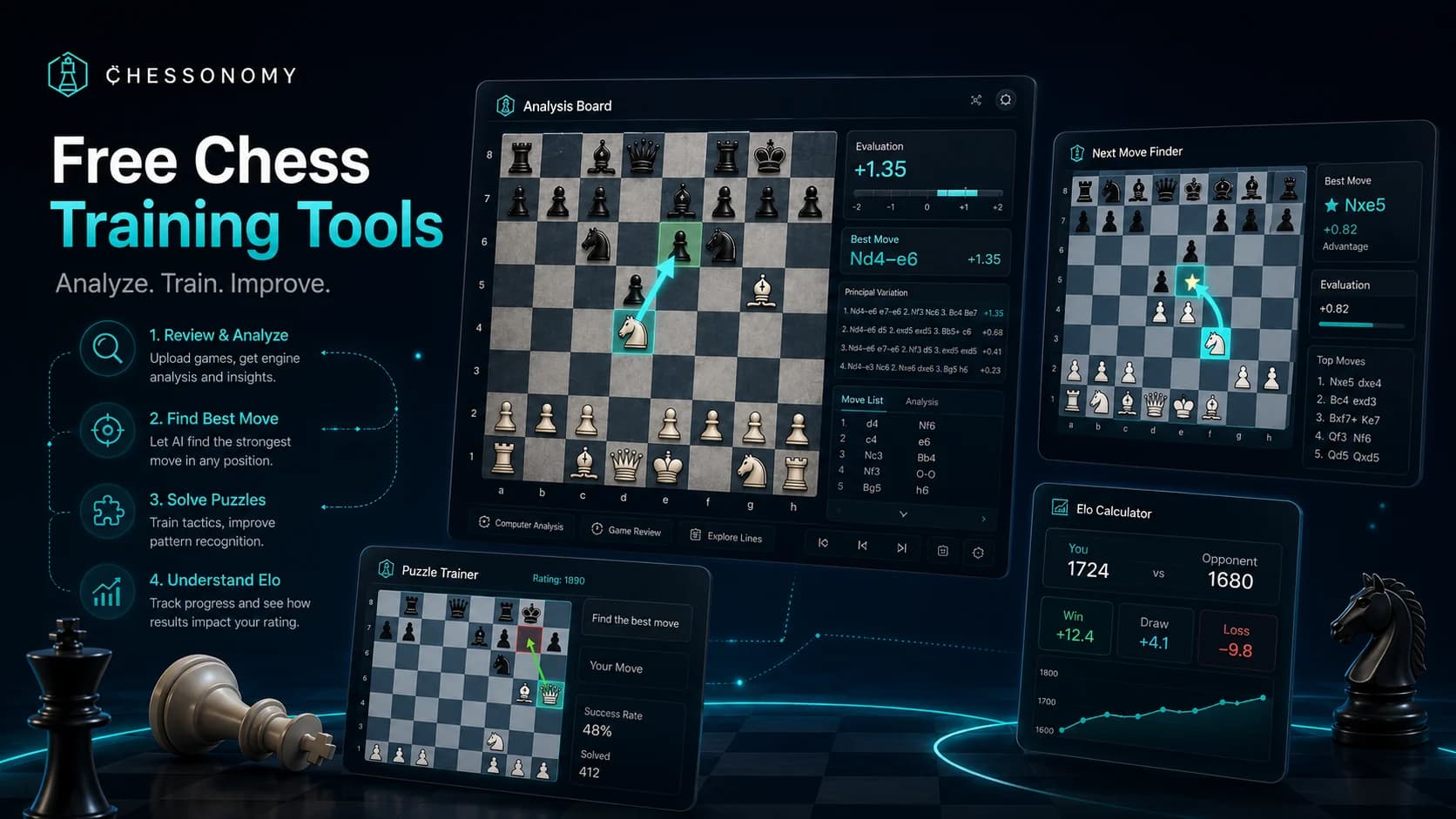
Chessonomy is built around a simple training loop: review a game, understand the critical position, then turn the lesson into practice.
- Use game review to find the important moments.
- Use the analysis board to understand the position.
- Use the next-move tool when you only need a focused FEN answer.
- Use puzzles to train the pattern you missed.
- We describe only tools that exist in the current Chessonomy workflow.
- We explain what each tool is useful for instead of presenting a generic feature list.
- We connect product pages with learning intent so users and search engines understand the site structure.
Most chess improvement tools solve one isolated problem. A board analyzes positions. A puzzle trainer gives tactics. A rating tool estimates Elo changes. Chessonomy is built to keep those jobs close together so a player can move from review to practice without rebuilding the same position in five different places.
The goal is not to make the interface louder. It is to make the training loop clearer. When you finish a game, the question should be simple: where did the game change, what should I have played, and how do I train that pattern before the next game?
The Core Workflow
| Tool | Use it when | Training output |
|---|---|---|
| Game review | You have a PGN, Chess.com game, Lichess game, or full move list. | Critical mistakes, turning points, and review labels. |
| Analysis board | You want to study one position with full control. | Candidate moves, legal replies, and engine-supported explanations. |
| Next move finder | You have a FEN and need the strongest move quickly. | Best move, principal variation, and position direction. |
| Puzzle trainer | You want to convert patterns into repetition. | Tactical accuracy, streaks, and puzzle rating. |
| Elo calculator | You want to understand expected rating changes. | Expected score and rating-change context. |
Why Keep Free Chess Tools Public?
Public tools matter because players often arrive with one urgent question. They want to check a move, review a game, solve a puzzle, or understand a rating result. Hiding every useful tool behind an account wall creates friction before the player sees value.
A better model keeps the learning entry points open and reserves accounts for saved progress, history, preferences, and deeper workflows. That approach is better for users and cleaner for SEO because search engines can understand the real purpose of each page.
How a Player Should Use Chessonomy
Start with a game review after a serious game. Do not inspect every move with equal attention. Find the two or three moments where the evaluation changed, where a tactic appeared, or where your plan stopped making sense. Then open the position in the analysis board and compare candidate moves.
- Use game review to find the important moments.
- Use the analysis board to understand the position.
- Use the next-move tool when you only need a focused FEN answer.
- Use puzzles to train the pattern you missed.
- Use the Elo calculator for rating context, not as a promise of future rating.
What Makes the Study Lab Different
Chessonomy is intentionally board-first and study-focused. The design avoids turning chess improvement into a feed of badges. Stronger play comes from repeated work: finding mistakes, understanding why they happened, and training the same idea until it becomes easier to see.
That is why the platform connects analysis, puzzles, leaderboard progress, and rating context. Each feature should answer a practical question for a chess player, and each public page should be useful even before a user creates an account.
Why Chess Training Tools Need a Workflow
A chess website can offer many tools and still leave players confused. A game review tool, analysis board, puzzle trainer, next-move calculator, and Elo calculator are useful only if the player knows when to use each one. Chessonomy is built around a workflow rather than a pile of isolated features. The workflow starts with a real question from the player and ends with a training action.
A typical player does not arrive thinking about software architecture. They arrive because they lost a game, missed a tactic, want to check a move, or want to understand a rating change. The site should help them move from that question to the right tool quickly. That is a product decision, but it is also an SEO decision. Search pages should match real user intent.
The Game Review Entry Point
Game review is the best starting point after a serious game. A full game contains opening decisions, tactical moments, time-pressure mistakes, conversion problems, and missed defensive chances. Reviewing the whole game helps you find the few moments that actually mattered. Without that context, players often overanalyze random positions and miss the real turning point.
A useful game review should not only label moves. It should help the player ask better questions. Why was this move inaccurate? What was the best move trying to achieve? Was the mistake tactical, strategic, or practical? Did the position require calculation or a simple improving move? These questions turn review into study.
The Analysis Board Entry Point
The analysis board is for positions that deserve deeper attention. After game review identifies a critical moment, the board lets the player slow down. They can test candidate moves, paste FEN, replay variations, and compare ideas with Stockfish. This is where the player learns why a move works, not only that it was recommended.
A board-first design matters here. The chess position should remain central. Controls should support the analysis instead of distracting from it. Good UI for chess study is quiet, predictable, and dense enough for repeated use. The player should be able to move between board, line, evaluation, and explanation without losing the thread.
The Next-Move Entry Point
The next-move calculator is for a narrow question: what is the strongest move in this exact position? It should not replace full game review, but it is valuable when the user has a FEN, a puzzle-like position, or one critical decision. The tool answers quickly and keeps the scope clear.
From an SEO perspective, this page targets a different intent from the analysis board. Some users search for a chess move calculator because they want one answer. Others search for an analysis board because they want a workspace. Keeping those pages separate helps both users and search engines understand the site.
The Puzzle Trainer Entry Point
Puzzle training converts lessons into repetition. If a game review shows that a player missed a deflection tactic, the next step is not just reading the engine line. The next step is training similar motifs. Puzzles create the repeated decision-making that builds pattern recognition and calculation discipline.
A useful puzzle trainer should support both habit and depth. Daily puzzles help consistency. Classic sessions help longer calculation. Leaderboards can add motivation, but the core value is still the training loop: solve, review, remember, and apply.
The Elo Calculator Entry Point
An Elo calculator answers a different kind of question. Players want to understand expected score, rating changes, K-factor, and why beating a lower-rated opponent gives fewer points than beating a higher-rated opponent. This is educational content as much as a tool. It helps players understand rating systems without treating the calculator as a guarantee.
This page is especially useful when paired with training content. Rating change is the result. Study habits are the cause. A player should be able to check rating math, then return to analysis and puzzles where improvement actually happens.
How the Tools Work Together
The strongest Chessonomy workflow is simple. Review a game. Identify the critical position. Open that position on the analysis board. Compare candidate moves. Save the tactic or idea. Train related puzzles. Track progress over time. This sequence turns one game into several useful training decisions.
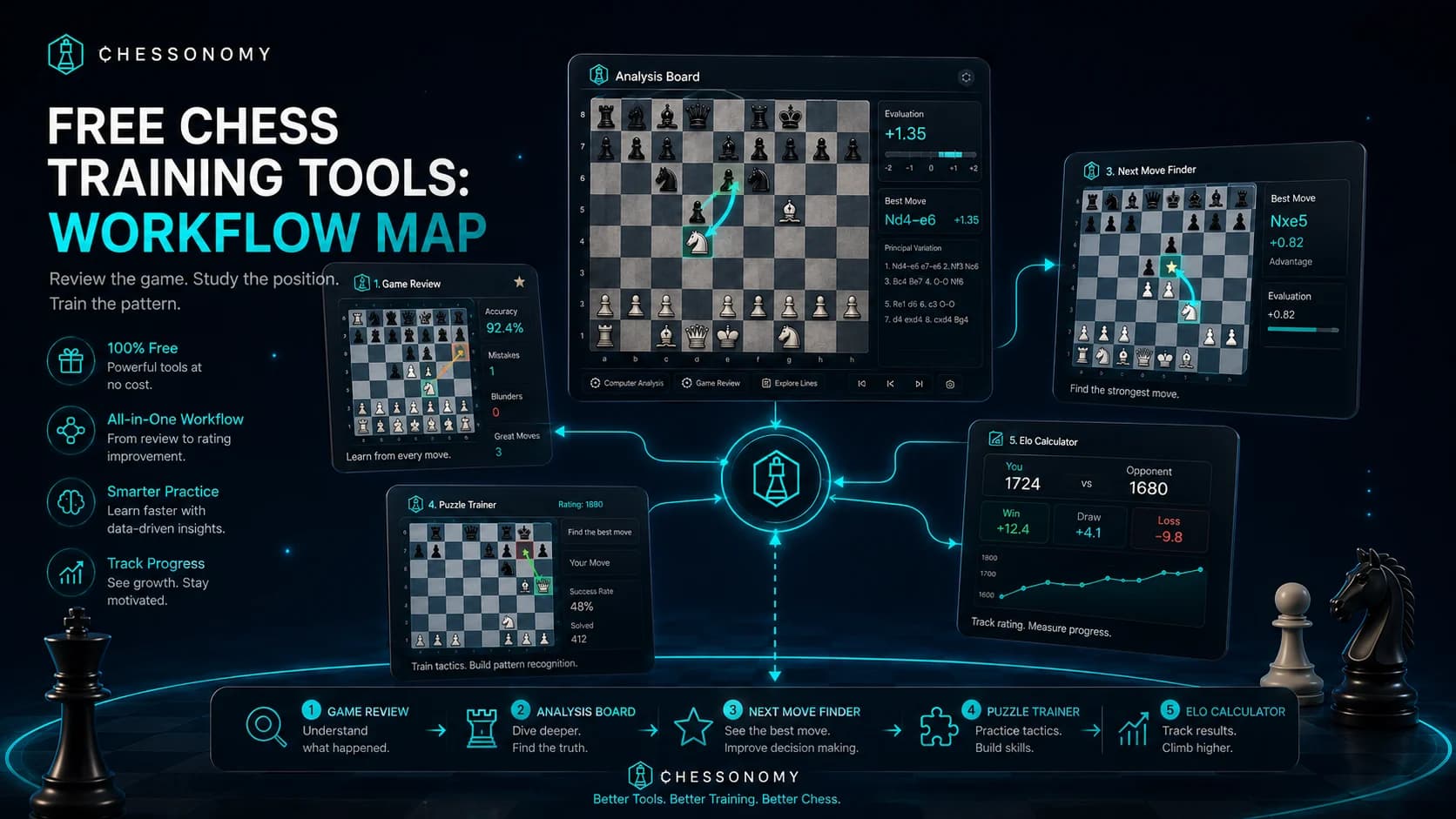
| User question | Best page | Next action |
|---|---|---|
| Why did I lose this game? | Game review | Find the critical position and mistake type. |
| What should I play here? | Next move finder | Verify the best move and principal line. |
| Why is this move best? | Analysis board | Compare candidates and defensive replies. |
| How do I stop missing this tactic? | Puzzle trainer | Train the repeated motif. |
| How will this result affect rating? | Elo calculator | Understand expected score and K-factor. |
Why Public Tool Pages Matter for SEO
Public tool pages are valuable because they satisfy immediate search intent. A player searching for free chess game analysis should land on a page that actually helps review a game. A player searching for chess Elo calculator should find a calculator, not a marketing page. Search engines reward pages that match intent and provide useful content without unnecessary friction.
This does not mean every feature must be free forever. It means the public page should contain real value and a clear explanation. Accounts can support saved progress, deeper settings, and personal history. The entry point should still prove that the product understands the player's problem.
How Chessonomy Should Grow
The best growth path is to keep the study loop coherent. New features should answer real training questions. A future opening explorer should connect to game review. A future mistake dashboard should connect to puzzle themes. A future coach layer should explain repeated weaknesses. Every addition should reduce friction between insight and practice.
Content should follow the same principle. Blog articles should not be generic. They should support tool pages, explain chess concepts, answer search intent, and give players a next action. A strong article sends the reader to the right board, puzzle, calculator, or review workflow when the explanation naturally calls for it.
What Makes a Chess Tool Trustworthy
Trust comes from accuracy, clarity, and honest limits. Engine lines should not be presented as magic. Move labels should explain uncertainty. Rating calculators should explain assumptions. Puzzle trainers should value review, not only streaks. A trustworthy chess tool helps the player understand what it can and cannot tell them.
This is also good SEO. Search engines increasingly reward experience and usefulness. A page that explains its method, links to related tools, uses clear examples, and avoids exaggerated promises is stronger than a page stuffed with keywords. Chess players can tell the difference too.
Final Takeaway
Chessonomy's advantage is not simply that it has free chess tools. The advantage is that those tools can work together as a study lab. Game review finds the lesson. Analysis explains it. Next-move calculation focuses it. Puzzles train it. Elo context explains the rating side. When the workflow is clear, players spend less time switching tools and more time improving.
That is the direction a serious chess training site should take. Keep the useful entry points public, make each page answer a real search intent, and connect every explanation to a practical training action. That is better for users, better for SEO, and better for long-term product quality.
A Real Example of the Chessonomy Study Loop
Suppose a player loses a rapid game after a kingside attack. The first step is not opening a random engine board. The first step is importing the game and finding the critical moment. Maybe the review shows that the evaluation changed after a pawn move near the king. That position becomes the focus. The player opens it on the analysis board and asks what the pawn move weakened.
The analysis board shows that the pawn move opened a diagonal and removed a defender from a key square. The next-move tool can verify the exact best response if the player wants a focused answer. Then the player trains related puzzles: diagonal attacks, king safety, and deflection. The Elo calculator is not part of the tactical lesson, but it can explain the rating impact of the game result. Each tool has a job.
This is the product logic behind Chessonomy. The site should not push every user into every feature. It should help the user take the next useful step. Review leads to analysis. Analysis leads to training. Training leads to better games. Better games create new review material. The loop is simple, and that is why it works.
Why Tool Pages Need Editorial Content
A tool page with only a calculator or board may be useful to a human who already knows what to do, but it is weaker for search and weaker for new users. Editorial content explains the use case, limitations, and next steps. It helps a visitor understand not only how to use the tool, but when and why to use it.
For SEO, editorial content also clarifies search intent. A page about free chess game analysis should discuss PGN, Chess.com, Lichess, move review, critical positions, and training outcomes. A page about Elo should explain expected score and K-factor. A page about puzzles should explain calculation and review. The content must support the tool, not sit below it as unrelated text.
Free Tools and Paid Features Can Coexist
A healthy chess product can keep public tools useful while reserving advanced workflows for accounts. Public tools create trust and serve search intent. Accounts can save history, personalize training, track progress, and unlock deeper settings. The mistake is hiding all value before the user understands the product. Another mistake is giving away every saved workflow without a sustainable model.
The best balance is clear. Let users analyze, test, calculate, and train enough to see value. Then make accounts useful for memory. Saved games, puzzle history, dashboards, preferences, and long-term progress are natural account features. This approach respects users and supports SEO because the public pages remain genuinely helpful.
How Chessonomy Content Should Support the Tools
Every blog article should connect to a real task. A brilliant-move article should send readers to game review and analysis. A mate-in-3 article should send readers to puzzles and the analysis board. An Elo article should support the Elo calculator. This internal linking is useful for SEO, but it is also good UX. The reader gets a natural next action.
The content should also be honest about limits. A game review tool can miss nuance. An engine line can be hard to interpret. A puzzle rating is not the same as tournament strength. An Elo calculator is an estimate. Trust increases when a site explains these limits instead of pretending tools are perfect.
What Makes the Brand Different
Chessonomy's strongest brand direction is calm, serious study. The site should feel like a lab, not a casino of badges. Chess players need focus. They need a readable board, direct controls, clear explanations, and a path from mistake to training. The design should support repeated study sessions, not only first impressions.
This matters because chess improvement is repetitive. A player may use the same board, puzzle trainer, and review page hundreds of times. Small UX decisions compound. Clear labels, stable layouts, readable contrast, fast loading, and predictable navigation are not decoration. They are part of the training experience.
How to Measure Whether the Platform Helps
The platform helps if users can identify mistakes faster, understand critical positions more clearly, and train relevant patterns more consistently. Vanity metrics are not enough. Page views matter for growth, but product quality depends on whether players return after games, solve puzzles with review, and build a stronger decision process.
Useful measurements include imported games, reviewed critical positions, puzzle completion with review, saved training themes, and return visits after playing sessions. These metrics connect to the study loop. They are better than measuring only clicks on generic features.
The Long-Term SEO Strategy
The long-term SEO strategy should be topical depth. Chessonomy should own clusters around game review, move labels, chess analysis, Stockfish workflows, tactical training, mate patterns, Elo explanations, and practical improvement routines. Each article should support a tool or category page. Each tool page should support a real workflow. This creates a site that search engines can understand and users can navigate.
The key is quality control. Every article needs a target keyword, search intent, unique image, internal links, external authority when useful, FAQ, reviewed methodology, and a next action. Thin posts will not build authority. Production-ready articles will. That standard should apply from now on.
How Each Tool Should Help a Different Search Intent
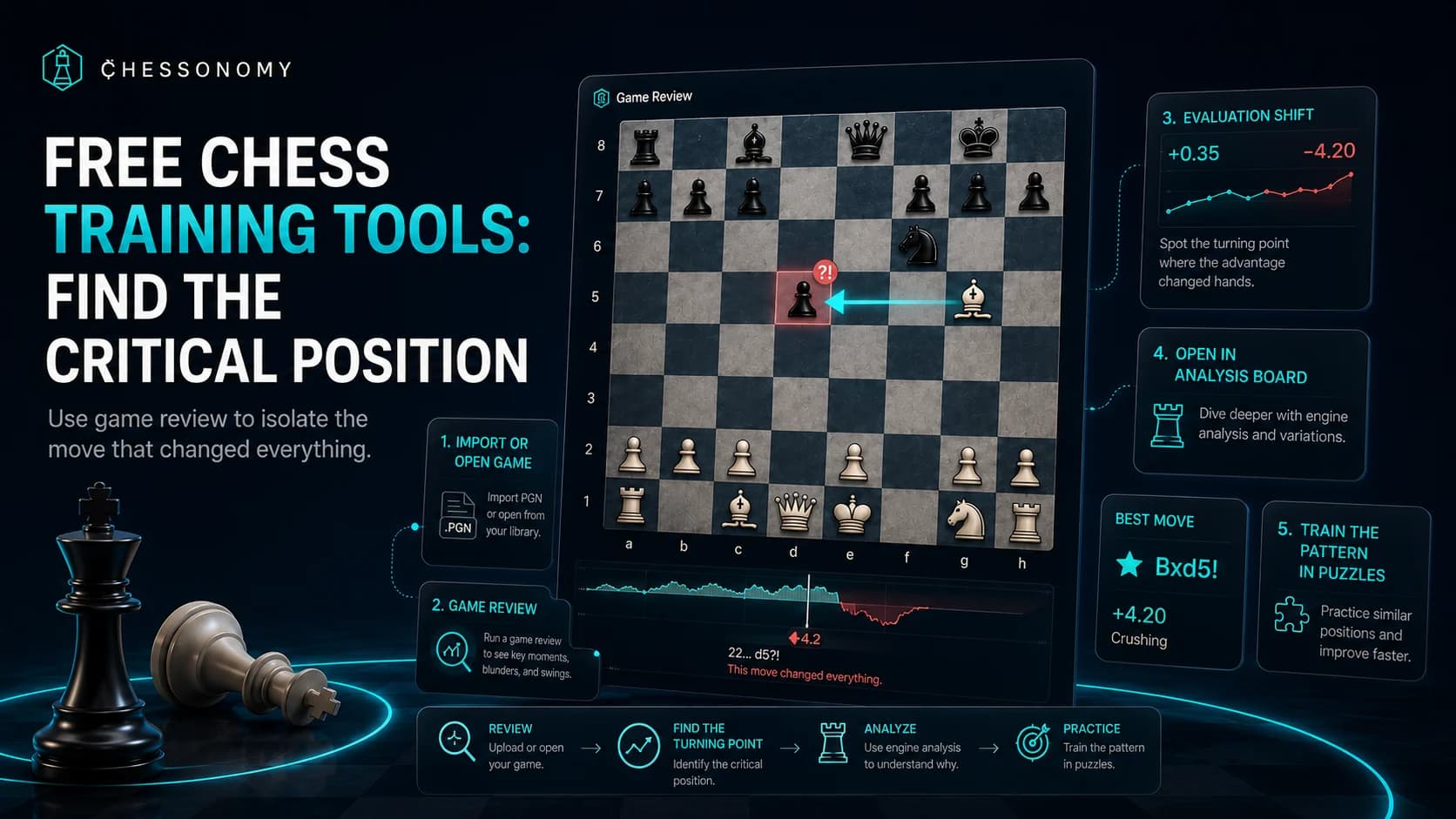
Search intent matters because chess players arrive with different levels of urgency. Someone searching for free chess game analysis probably has a game ready to review. Someone searching for chess move calculator probably has one position. Someone searching for free chess puzzles wants immediate practice. Someone searching for Elo calculator wants a rating explanation. Each page should answer that specific intent before sending the user elsewhere.
This is why a strong SEO structure does not merge every tool into one generic page. Separate pages can be more useful when they serve distinct tasks. The internal links then connect the tasks into a workflow. Search engines understand the topical map, and users understand what to do next.
Why Tool Accuracy and Explanation Both Matter
Accuracy earns trust, but explanation creates learning. A tool that gives the best move without context may answer a question, but it does not help the player improve as much as a tool that encourages review. A rating calculator that gives a number without explaining expected score is less useful than one that teaches the formula. A puzzle trainer that marks right or wrong without review misses part of the learning loop.
For Chessonomy, the strongest product direction is accurate tools paired with clear educational content. The user gets the answer and the reason. That combination is good for retention, good for SEO, and good for the brand.
How Future Blog Articles Should Fit the Platform
Future blog articles should not be isolated essays. Each article should support a cluster. A mate article supports puzzles. A brilliant-move article supports game review. A Stockfish article supports analysis tools. An Elo article supports the calculator. This structure creates internal relevance and gives readers useful next steps.
Each article should also have a unique image, clear metadata, strong headings, tables or examples where useful, FAQ content, and a practical call to action. The goal is not only ranking. The goal is making the page genuinely helpful when a chess player lands on it from search.
Why Chessonomy Should Stay Focused
Chess sites can become cluttered quickly. Too many modes, badges, popups, and decorative sections can distract from study. Chessonomy should stay focused on the core loop: review, understand, train. New features should support that loop. If a feature does not help a player make a better chess decision, it should be questioned.
Focus is also a competitive advantage. Many players do not need more noise. They need a calm place to inspect a position, understand a mistake, and train the pattern. That is the brand lane Chessonomy can own.
Final Product SEO Principle
The best product SEO is not a layer added after development. It is the structure of the product itself. Public pages answer real questions. Tools solve real tasks. Articles explain real chess problems. Internal links connect the workflow. Metadata and schema describe the page honestly. When those pieces align, the site becomes easier for users and search engines to understand.
How to Build Authority Without Losing Product Quality
SEO growth should not push the product away from its purpose. It is tempting to publish every possible keyword article, but authority comes from depth and consistency. Chessonomy should publish articles that support its tools, answer real player questions, and improve the study experience. A smaller library of strong pages is better than a large library of thin content.
Product quality and SEO can reinforce each other. If users land on an article about mate in 3 and can immediately train puzzles, the article is more useful. If users read about analysis and can open a board, the content becomes actionable. If a tool page explains its method clearly, it earns trust. This is how content becomes part of the product instead of a separate marketing layer.
This also protects the site from shallow growth. A chess player who lands on a page should feel that the author understands the board, the training problem, and the next action. That is what separates a real chess study platform from a keyword site. The article, the tool, and the navigation should all point in the same direction: helping the player review better, calculate better, and train better.
As the site adds languages in the future, this standard becomes even more important. Translation should not mean thin copies. Each localized article should preserve the chess explanation, image intent, internal links, and search intent. The structure can scale, but the quality bar should stay the same.
How to Keep Future Pages Connected
Every future page should have a clear place in the site map. A new opening article should link to analysis. A new tactics article should link to puzzles. A new rating article should link to the Elo calculator. A new product update should explain what changed and which workflow improved. This keeps users moving naturally through the study lab.
That internal structure is also how search engines discover importance. Pages that receive relevant internal links from articles, category pages, tools, and the footer are easier to understand. The goal is not random linking. The goal is a clear topical network around chess improvement.
How to Keep Content Useful After Publication
Publishing an article is not the end of SEO work. A serious chess platform should revisit important pages after real users interact with them. If searchers land on a page and leave quickly, the intro may not answer the query fast enough. If users scroll but never click a tool, the call to action may be weak. If a page ranks for an unexpected keyword, the article may need a new section that answers that intent directly.
This is how content stays production-ready. The first version should be strong, but the best pages improve over time. Chess rules, engine behavior, product features, and user questions can change. Updating articles with clearer examples, better screenshots, stronger internal links, and more precise explanations keeps the site useful instead of letting the blog become an archive of old assumptions.
How to Turn a First Visit Into a Study Session
A first-time visitor should not need to understand the entire platform. They should be able to start with one task. If they have a game, they use game review. If they have a position, they use the analysis board or next-move tool. If they want practice, they open puzzles. If they want rating context, they use the Elo calculator. The first session should be direct.
After the first task, the site can suggest the next step. A reviewed mistake can become an analysis-board position. A missed tactic can become puzzle training. A rating question can lead to a training plan. This is good UX because it follows the user's intent instead of forcing a generic onboarding path.
How the Blog Should Support Product Trust
The blog should show that Chessonomy understands chess, not only software. Articles should explain why move labels differ, how to solve tactics, how to analyze positions, and how to use tools responsibly. This builds trust before a user imports a game or relies on an analysis recommendation.
Trust also comes from specificity. A generic article about improve your chess is weak. A detailed article about mate in 3, brilliant moves, Stockfish analysis, or puzzle routines is stronger because it answers a concrete question. Specific content is better for users and better for topical authority.
How to Keep the Platform Useful as It Grows
As more tools and articles are added, navigation becomes important. Users should always know where they are and what the next useful action is. Category pages, footer links, internal article cards, and tool CTAs should guide the study loop. Growth should not create clutter.
The same principle applies to SEO. More pages are not automatically better. More useful pages are better. Each new page should have a clear keyword, unique angle, unique image, internal links, and a reason to exist. That standard keeps the site strong as the content library expands.
Why This Matters for Long-Term Rankings
Long-term rankings come from consistent usefulness. A chess site that publishes deep, accurate, internally connected content around real tools can build authority over time. A site that publishes thin pages or generic posts may get crawled, but it will struggle to earn trust. Chessonomy should choose the first path.
That means every tool page and blog article should feel complete. The page should answer the searcher's question, show experience with the topic, link to the next helpful action, and avoid unsupported claims. This is the foundation for strong SEO and a better product experience.
Chessonomy is an independent chess training workspace focused on practical game review, Stockfish analysis, puzzle training, and player-friendly explanations of engine feedback.
Questions Players Ask
Is Chessonomy free to use?
Chessonomy keeps core training entry points public, including game review, analysis tools, puzzles, next-move calculation, and Elo context. Accounts are useful for saved progress and deeper workflows.
What is the best Chessonomy tool to start with?
Start with game review if you have a recent game. Start with the analysis board if you have one position. Start with puzzles if you want immediate tactics practice.
Does Chessonomy replace a chess coach?
No. Chessonomy helps organize analysis and training, but a coach can still add personal judgment, opening preparation, tournament planning, and accountability.
Why does Chessonomy use Stockfish?
Stockfish is one of the strongest open-source chess engines. Chessonomy uses engine analysis as one signal, then presents it inside workflows built for human review and training.