
What Is a Brilliant Move in Chess? Examples
Learn what a brilliant chess move means, how it differs from best moves, why tools disagree, and how to review brilliant sacrifices correctly.
Brilliant moves are usually difficult engine-approved tactics, often sacrifices. The label is useful, but different review tools can judge the same move differently.
- The move gives up material, time, or an obvious comfort in exchange for a forcing idea.
- A shallow engine search or quick human glance may underestimate the move.
- The opponent has no simple refutation after best defense is checked.
- The idea changes the game: mate attack, decisive material recovery, promotion race, or a long-term bind.
- We separate official chess notation from product-specific review labels because brilliant is not a rule-book term.
- We treat engine agreement, sacrifice quality, human difficulty, and defensive resources as separate signals.
- We avoid promising identical labels across platforms because review systems use different depths, thresholds, and product choices.
A brilliant move in chess is usually a move that looks risky at first but works because of a deeper tactical or positional idea. In practical terms, it is the move where a player gives up something visible, calculates past the obvious reply, and reaches a position where the compensation is real.
The important detail is that brilliant is not an official chess rule. It is a review label. Chess.com popularized the term in game review, Lichess does not use the same dedicated brilliant label in its standard analysis, and independent tools such as Chessonomy can apply stricter or different detection rules.
Brilliant Move vs Best Move vs Great Move
A best move is the engine's strongest move in the position. A great move is usually a strong human move that improves the position or avoids a serious problem. A brilliant move needs something extra: depth, surprise, and usually a sacrifice or hidden tactical point.
| Label | What it usually means | What to check |
|---|---|---|
| Best move | The engine's top continuation from the position. | Was it clearly better than the alternatives? |
| Great move | A strong practical move that solves a real problem. | Did it avoid a tactic, improve the position, or keep an advantage? |
| Brilliant move | A difficult, sound idea that is often sacrificial or non-obvious. | Does the compensation survive best defense and deeper analysis? |
What Makes a Move Brilliant?
Most reliable brilliant-move definitions combine four signals. First, the move should be one of the engine's best choices. Second, it should be hard for a human to find. Third, it should involve a concrete idea, often a sacrifice or quiet tactical resource. Fourth, the line should remain sound against the opponent's best defense.
- The move gives up material, time, or an obvious comfort in exchange for a forcing idea.
- A shallow engine search or quick human glance may underestimate the move.
- The opponent has no simple refutation after best defense is checked.
- The idea changes the game: mate attack, decisive material recovery, promotion race, or a long-term bind.
Why Chess.com, Lichess, and Chessonomy Can Disagree
Blunder, mistake, and inaccuracy labels usually come from evaluation loss. Brilliant labels are less universal because they depend on human difficulty, sacrifice rules, engine depth, and product decisions. That is why one tool can show two brilliant moves while another shows zero in the same game.
| Tool | How to think about the label | Why results may differ |
|---|---|---|
| Chess.com | A proprietary game-review label made popular by !! move feedback. | The exact rules can change and may include product-specific thresholds. |
| Lichess | Standard analysis focuses on engine evaluation and mistake severity, not a dedicated brilliant label. | A move can be excellent without receiving a brilliant badge. |
| Chessonomy | A conservative review should reward sound, difficult, explainable ideas rather than flashy moves. | It may avoid brilliant labels when the sacrifice is not clearly forced or several easy alternatives exist. |
| Stockfish only | The engine gives evaluations and best lines, not human-style praise by itself. | A separate review system must translate engine output into labels. |
Famous Brilliant Move Examples
Classic attacking games show why the brilliant label exists. Fischer's Be6 against Byrne in 1956, Kasparov's Rxd4 against Topalov in 1999, and Wei Yi's quiet Bf8 against Bruzon in 2015 are remembered because the strongest idea was not the most obvious one. Each move demanded calculation beyond the first capture.
You do not need to copy those games to benefit from the concept. The training value is learning what made the move work: a pinned defender, overloaded piece, exposed king, forced mating net, or a sacrifice that removes the opponent's only coordination.
How to Review a Brilliant Move Correctly
Do not stop when a review tool gives you a brilliant badge. Rebuild the position, hide the engine line, and ask why the move works. The goal is not to admire the symbol. The goal is to understand the calculation pattern well enough to find it again.
- Check whether the move is one of the top engine choices at a useful depth.
- Replay the best defensive line, not only the move your opponent played.
- Name the tactic: deflection, clearance, overloaded piece, mating net, trapped piece, or promotion race.
- Compare it with simpler candidate moves. If many moves win easily, the brilliant label is less meaningful.
- Save the FEN and train a similar pattern with puzzles or the analysis board.
Common False Positives
Some moves look brilliant because they sacrifice material, but the sacrifice was obvious, forced, or unnecessary. Other moves receive praise because the opponent missed the refutation. A production-quality review should be strict enough to separate a real deep idea from a move that only looked spectacular in the game.
- The sacrifice works only because the opponent chose a bad reply.
- The move was the only legal or only obvious way to avoid mate.
- The position was already winning and several simple moves kept the advantage.
- The move appears in known opening theory rather than being a difficult original decision.
How to Find More Brilliant Moves in Your Own Games
Brilliant moves usually come from disciplined calculation, not from trying to be stylish. Review your games, find positions where forcing moves existed, and train the tactical themes you missed. The more often you calculate checks, captures, threats, and defensive resources, the more often deep tactical ideas become realistic during games.
How to Judge a Brilliant Move Without Trusting the Badge
A brilliant badge can be motivating, but the badge is not the lesson. The lesson is the relationship between the move, the position, and the opponent's best defense. If a review tool says a move is brilliant, your first question should not be whether the label is flattering. Your first question should be what the move actually changed. Did it open a line? Did it remove a defender? Did it force the king into a mating net? Did it make a material sacrifice that could not be accepted safely?
The most reliable way to judge the move is to rebuild the position and remove the label from your mind. Look at the board as if you were playing the game again. List the legal checks, captures, and threats. Then compare the brilliant move with the simpler candidates. If the move is genuinely special, you should be able to explain why the obvious alternatives were less accurate, slower, or easier for the defender to meet.
This matters because some moves receive praise for reasons that are not useful for training. A sacrifice may be engine-approved only because the position was already winning. A move may look stunning because the opponent collapsed immediately. A quiet move may be called brilliant by one tool and only best by another. Your goal is to extract the chess idea, not to argue with the label.
The Four Signals Behind Most Brilliant Moves
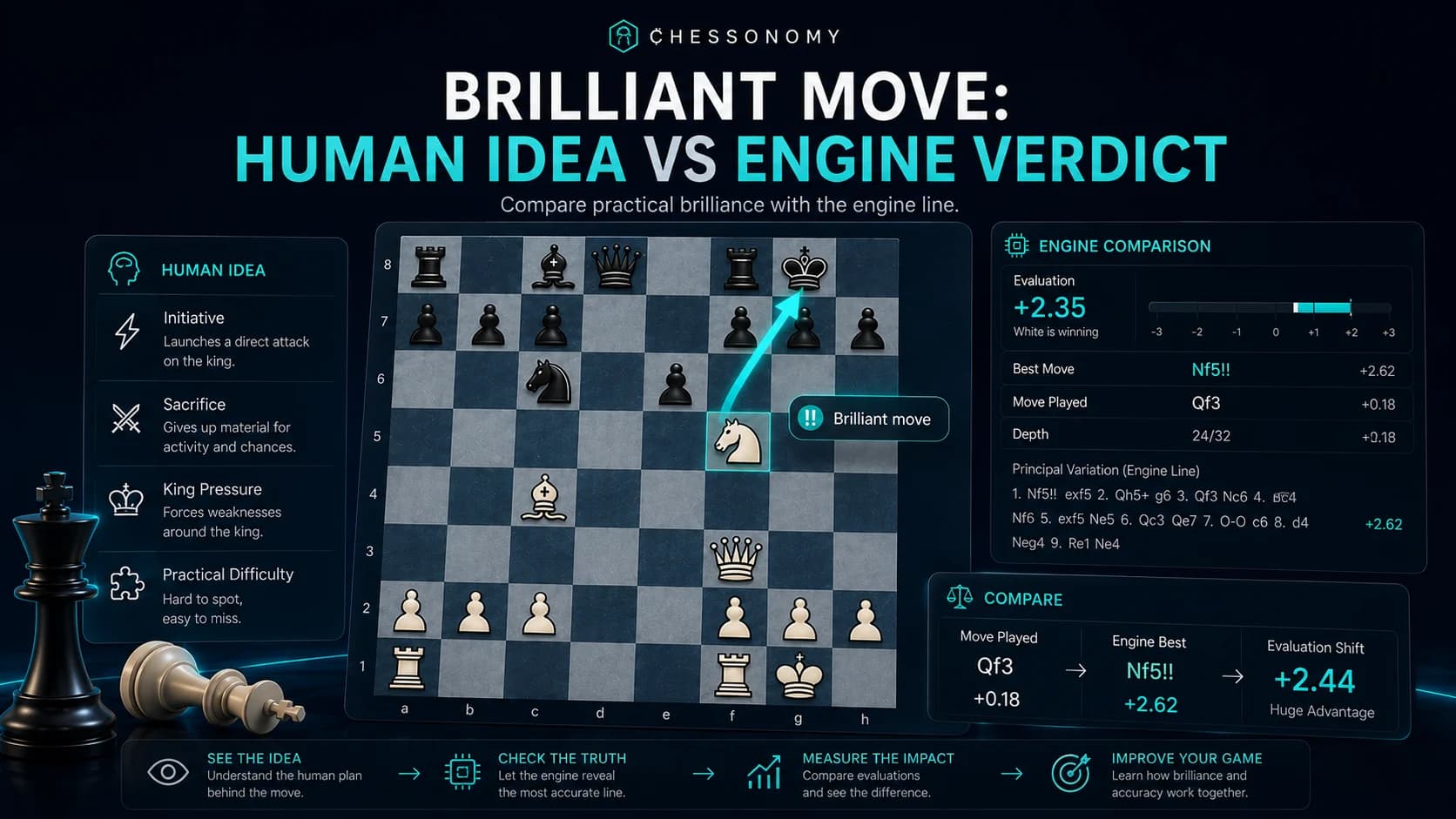
A practical brilliant-move review should examine four signals. The first signal is engine quality. The move must be sound. If deeper analysis shows the move throws away the advantage, it should not be treated as brilliant. The second signal is human difficulty. A move that any player would find automatically may be excellent, but it is not necessarily brilliant. The third signal is tactical or strategic depth. The move should reveal an idea that is not visible in one glance. The fourth signal is forcing power. The opponent's best defense should still leave the move justified.
| Signal | Question to ask | Training value |
|---|---|---|
| Engine quality | Does the move remain strong after deeper analysis? | Prevents learning unsound sacrifices. |
| Human difficulty | Was the move hard to find over the board? | Shows what calculation skill was required. |
| Depth | Is there a hidden tactic, quiet point, or long-term compensation? | Turns the move into a reusable pattern. |
| Forcing power | Can the defender choose a better reply and survive? | Separates real ideas from opponent mistakes. |
These signals also explain why two tools can disagree. One system may reward the visual sacrifice. Another may require a sharper evaluation swing. Another may avoid the label if the position has several winning moves. Disagreement does not automatically mean one tool is broken. It means the brilliant label is a product interpretation layered on top of engine analysis.
Why Sacrifices Get So Much Attention
Most players associate brilliant moves with sacrifices because sacrifice creates tension. A player gives up material now for something less obvious later: an attack, a forced mate, a trapped queen, a passed pawn, or a positional bind. That trade is exciting because it asks the player to trust calculation over material count. But a sacrifice is not automatically brilliant. Bad sacrifices are common. Decorative sacrifices are common. A real brilliant sacrifice has a concrete reason.
When reviewing a sacrifice, identify the exact compensation. If the move sacrifices a bishop, what does the bishop buy? If it removes a pawn shield, which files or diagonals open? If it offers a rook, what happens if the opponent declines? If it gives up a queen, is the mate forced or is the attacker only hoping? These questions convert the excitement into useful chess analysis.
You should also check whether the sacrifice was necessary. Sometimes a move wins beautifully, but a simpler move wins just as much with less risk. In a real game, the simple move may be the better practical choice. A brilliant label should not train you to prefer spectacle over reliability. It should train you to see when the position demands a concrete solution.
Brilliant Moves in Opening Theory
Opening theory creates a special case. A move can look brilliant to a player who has never seen it, but be well-known theory to experienced players. Some gambits, piece sacrifices, and forcing opening lines have been analyzed for decades. If you play one of those moves from memory, the move may still be strong, but the training value is different. You are demonstrating preparation, not necessarily original calculation at the board.
That does not make the move worthless. Opening sacrifices can teach important attacking themes. They show how development, king safety, and initiative can outweigh material. But when reviewing the game, separate memory from discovery. If you knew the line, study why the line works. If you found it during the game, study how you calculated it. Those are different lessons.
Brilliant Moves in Endgames
Brilliant moves are not limited to attacks against the king. Endgames can contain brilliant resources too. A quiet king move can force zugzwang. A pawn sacrifice can create an outside passer. A rook can give itself up to force promotion. A knight can move away from a pawn only because the resulting race is calculated to the final square. These moves may not look flashy, but they can be deeply precise.
Endgame brilliance is often harder for humans to notice because the board looks calmer. There may be fewer pieces and fewer direct checks. The key idea is usually timing. One tempo decides whether the king arrives, whether the pawn promotes, or whether a fortress holds. If a review tool calls an endgame move brilliant, do not dismiss it because it lacks a sacrifice. Study the move order and opposition carefully.
How to Study Your Own Brilliant Moves
When you find a brilliant move in your own game, save the position. Do not only save the full PGN. Save the exact FEN before the move. Then write a short note: what did I see, what did I miss, and what was the main idea? This turns the moment into a training asset. Later, you can return to the position and solve it again without the label.
- Replay the position before the move without engine help.
- Write down your candidate moves and compare them with the move played.
- Check the defender's best reply, not only the game continuation.
- Name the theme: deflection, decoy, clearance, mating net, overload, promotion race, or zugzwang.
- Create one follow-up puzzle or analysis position from the same theme.
The best brilliant moves become part of your pattern library. If your move was a deflection sacrifice, train more deflection puzzles. If it was a quiet move that trapped a queen, study piece-trapping patterns. If it was an endgame tempo, review similar pawn races. The label points to the work. The work is what improves your chess.
How to Study Opponents' Brilliant Moves Against You
It is useful when your opponent plays a brilliant move too, even if it hurts. Instead of treating the move as bad luck, ask what warning signs you missed. Was your king short of defenders? Was one piece overloaded? Did you allow a forcing check? Did your last move ignore a threat? A brilliant move against you is often the visible result of a position that was already tactically unstable.
Review the move from the defender's side. Find the last moment where you could have prevented it. Maybe you needed to trade an attacking piece, create luft, move the king, defend a key square, or avoid a pawn move that weakened a diagonal. This is where game review becomes practical. You are not only admiring the opponent's tactic. You are identifying the earlier decision that made it possible.
Common False Brilliant Moves
A false brilliant move is a move that looks impressive but does not deserve special trust. The most common example is a sacrifice that works only because the opponent chooses a bad reply. Another example is a move that was forced. If you had only one legal move to avoid mate, it may be important, but the difficulty is different. A third example is a move that wins material from a completely winning position where several simple moves also win.
False brilliance is dangerous because it can train the wrong habit. A player may start looking for sacrifices in positions that require consolidation. They may confuse engine approval with practical decision-making. They may celebrate an attack without understanding the defensive resource that almost refuted it. Strong review means asking whether the move is repeatable as a lesson.
A Production-Ready Review Checklist
Use this checklist whenever a review tool marks a move as brilliant. First, confirm the position and side to move. Second, check the top engine choices at a reasonable depth. Third, compare the brilliant move with at least two human candidate moves. Fourth, test the opponent's best defense. Fifth, identify the tactical or positional theme. Sixth, decide what you should train next.
| Review step | What to do | Why it matters |
|---|---|---|
| Confirm | Check FEN, side to move, castling rights, and move order. | Avoids studying the wrong position. |
| Compare | Look at the brilliant move beside simpler alternatives. | Shows whether the move was necessary. |
| Defend | Give the opponent their best reply. | Prevents learning a line based on cooperation. |
| Explain | Name the theme in plain language. | Turns the badge into memory. |
| Train | Save a related puzzle or position. | Connects review to improvement. |
This is the difference between entertainment and training. Entertainment stops at the badge. Training turns the move into a pattern you can find again. A brilliant move should leave you with a clearer sense of calculation, not only a screenshot.
Final Takeaway
A brilliant move is best understood as a strong, difficult, explainable move that survives serious defense. It may be a sacrifice, but it does not have to be. It may be the engine's best move, but being best is not enough by itself. The move should reveal something about the position that a human can learn from: a hidden tactic, a precise endgame idea, a quiet threat, or a forcing sequence that changes the game.
If you approach brilliant moves this way, the label becomes useful instead of distracting. You can appreciate the moment, verify the analysis, and convert the idea into training. That is the real value. The badge disappears after the review, but the pattern can stay in your games for years.
A Practical Walkthrough of a Brilliant-Move Review
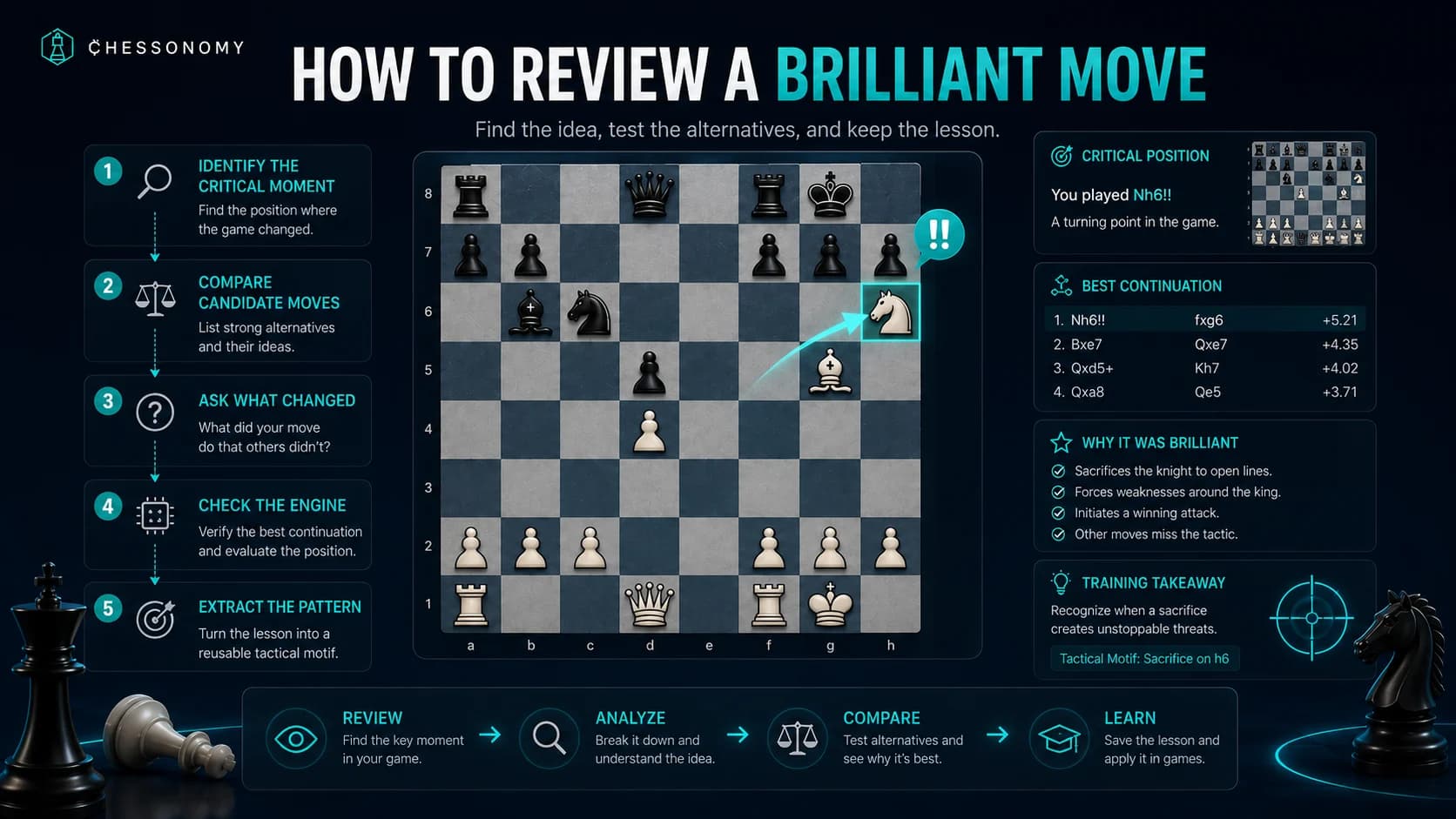
Imagine you review a game and the tool marks a rook sacrifice as brilliant. The first reaction is usually emotional: it feels good if you played it, and it feels unfair if your opponent played it. But a strong review starts after that reaction. Set the board to the position before the sacrifice. Hide the engine line for a moment. Ask what each side threatens, which king is weaker, and which pieces are defending the critical squares. This gives the move context before the engine verdict shapes your thinking.
Next, list the normal candidate moves. Maybe you could move the rook to safety, trade queens, make a check, or improve a knight. These normal moves matter because they show what the brilliant move had to beat. If the sacrifice is only equal to several simple moves, the training lesson is different from a sacrifice that is clearly the only winning continuation. Strong analysis compares choices instead of admiring one move in isolation.
Now test acceptance. If the opponent takes the rook, what is the forcing continuation? Do you win the queen, force mate, recover material with interest, or create a passed pawn that cannot be stopped? Write the line until the point is clear. Then test refusal. If the opponent declines the sacrifice, do you still have a threat? A brilliant sacrifice is usually robust. It should not depend on the opponent choosing the most cooperative response.
Finally, name the theme. Was the sacrifice a deflection because it pulled a defender away? Was it a decoy because it dragged the king to a bad square? Was it a clearance move because it opened a file or diagonal? Was it a removal of the guard? The theme is what you can carry into future games. The exact position may never repeat, but the theme will.
How Brilliant Moves Differ by Rating Level
A move that is brilliant for one player may be routine for another. This is not an insult to either player. Chess skill changes what is hard to see. A beginner may find a simple back-rank sacrifice astonishing because the idea is new. A master may see the same motif instantly but struggle with a quiet endgame move that requires exact tempo calculation. Human difficulty is relative, and any review system that tries to model brilliance has to simplify that reality.
For beginners, brilliant moves often teach basic tactical motifs: forks, pins, discovered attacks, deflections, and mating nets. The right study question is usually, what pattern did I miss? For intermediate players, brilliant moves often involve move order and defensive resources. The question becomes, why does this sacrifice work against best defense? For advanced players, the lesson may be strategic or endgame-based: why is this quiet move the only way to preserve the advantage?
This is why it is dangerous to compare badge counts across players. One player might get many brilliant labels from sharp tactical games. Another might play clean positional chess with few spectacular moments. The goal is not collecting labels. The goal is improving the quality of decisions. If a brilliant move teaches a repeatable pattern, it is valuable. If it is only a trophy, its value fades quickly.
When the Best Move Is Not the Most Practical Move
Engine analysis can recommend a move that is objectively best but practically dangerous for a human. A sacrifice may be sound only if you find four precise follow-up moves. A quiet move may maintain a small advantage but leave the opponent with many active options. A simplifying move may be slightly less accurate but lead to an endgame you understand. Brilliant moves exist inside this tension between objective truth and practical play.
When reviewing your own games, ask whether you would trust yourself to play the continuation over the board. If the answer is no, the move may still be worth studying, but it may not be the move you should choose in a similar practical situation until you understand the pattern better. Training should reduce that gap. The more you study forcing lines, mating nets, and compensation, the more practical these moves become.
This is also why game context matters. In a must-win position, a sharp brilliant move may be the correct practical choice. In a winning endgame with little time, the clean conversion may be better. Review labels do not know your nerves, clock, tournament situation, or comfort with the resulting position. You need to add that human layer yourself.
How to Turn Brilliant Moves Into Training Material
The best way to learn from a brilliant move is to convert it into a mini lesson. Start with the position before the move. Create three questions: what is the threat, what is the candidate move, and what happens after best defense? Then solve the position again one day later. If you still find the idea, the pattern is starting to stick. If you miss it again, the theme needs more work.
You can also make comparison positions. Move one defender to a different square and ask whether the sacrifice still works. Add an escape square for the king. Remove the attacking bishop. Change the side to move. These small changes reveal which detail made the original move brilliant. This is more powerful than replaying the same line mechanically.
If you keep a training notebook, use short labels. Brilliant rook sacrifice is less useful than deflection on f7 after overloaded queen. The second note tells you what to look for later. It contains the pattern, the target square, and the reason the tactic worked. Good notes are searchable by idea, not only by emotion.
What Searchers Usually Want From This Topic
Many players search for the meaning of brilliant move because they saw the label in a game review and want to know whether it is special. A production-ready answer should not only define the term. It should explain that brilliant is not an official chess rule, show how it differs from best and great moves, explain why tools disagree, and teach the reader how to review the move correctly. That is the search intent behind this article.
The article also needs to avoid overpromising. No public guide can state the exact private scoring model of every chess platform. The honest approach is to explain the common signals and the limits. This builds more trust than pretending the label is universal. Chess players are analytical. They can tell when a page is guessing.
How Brilliant Moves Should Influence Your Next Game
A brilliant move should not make you hunt for beauty in every position. That is the wrong lesson. The right lesson is to become more alert when the position contains forcing ingredients. If the opponent's king has few defenders, if a piece is overloaded, if a line can be opened with tempo, or if a sacrifice removes the only guard, then you should slow down and calculate. Brilliant moves usually appear when the board gives permission for concrete play.
In your next game, use the brilliant-move review as a trigger list. Before making a routine move in a sharp position, ask whether there are checks, captures, threats, or quiet forcing moves. If nothing works, play normally. If something almost works, calculate the defender's resource. This is how the lesson becomes practical. You are not trying to force brilliance. You are trying to notice when the position contains a tactical demand.
This mindset is especially useful after you miss a brilliant move. The missed move tells you that a tactical signal was present but ignored. Maybe the enemy queen was overloaded. Maybe a back-rank weakness existed. Maybe your bishop aimed at the king but you did not consider a clearance sacrifice. Turn that missed signal into a pre-move question for future games.
How to Explain a Brilliant Move to Another Player
If you can explain a brilliant move simply, you probably understand it. Start with the position problem. Then explain the move's idea. Then show the main defense and why it fails. Avoid starting with a long engine line. A useful explanation sounds like this: Black's queen was the only defender of h7, so White sacrificed on e6 to deflect it; if Black accepts, Qh7 is mate, and if Black declines, the e-file attack wins.
Teaching the move to someone else exposes gaps in your own understanding. If you cannot explain why the sacrifice works when declined, you have only memorized one branch. If you cannot say which defender was removed, you have not found the core mechanism. This is why verbal explanation is a strong study tool. It forces the pattern out of the engine line and into human language.
A Final Brilliant-Move Study Routine
Use a three-day routine for any move you want to remember. On day one, review the full line with the engine and write the theme. On day two, solve the position from scratch without the label. On day three, change one defensive detail and ask whether the idea still works. If you can answer that, you understand the move better than most players who only saved a screenshot.
One Last Test Before You Trust the Label
Before you trust any brilliant label, ask whether you could find the same move again from the same clues. If the answer is yes, the move has become a useful pattern. If the answer is no, return to the position and identify the missing clue. Maybe it was an overloaded defender, a trapped king, a clearance square, or a tactical move order. The goal is to make the clue visible.
This final test keeps the article practical. A brilliant move is not only something to admire after the game. It is a position-reading exercise. The more clearly you can describe the clue, the more likely you are to notice the same idea in a future game without needing a review badge to point at it.
Chessonomy is an independent chess training workspace focused on practical game review, Stockfish analysis, puzzle training, and player-friendly explanations of engine feedback.
Questions Players Ask
Is a brilliant move always the best move?
Usually it should be one of the engine's best moves, but a move can be best without being brilliant. Brilliant usually adds difficulty, surprise, or sacrifice to engine strength.
Why does Chess.com show brilliant moves when another tool does not?
Chess.com uses a proprietary review system. Other tools may require stricter evidence, deeper engine agreement, or a clearer sacrifice before using the brilliant label.
Can Lichess show brilliant moves?
Lichess standard analysis does not use the same dedicated brilliant-move label. It can still show that a move was best or that a tactic was strong through engine evaluation.
Can a brilliant move be a pawn move?
Yes. A pawn sacrifice, quiet pawn push, or promotion tactic can be brilliant if it is hard to find, engine-sound, and changes the position in a concrete way.
Should I try to make brilliant moves?
No. Try to make strong moves. Brilliant moves usually appear when a position demands a concrete tactical solution, not when a player tries to force style.